Structured workbook
All extracted sections, tables, rubrics, worksheets and session materials remain in the reading view.
CLIL + PBL learning situation · 3rd ESO · EHU 2026
Framed within a CLIL model and structured according to Project-Based Learning (PBL) principles, it immerses students in a simulated Basque Government youth sustainability challenge
All extracted sections, tables, rubrics, worksheets and session materials remain in the reading view.
The twelve-session sequence is directly accessible from a dedicated session bar for classroom use.
The complete 140-page document is available as a lazy-loaded facsimile gallery for layout fidelity.
Complete Teacher’s Edition of the Learning Situation
This workbook offers a fully developed CLIL–PBL learning situation for 3rd ESO, structured into twelve sessions with a stable four‑phase lesson architecture, detailed guidance and ready‑to‑use materials.
CONTEXTUALISED WORKBOOK
From Iron to Innovation
A CLIL + PBL Learning Situation for 3rd year of Compulsory Secondary Education
Master's Degree in Secondary Teacher Training
Specialisation in Foreign Language Teaching (English)
University of the Basque Country (EHU) · 2026
Author: Johanna Ferrer Carbajo
Tutor: Joseba Ezeiza Ramos
INDEX
1.1. Learning situation at a glance 1
1.2. Why a learning situation, not only a didactic sequence 2
1.3. CLIL, plurilingualism and mediation 2
1.4. Linguistic policy in the classroom 3
2. DEVELOPMENT OF THE LEARNING SITUATION 5
3.1 Description of each session 19
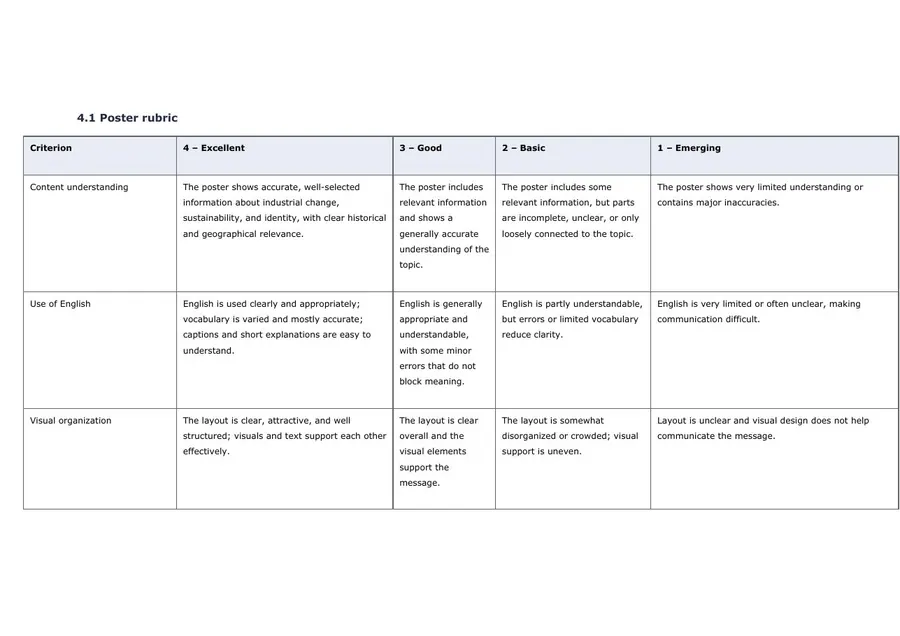
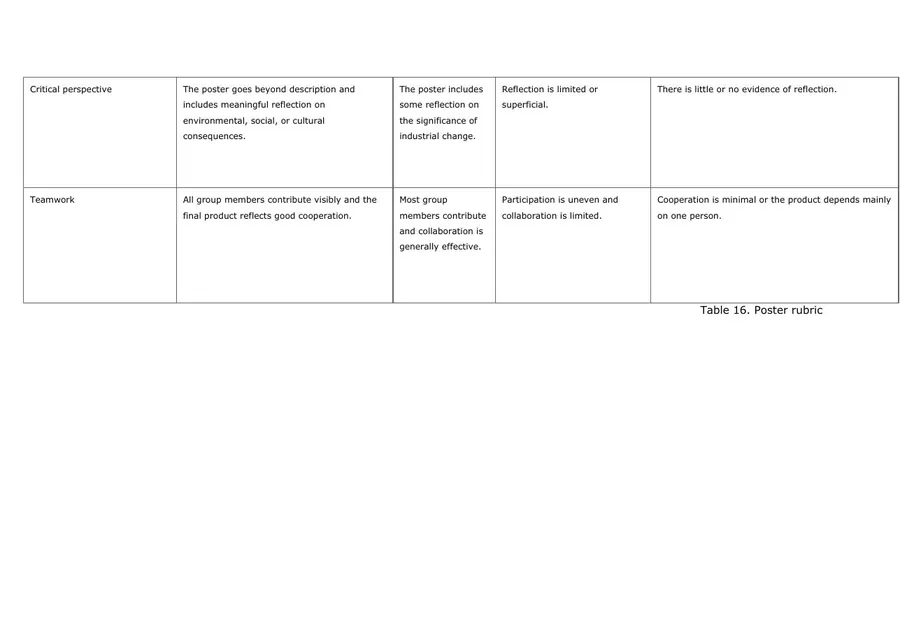
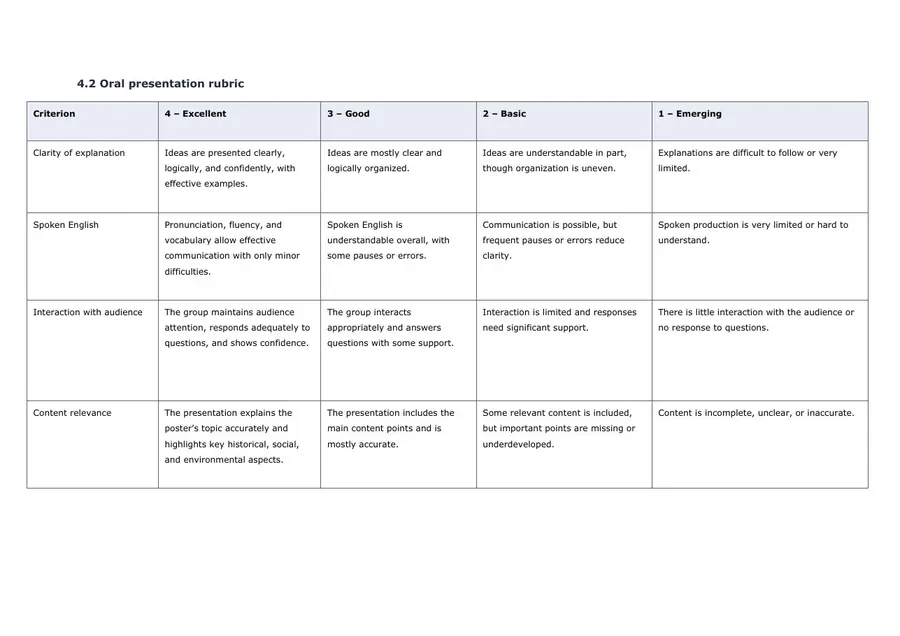
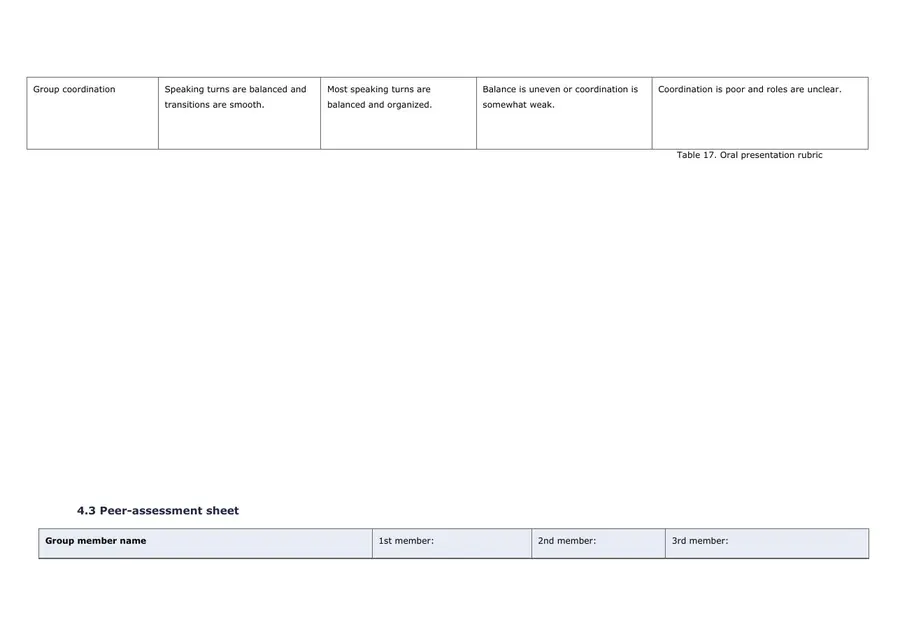
4.2 Oral presentation rubric 128
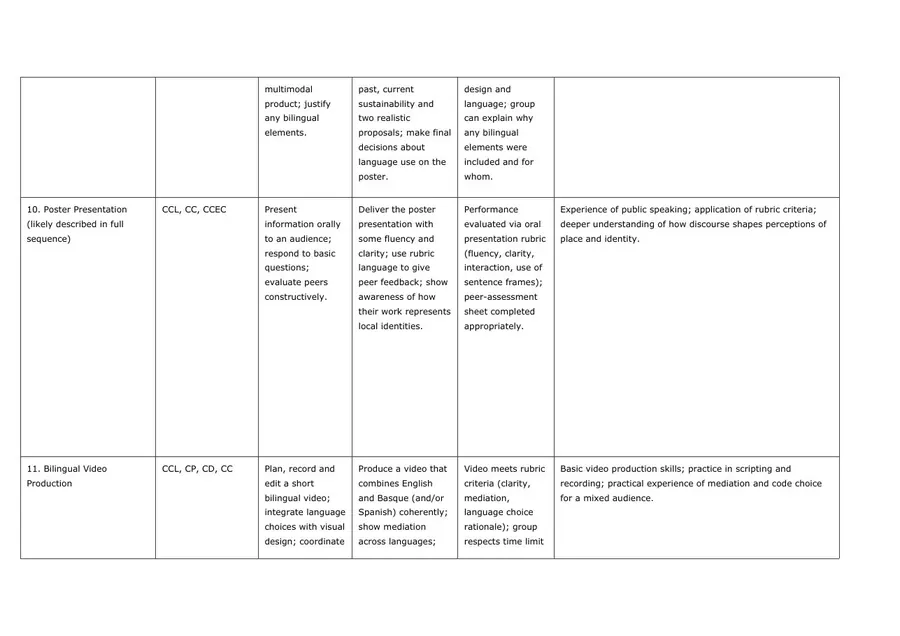
5. CURRICULAR ARGUMENTATION 133
Context
The learning situation "From Iron to Innovation" is a CLIL PBL sequence for 3rd ESO students in a Basque-medium school (Model D), positioning learners as youth advisors in a simulated Basque Government Youth Sustainability Challenge on regional industrial history and sustainable urban development in Bilbao and Vitoria-Gasteiz. It integrates English as the vehicular language with Basque/Spanish for mediation, following LOMLOE and Basque Decree 77/2023, emphasizing real-world social purpose beyond the classroom.
Scenario pitch that will be presented to the student
You are advisors to the Basque Government Youth Sustainability Challenge. A panel of European delegates has asked secondary students from across the Basque Country to answer one question: what can industrial history teach us about building a more sustainable Basque country? Your class has been selected as one of ten pilot teams. Over the next twelve sessions, you will investigate the Basque iron and steel tradition, compare it with today's digital and green industries, and produce a digital poster and a bilingual video that will be screened at the simulated Youth Sustainability Forum in Vitoria-Gasteiz.
Your recommendations will travel in English, but you will use Basque and Spanish wherever they help you think more clearly, reach a wider audience or gather evidence from local sources. The final screening will be attended by classmates, families and a representative from the simulated regional government. Every voice in the room counts.
Starting Point – Final Product
Students begin with prior knowledge activation via brainstorming on industrialization and video analysis of Bilbao's regeneration. The final product consists of a group-created digital poster and a bilingual video pitch that together serve as the students’ submission to a simulated Basque Government Youth Sustainability Challenge on sustainable urban development in the Basque Country. In the poster, students use English to present a historically grounded account of industrialisation in Bilbao and Vitoria-Gasteiz, compare past and present industrial and environmental realities, and propose at least two realistic measures to improve sustainability in their region, integrating images, data and captions into a coherent visual narrative. The accompanying video, lasting around two to three minutes, revises and adapts the poster’s main ideas for an external audience, strategically combining English with Basque and/or Spanish so that language choice itself becomes part of the communicative design and mediation work. Each group member appears in the video and assumes responsibility for a specific section linked to the poster, and both products are evaluated with rubrics that highlight content accuracy, critical perspective, language use, digital quality and effective collaboration.
Subjects Involved
English (vehicular language, debates, writing, presentations)
Geography and History (industrial heritage, city comparisons)
Technology and Digitalization (Google Earth, poster/video production)
Assessment and Curricular References
Assessment includes digital poster (30%), oral presentation
(25%), bilingual video (20%), peer-assessment (15%), self-reflection
journal (10%), with rubrics for content, language, mediation.
References: LOMLOE, Basque Decreto 77/2023, CEFR B1, Coyle's 4Cs,
plurilingualism (Cenoz 2022, CEFR Companion 2018).
Technical Sheet
Title: From Iron to Innovation
Area/Subject: English (CLIL vehicular), Geography/History, Technology/Digitalization
Description: Action-oriented CLIL PBL with plurilingual mediation; students research Basque industrial transformation and propose sustainability via poster/video.
Final Product: Digital poster and bilingual video for Youth Sustainability Challenge
Contents: Industrial history (mining/steel), geography (Bilbao/Vitoria-Gasteiz), sustainability vocab/structures (past tenses, comparatives, opinions)
Timing: 12 x 55-min sessions (~6 weeks)
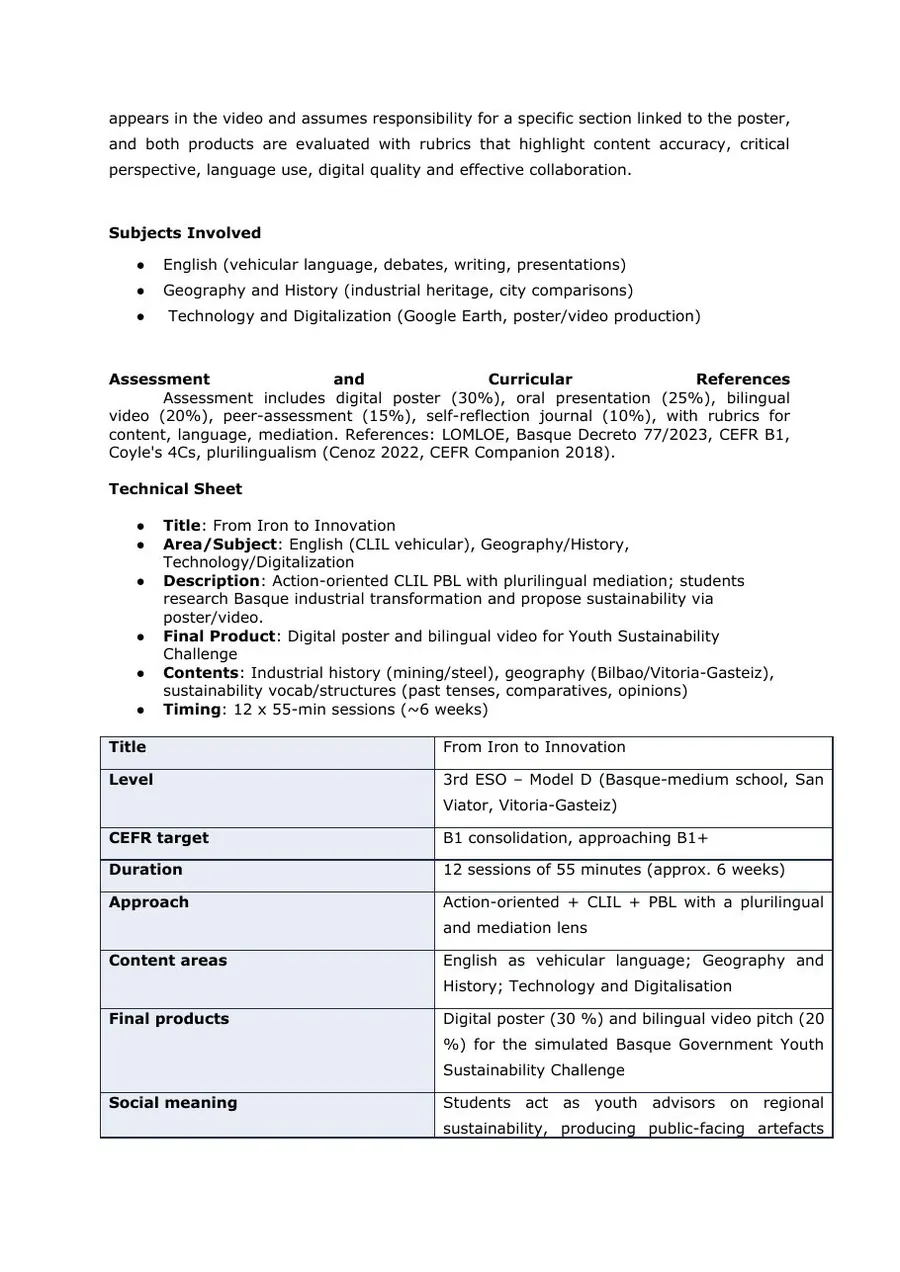
| Title | From Iron to Innovation |
|---|---|
| Level | 3rd ESO – Model D (Basque-medium school, San Viator, Vitoria-Gasteiz) |
| CEFR target | B1 consolidation, approaching B1+ |
| Duration | 12 sessions of 55 minutes (approx. 6 weeks) |
| Approach | Action-oriented + CLIL + PBL with a plurilingual and mediation lens |
| Content areas | English as vehicular language; Geography and History; Technology and Digitalisation |
| Final products | Digital poster (30 %) and bilingual video pitch (20 %) for the simulated Basque Government Youth Sustainability Challenge |
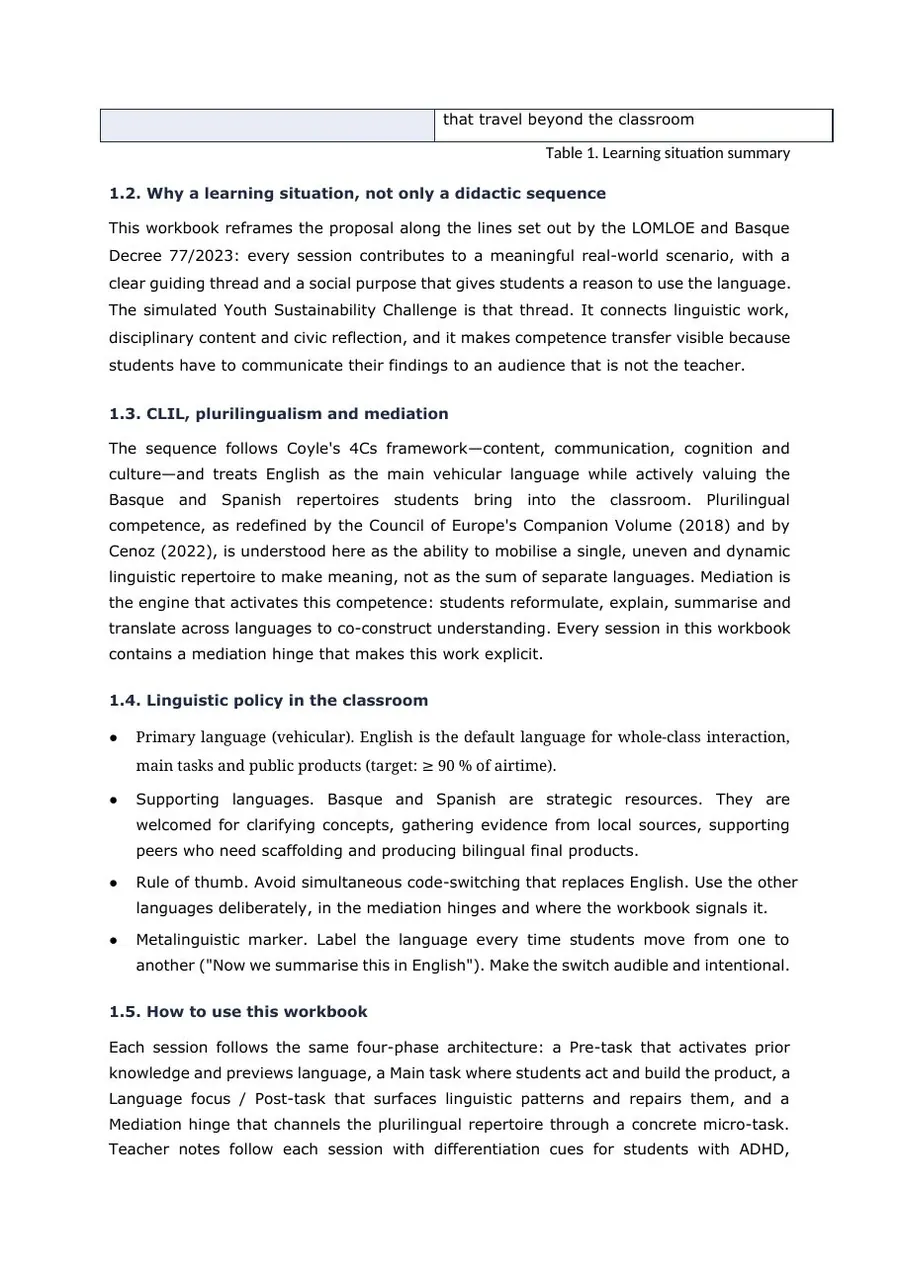
| Social meaning | Students act as youth advisors on regional sustainability, producing public-facing artefacts that travel beyond the classroom |
Table 1. Learning situation summary
This workbook reframes the proposal along the lines set out by the LOMLOE and Basque Decree 77/2023: every session contributes to a meaningful real-world scenario, with a clear guiding thread and a social purpose that gives students a reason to use the language. The simulated Youth Sustainability Challenge is that thread. It connects linguistic work, disciplinary content and civic reflection, and it makes competence transfer visible because students have to communicate their findings to an audience that is not the teacher.
The sequence follows Coyle's 4Cs framework—content, communication, cognition and culture—and treats English as the main vehicular language while actively valuing the Basque and Spanish repertoires students bring into the classroom. Plurilingual competence, as redefined by the Council of Europe's Companion Volume (2018) and by Cenoz (2022), is understood here as the ability to mobilise a single, uneven and dynamic linguistic repertoire to make meaning, not as the sum of separate languages. Mediation is the engine that activates this competence: students reformulate, explain, summarise and translate across languages to co-construct understanding. Every session in this workbook contains a mediation hinge that makes this work explicit.
Primary language (vehicular). English is the default language for whole-class interaction, main tasks and public products (target: ≥ 90 % of airtime).
Supporting languages. Basque and Spanish are strategic resources. They are welcomed for clarifying concepts, gathering evidence from local sources, supporting peers who need scaffolding and producing bilingual final products.
Rule of thumb. Avoid simultaneous code-switching that replaces English. Use the other languages deliberately, in the mediation hinges and where the workbook signals it.
Metalinguistic marker. Label the language every time students move from one to another ("Now we summarise this in English"). Make the switch audible and intentional.
Each session follows the same four-phase architecture: a Pre-task that activates prior knowledge and previews language, a Main task where students act and build the product, a Language focus / Post-task that surfaces linguistic patterns and repairs them, and a Mediation hinge that channels the plurilingual repertoire through a concrete micro-task. Teacher notes follow each session with differentiation cues for students with ADHD, dyslexia, newly arrived foreign students and high-ability learners. All worksheets, sentence frames and reflection prompts referred to in the sessions are collected in the Materials Appendix at the end of the workbook.
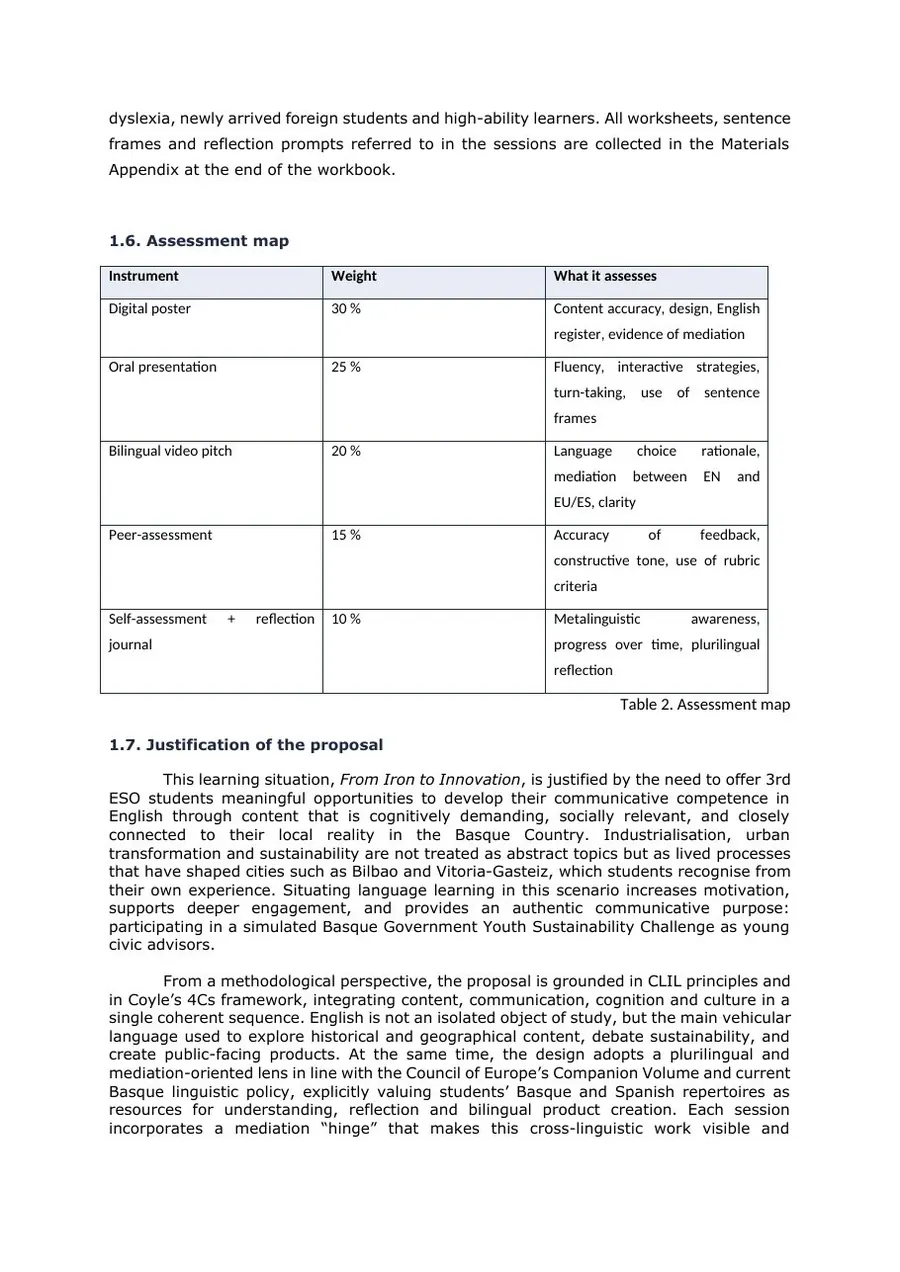
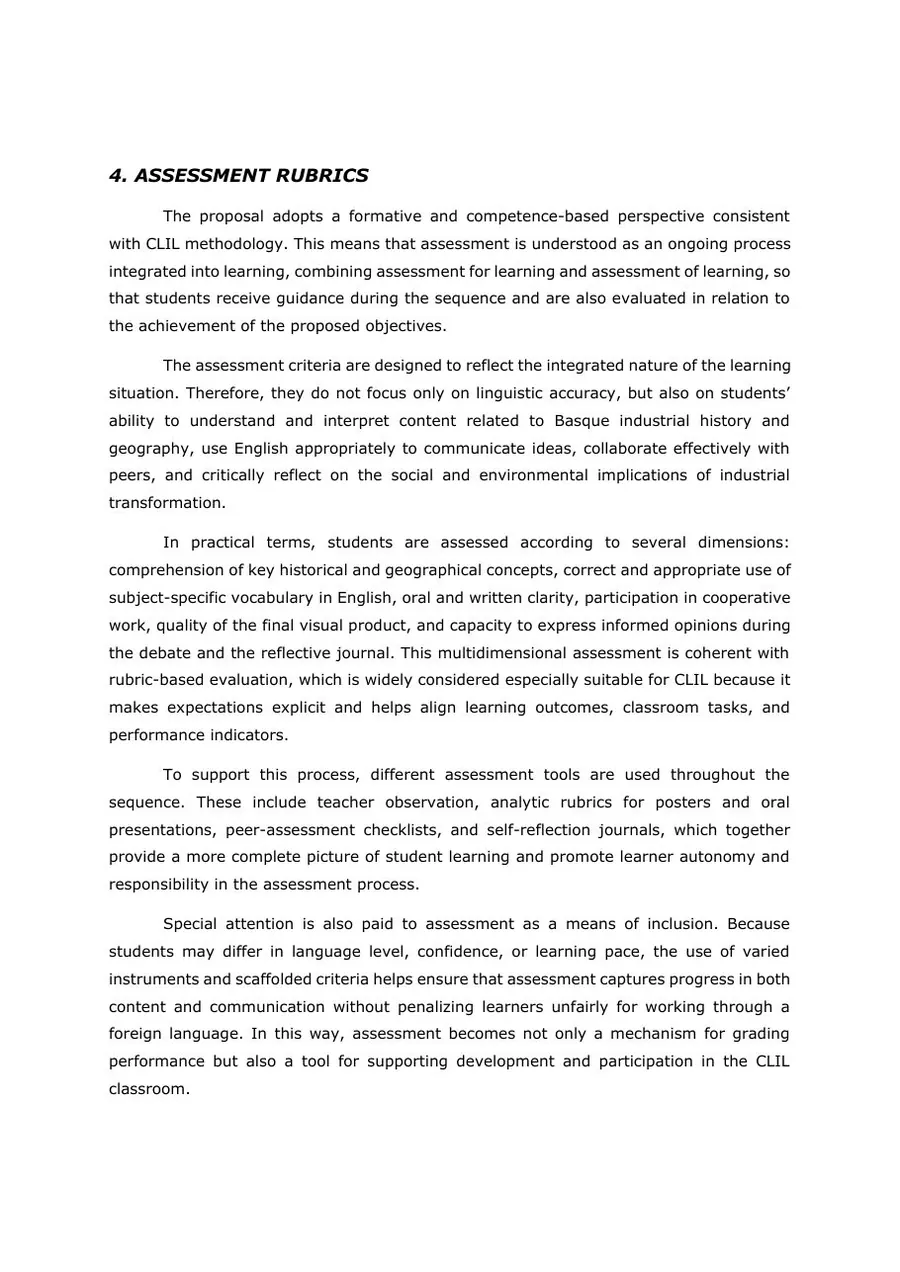
| Instrument | Weight | What it assesses |
|---|---|---|
| Digital poster | 30 % | Content accuracy, design, English register, evidence of mediation |
| Oral presentation | 25 % | Fluency, interactive strategies, turn-taking, use of sentence frames |
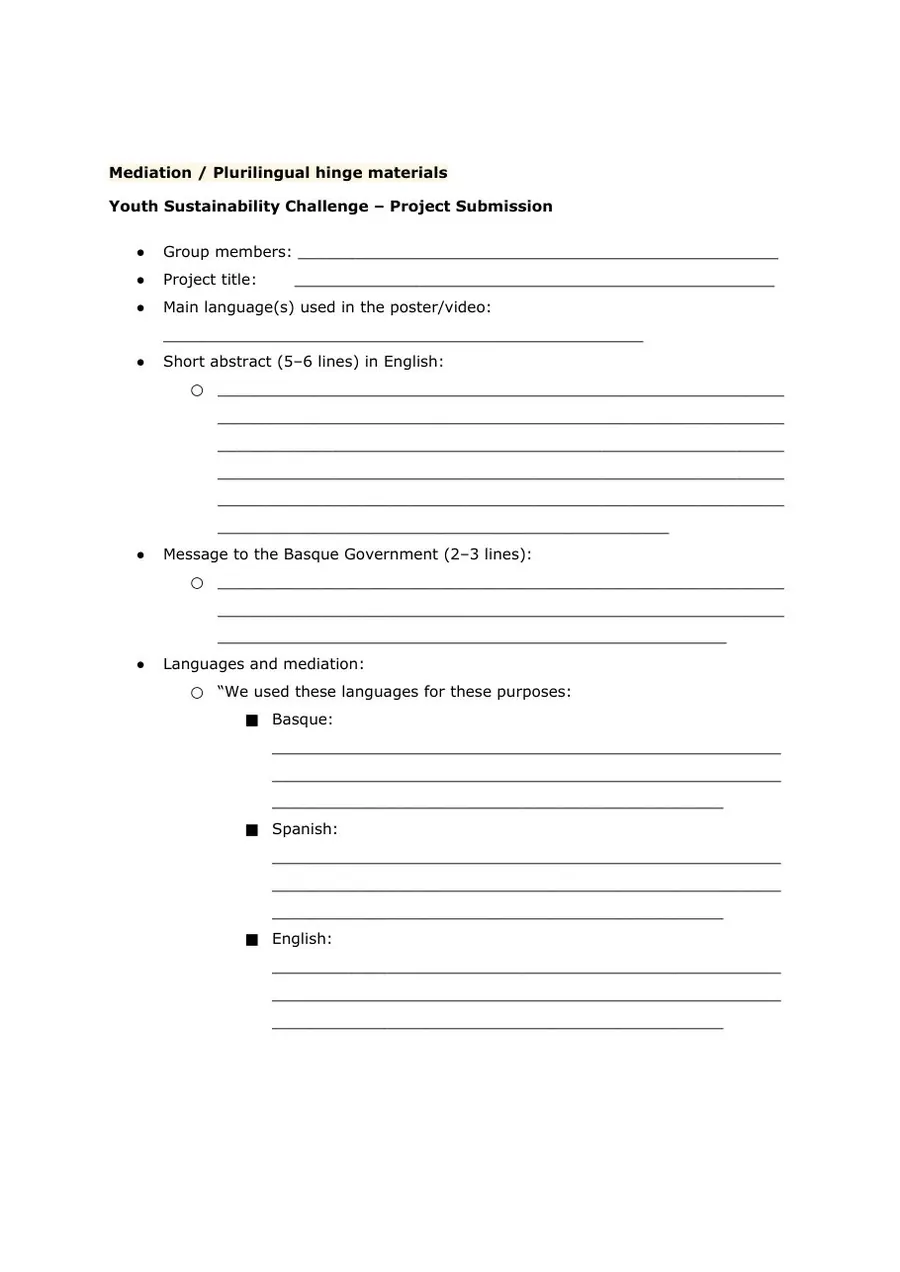
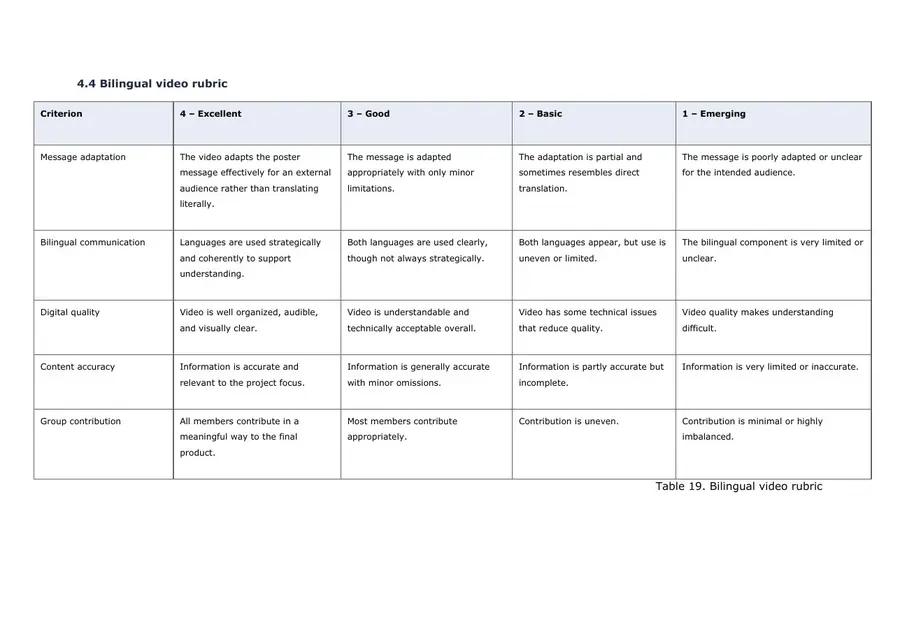
| Bilingual video pitch | 20 % | Language choice rationale, mediation between EN and EU/ES, clarity |
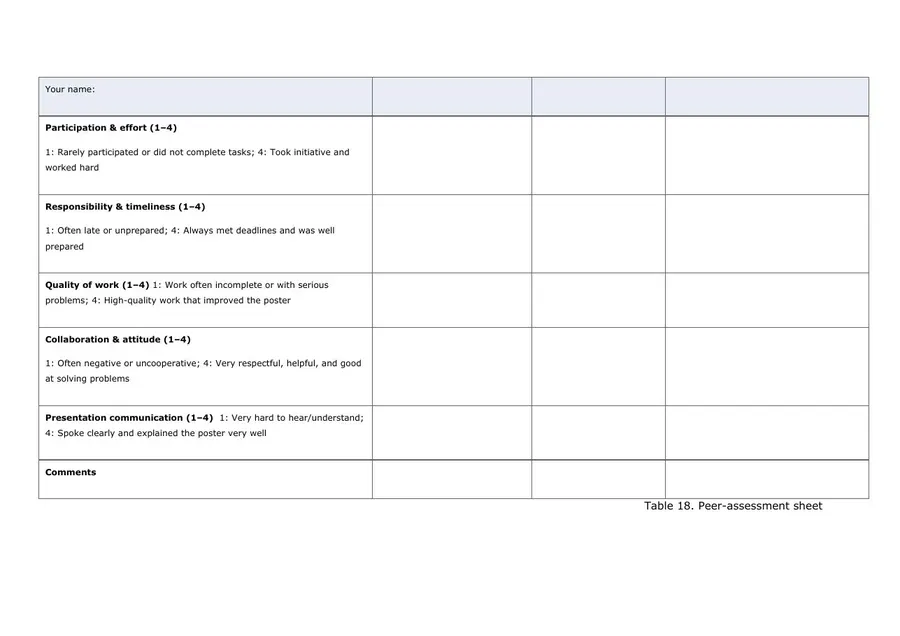
| Peer-assessment | 15 % | Accuracy of feedback, constructive tone, use of rubric criteria |
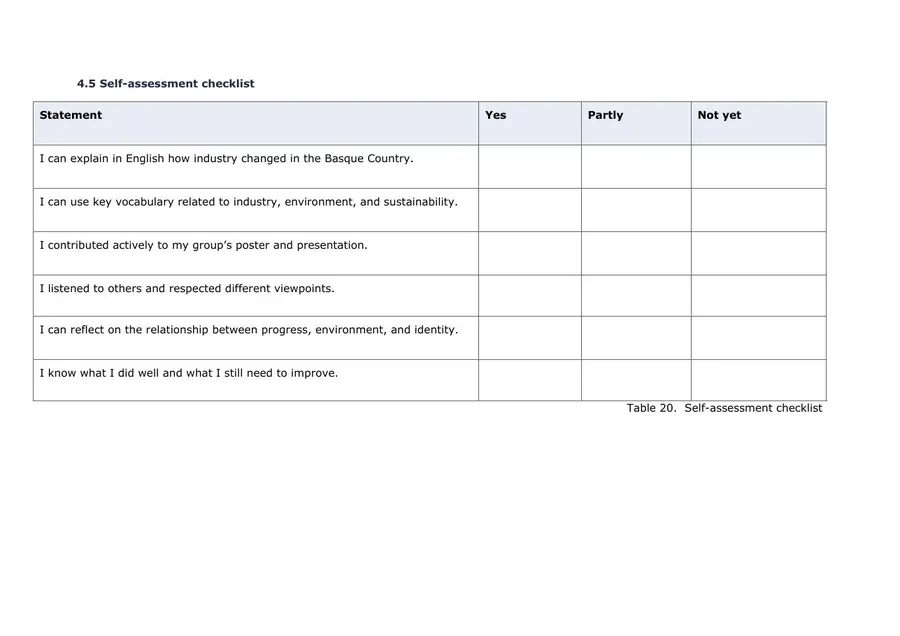
| Self-assessment + reflection journal | 10 % | Metalinguistic awareness, progress over time, plurilingual reflection |
Table 2. Assessment map
This learning situation, From Iron to Innovation, is justified by the need to offer 3rd ESO students meaningful opportunities to develop their communicative competence in English through content that is cognitively demanding, socially relevant, and closely connected to their local reality in the Basque Country. Industrialisation, urban transformation and sustainability are not treated as abstract topics but as lived processes that have shaped cities such as Bilbao and Vitoria-Gasteiz, which students recognise from their own experience. Situating language learning in this scenario increases motivation, supports deeper engagement, and provides an authentic communicative purpose: participating in a simulated Basque Government Youth Sustainability Challenge as young civic advisors.
From a methodological perspective, the proposal is grounded in CLIL principles and in Coyle’s 4Cs framework, integrating content, communication, cognition and culture in a single coherent sequence. English is not an isolated object of study, but the main vehicular language used to explore historical and geographical content, debate sustainability, and create public-facing products. At the same time, the design adopts a plurilingual and mediation-oriented lens in line with the Council of Europe’s Companion Volume and current Basque linguistic policy, explicitly valuing students’ Basque and Spanish repertoires as resources for understanding, reflection and bilingual product creation. Each session incorporates a mediation “hinge” that makes this cross-linguistic work visible and intentional, thus fostering plurilingual competence as defined in LOMLOE and Decreto 77/2023.
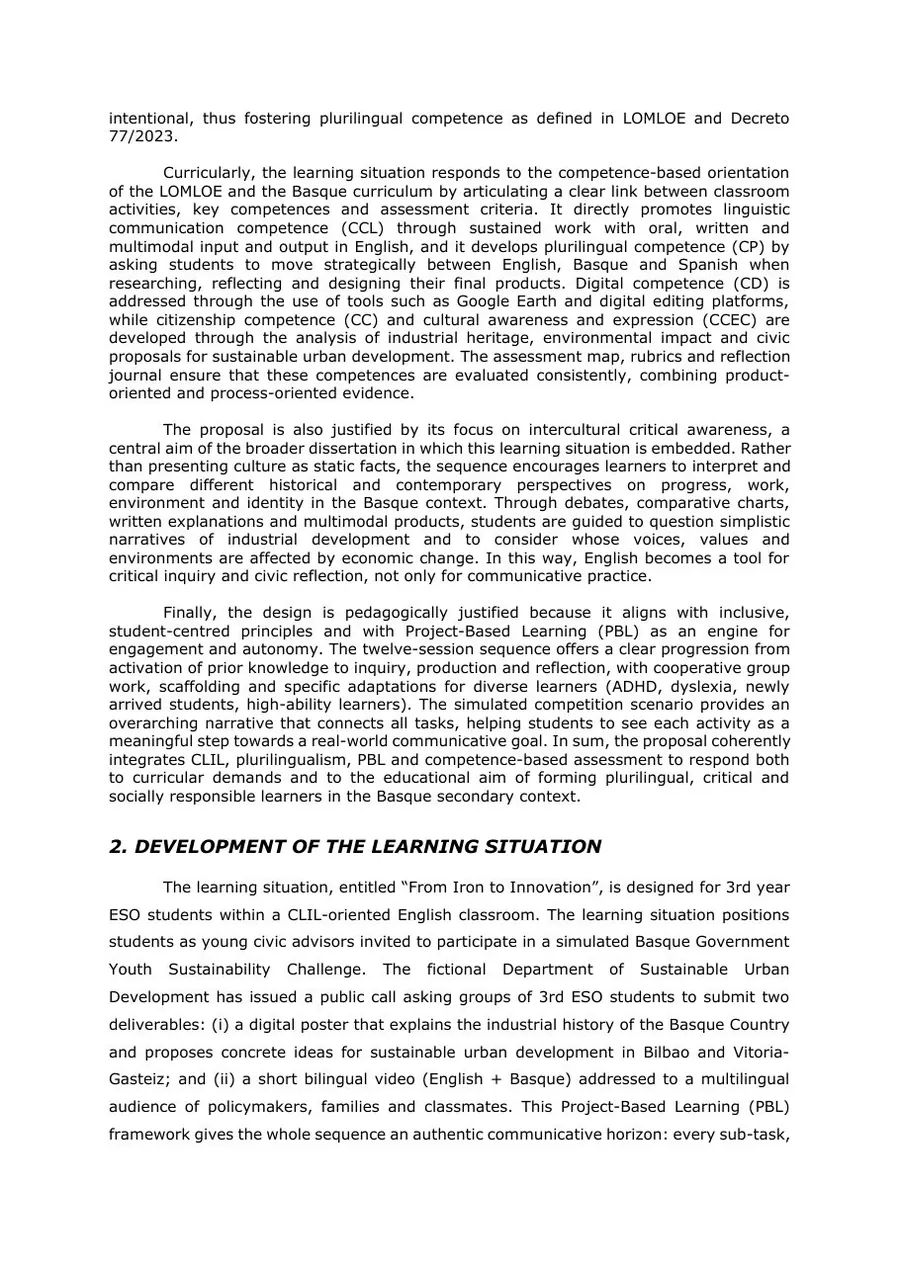
Curricularly, the learning situation responds to the competence-based orientation of the LOMLOE and the Basque curriculum by articulating a clear link between classroom activities, key competences and assessment criteria. It directly promotes linguistic communication competence (CCL) through sustained work with oral, written and multimodal input and output in English, and it develops plurilingual competence (CP) by asking students to move strategically between English, Basque and Spanish when researching, reflecting and designing their final products. Digital competence (CD) is addressed through the use of tools such as Google Earth and digital editing platforms, while citizenship competence (CC) and cultural awareness and expression (CCEC) are developed through the analysis of industrial heritage, environmental impact and civic proposals for sustainable urban development. The assessment map, rubrics and reflection journal ensure that these competences are evaluated consistently, combining product-oriented and process-oriented evidence.
The proposal is also justified by its focus on intercultural critical awareness, a central aim of the broader dissertation in which this learning situation is embedded. Rather than presenting culture as static facts, the sequence encourages learners to interpret and compare different historical and contemporary perspectives on progress, work, environment and identity in the Basque context. Through debates, comparative charts, written explanations and multimodal products, students are guided to question simplistic narratives of industrial development and to consider whose voices, values and environments are affected by economic change. In this way, English becomes a tool for critical inquiry and civic reflection, not only for communicative practice.
Finally, the design is pedagogically justified because it aligns with inclusive, student-centred principles and with Project-Based Learning (PBL) as an engine for engagement and autonomy. The twelve-session sequence offers a clear progression from activation of prior knowledge to inquiry, production and reflection, with cooperative group work, scaffolding and specific adaptations for diverse learners (ADHD, dyslexia, newly arrived students, high-ability learners). The simulated competition scenario provides an overarching narrative that connects all tasks, helping students to see each activity as a meaningful step towards a real-world communicative goal. In sum, the proposal coherently integrates CLIL, plurilingualism, PBL and competence-based assessment to respond both to curricular demands and to the educational aim of forming plurilingual, critical and socially responsible learners in the Basque secondary context.
The learning situation, entitled “From Iron to Innovation”, is designed for 3rd year ESO students within a CLIL-oriented English classroom. The learning situation positions students as young civic advisors invited to participate in a simulated Basque Government Youth Sustainability Challenge. The fictional Department of Sustainable Urban Development has issued a public call asking groups of 3rd ESO students to submit two deliverables: (i) a digital poster that explains the industrial history of the Basque Country and proposes concrete ideas for sustainable urban development in Bilbao and Vitoria-Gasteiz; and (ii) a short bilingual video (English + Basque) addressed to a multilingual audience of policymakers, families and classmates. This Project-Based Learning (PBL) framework gives the whole sequence an authentic communicative horizon: every sub-task, every piece of vocabulary and every moment of reflection is oriented towards this final submission.
The choice of this topic is deliberate. As discussed in the theoretical framework, meaningful CLIL proposals should be grounded in content that is both cognitively rich and socially relevant. Industrialisation, urban transformation, sustainability, and local identity fulfil these conditions because they allow students to connect classroom learning with the historical and social realities of their own environment. In addition, this topic offers productive opportunities for the integration of the 4Cs: students engage with disciplinary content, use English for communication, activate higher-order thinking through comparison and evaluation, and reflect on cultural and civic dimensions of regional change (Coyle et al., 2010).
The selection of this learning situation also reflects the role of intercultural critical awareness in the dissertation. Rather than limiting interculturality to the presentation of cultural facts, the proposal adopts the view defended in Chapter 2 that intercultural learning should involve interpretation, comparison, and critical reflection. In this sense, students are encouraged not only to learn about industrial change in the Basque Country, but also to examine how that change has shaped identities, environments, and social values over time.
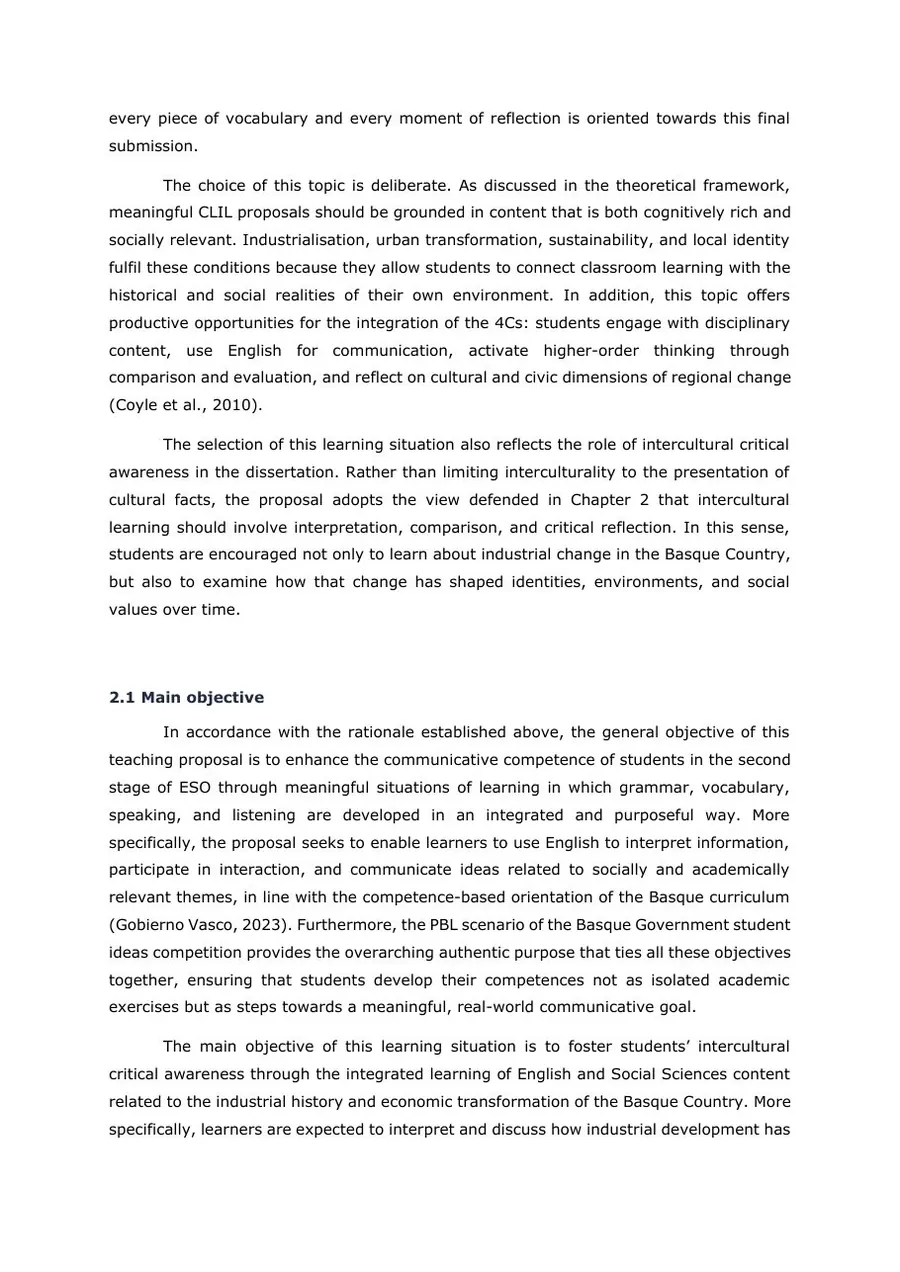
In accordance with the rationale established above, the general objective of this teaching proposal is to enhance the communicative competence of students in the second stage of ESO through meaningful situations of learning in which grammar, vocabulary, speaking, and listening are developed in an integrated and purposeful way. More specifically, the proposal seeks to enable learners to use English to interpret information, participate in interaction, and communicate ideas related to socially and academically relevant themes, in line with the competence-based orientation of the Basque curriculum (Gobierno Vasco, 2023). Furthermore, the PBL scenario of the Basque Government student ideas competition provides the overarching authentic purpose that ties all these objectives together, ensuring that students develop their competences not as isolated academic exercises but as steps towards a meaningful, real-world communicative goal.
The main objective of this learning situation is to foster students’ intercultural critical awareness through the integrated learning of English and Social Sciences content related to the industrial history and economic transformation of the Basque Country. More specifically, learners are expected to interpret and discuss how industrial development has influenced local identity, urban change, environmental values, and contemporary ideas of progress, while using English as the medium for communication, collaboration, and reflection.
This objective reflects the central claim of the dissertation that a CLIL-oriented proposal should be justified not only by its potential usefulness in the classroom, but by its coherence with the theoretical principles that sustain it. In this case, the learning situation combines content learning, communicative competence, critical thinking, and intercultural reflection within a single pedagogical sequence.
In addition, the proposal is designed to foster learner autonomy through guided planning, reflection, and self-assessment, while also contributing to broader educational aims such as plurilingual competence, intercultural awareness, inclusion, and responsible participation. In this respect, the objectives of the intervention are aligned both with the curricular expectations of foreign language learning and with the theoretical claim developed in Chapter 2 that language education in CLIL settings should support not only linguistic growth, but also cognitive, social, and intercultural development.
From this main objective, several more specific objectives emerge. Students are expected to identify key stages in the industrial development of the Basque Country and to relate them to broader processes of economic, environmental, and urban transformation. They are also expected to compare examples of traditional industry and contemporary sustainable innovation in places such as Bilbao and Vitoria-Gasteiz, using English to understand information and communicate their interpretations.
At the linguistic level, the sequence is designed to develop students’ ability to understand oral, written, and visual input related to industrial history, geography, and sustainability, as well as to strengthen oral interaction and spoken production through collaborative inquiry, discussion, and presentation. In addition, the proposal promotes the use of thematic vocabulary in context and encourages students to articulate informed opinions about the relationship between economic development, environmental impact, cultural identity, and collective responsibility.
Finally, the learning situation seeks to foster cooperation, digital competence, and learner autonomy through group work, guided research, and reflective activities. A more schematic version of these objectives is provided in the appendix materials, but the main body retains them in prose form in order to preserve the argumentative continuity of the chapter. All of these specific objectives converge on the PBL competition scenario: students must research, collaborate, create, and present in English in order to produce a compelling poster and bilingual video for the Basque Government competition, thus demonstrating their attainment of the linguistic, cognitive, and intercultural goals of the learning situation in a single authentic context.
The learning situation contributes directly to the development of the key competences established in the LOMLOE and Decreto 77/2023. It promotes linguistic communication competence (CCL), since students use English to understand audiovisual and written input, discuss ideas and present content in academic situations; it strengthens plurilingual competence (CP) by connecting English-medium learning with students’ Basque and Spanish repertoires through explicit mediation and metalinguistic tasks; it develops digital competence (CD) through the use of Google Earth, online maps and multimodal editing tools for the poster and the bilingual video; and it fosters citizenship competence (CC) by asking students to analyse the social and environmental consequences of industrialisation and to articulate a civic proposal. It also engages cultural awareness and expression (CCEC), since students interpret the industrial heritage of the Basque Country as part of a broader cultural and historical process. Each competence is later explained in the description of each session.
The main disciplinary contents are related to the industrial history of the Basque Country, including mining, steel production, manufacturing, urban transformation, and the emergence of contemporary industrial and sustainable models. Students also work with geographical concepts such as location, economic activity, environmental impact, and regional development, all of which are approached through examples from Bilbao and Vitoria-Gasteiz.
From the linguistic point of view, the proposal focuses on subject-specific vocabulary related to industry, geography, sustainability, and urban change. It also reinforces language structures such as past tenses to describe historical processes, comparatives to contrast past and present models, and functional language for giving opinions, agreeing, disagreeing, and presenting arguments in group discussion.
The methodology is based on CLIL principles and on a student-centered, competence-based approach. Following the integration of content, communication, cognition, and culture, the learning situation combines subject learning with purposeful language use and critical reflection, so that English becomes a tool for inquiry rather than an isolated object of study (Coyle et al., 2010).
The proposal also relies on cooperative learning, scaffolding, and multimodal resources to ensure inclusion and participation. The teacher assumes the role of facilitator by guiding interaction, modelling language, providing visual and lexical support (Byram, 2000). Therefore, the teacher is creating opportunities for students to compare perspectives and build meaning collaboratively, which is especially relevant for the development of intercultural critical awareness.
A central methodological pillar of this learning situation is PBL. The PBL-centred approach uses real-world problems to stimulate critical thinking and conflict resolution. Similarly, PBL goes beyond traditional educational methods by fostering students’ critical thinking and problem-solving skills. At the same time, it makes a strong commitment to lifelong learning and active engagement (Nicholus et al., 2023). Therefore, this method values students’ cognitive engagement, helping them analyse and solve complex problems while the teacher acts as a guide throughout the process.
In this learning situation, the PBL framework is operationalised through a meaningful and authentic scenario: students are told that their groups are participating in a real project in which they must send ideas to help improve their city and promote sustainable development. To do so, they create a poster that explores industrialisation in the Basque Country in the past and compares it with present-day industrialisation in Bilbao and Vitoria-Gasteiz, providing examples of how the region can become more.
English operates as the main vehicular language of the classroom: approximately 90% of classroom communication, instructions, tasks and outputs are in English. Basque and Spanish are used strategically and in a planned way in three types of moments: (i) comprehension checks of complex notions; (ii) initial brainstorming in the group when exploring concepts that are still being acquired in English; and (iii) parts of the final bilingual product, where the choice of language is itself part of the communicative design. This distribution reflects the holistic plurilingual approach defended by Cenoz (2022) and Cenoz and Gorter (2015), in which languages are resources within a single repertoire, not isolated codes.
Students mainly work in heterogeneous groups of four to foster cooperation, peer support, and shared responsibility. This organization takes into account a class of 28 students, allowing for the creation of seven balanced groups. Each group is assigned both a number and a name to facilitate easy identification, classroom management, and a sense of group identity. Group composition is carefully designed based on students’ performance levels to ensure a balanced distribution of abilities, so that no learner is left behind and all group members can contribute meaningfully while supporting one another. This structure also aligns with the fact that the classroom consists of an even number of students and does not exceed 30, in accordance with the legal limits established by Spanish educational regulations (Real Decreto 132/2010, de 12 de febrero) and the Basque educational framework. It is important to note that group composition may vary depending on the total number of students in the class. This type of grouping is particularly effective in CLIL contexts, as it allows learners with diverse linguistic and academic profiles to participate actively and benefit from interaction as a means of both content comprehension and language development.
In the proposed learning situation, students will explore industrial transformation in the Basque Country from a multidisciplinary and intercultural perspective. As mentioned above, this learning situation is designed for the 3rd year of ESO and develops content through English, Geography and History and Technology and Digitalization. As this learning situation takes place within a CLIL context, all three subjects are taught in English by teachers qualified to deliver instruction through this language. Within this framework, the PBL approach is operationalised through an authentic scenario in which students, working in groups, participate in a simulated real-world project aimed at proposing ideas to improve their city and promote sustainable development. To this end, they produce a digital poster and a bilingual video analysing past industrialisation in the Basque Country and comparing it with current developments in Bilbao and Vitoria-Gasteiz, while suggesting sustainable future-oriented solutions.
The learning sequence will be implemented over two weeks (12 sessions of 55 minutes), allowing students to analyze and represent regional history, environmental change, and contemporary innovation in English while connecting literacy, civic awareness, and creativity. The approach follows CLIL principles to integrate content, communication, cognition, and culture.
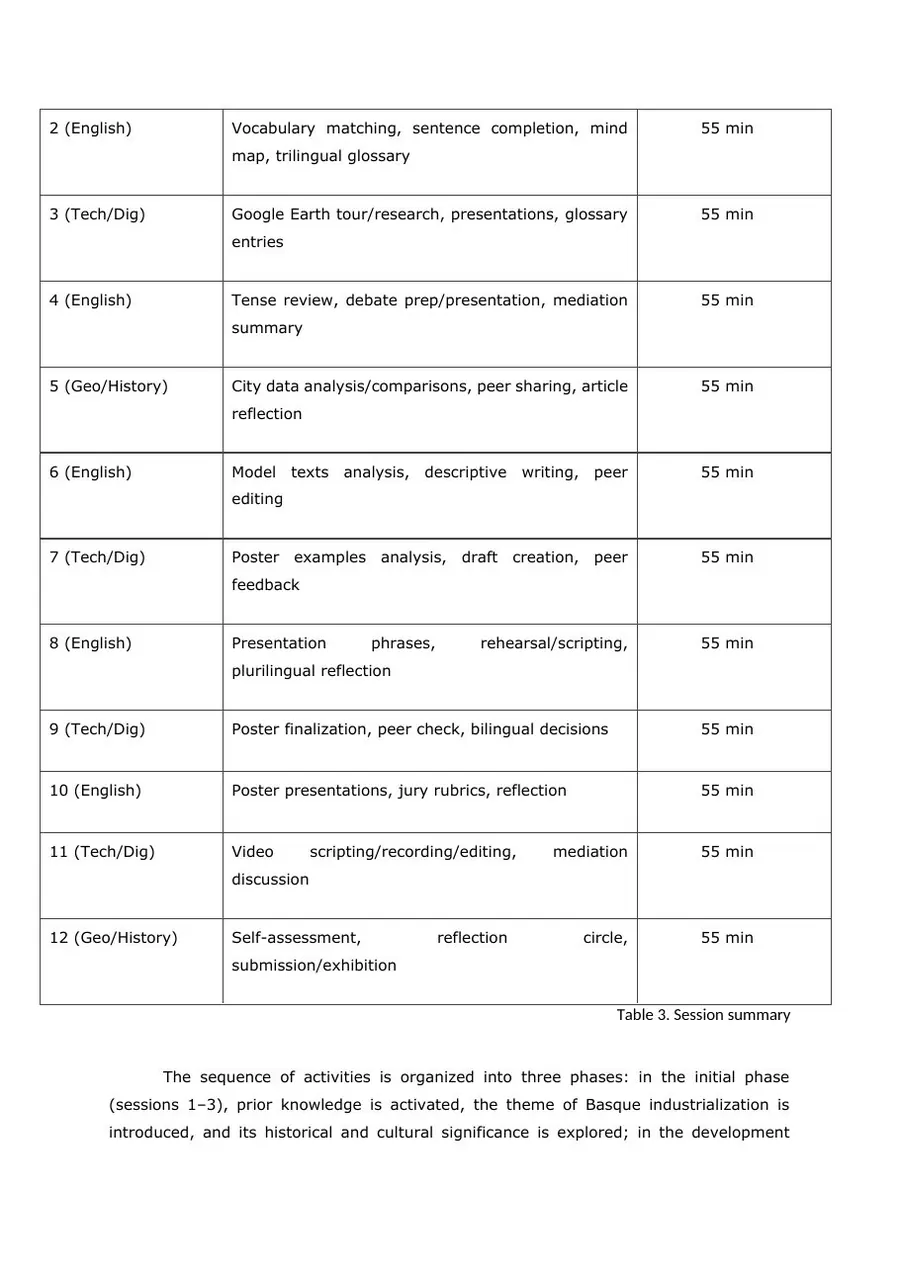
| Session | Tasks | Timing |
|---|---|---|
| 1 (Geo/History) | Brainstorming, Bilbao video/worksheet, image analysis, group formation | 55 min |
| 2 (English) | Vocabulary matching, sentence completion, mind map, trilingual glossary | 55 min |
| 3 (Tech/Dig) | Google Earth tour/research, presentations, glossary entries | 55 min |
| 4 (English) | Tense review, debate prep/presentation, mediation summary | 55 min |
| 5 (Geo/History) | City data analysis/comparisons, peer sharing, article reflection | 55 min |
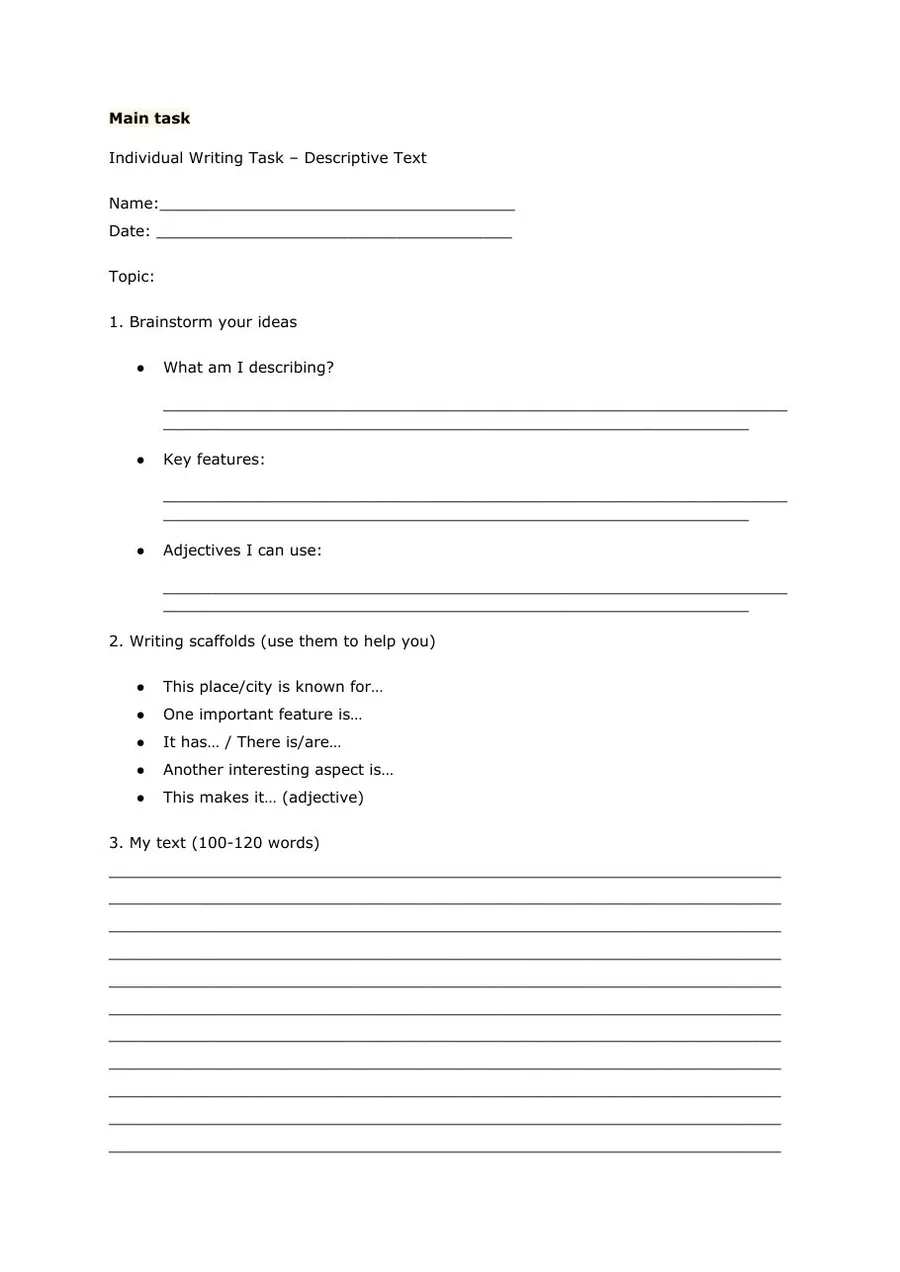
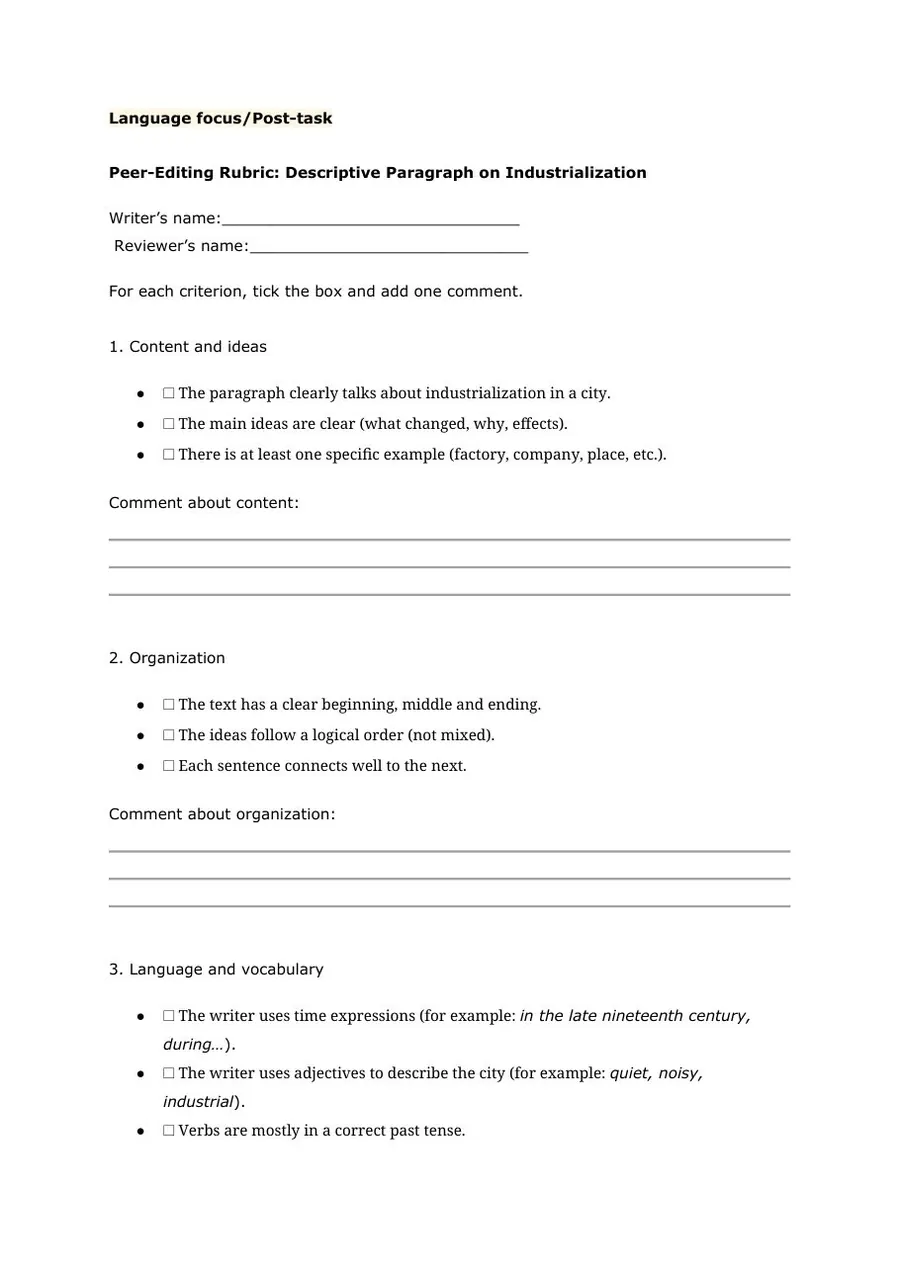
| 6 (English) | Model texts analysis, descriptive writing, peer editing | 55 min |
| 7 (Tech/Dig) | Poster examples analysis, draft creation, peer feedback | 55 min |
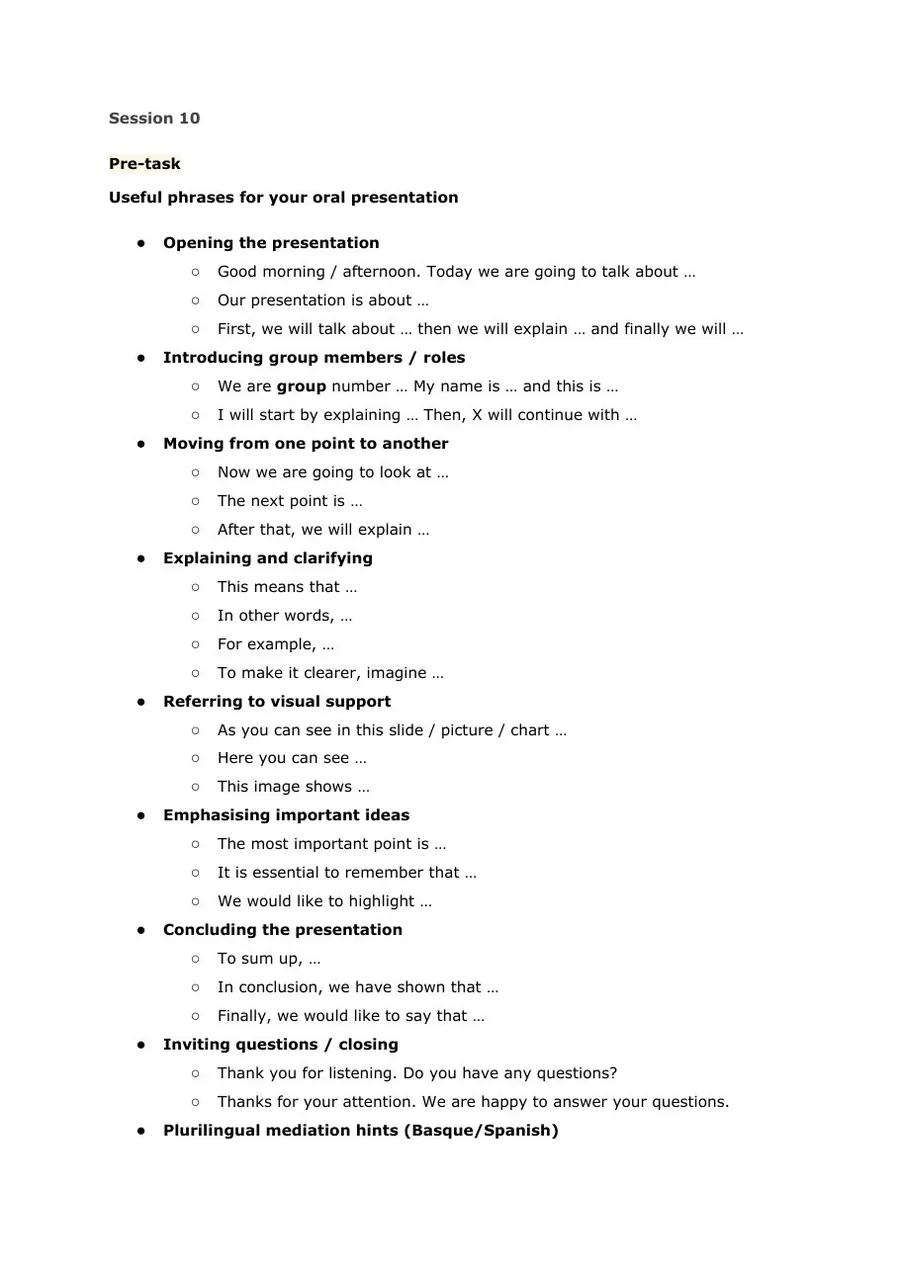
| 8 (English) | Presentation phrases, rehearsal/scripting, plurilingual reflection | 55 min |
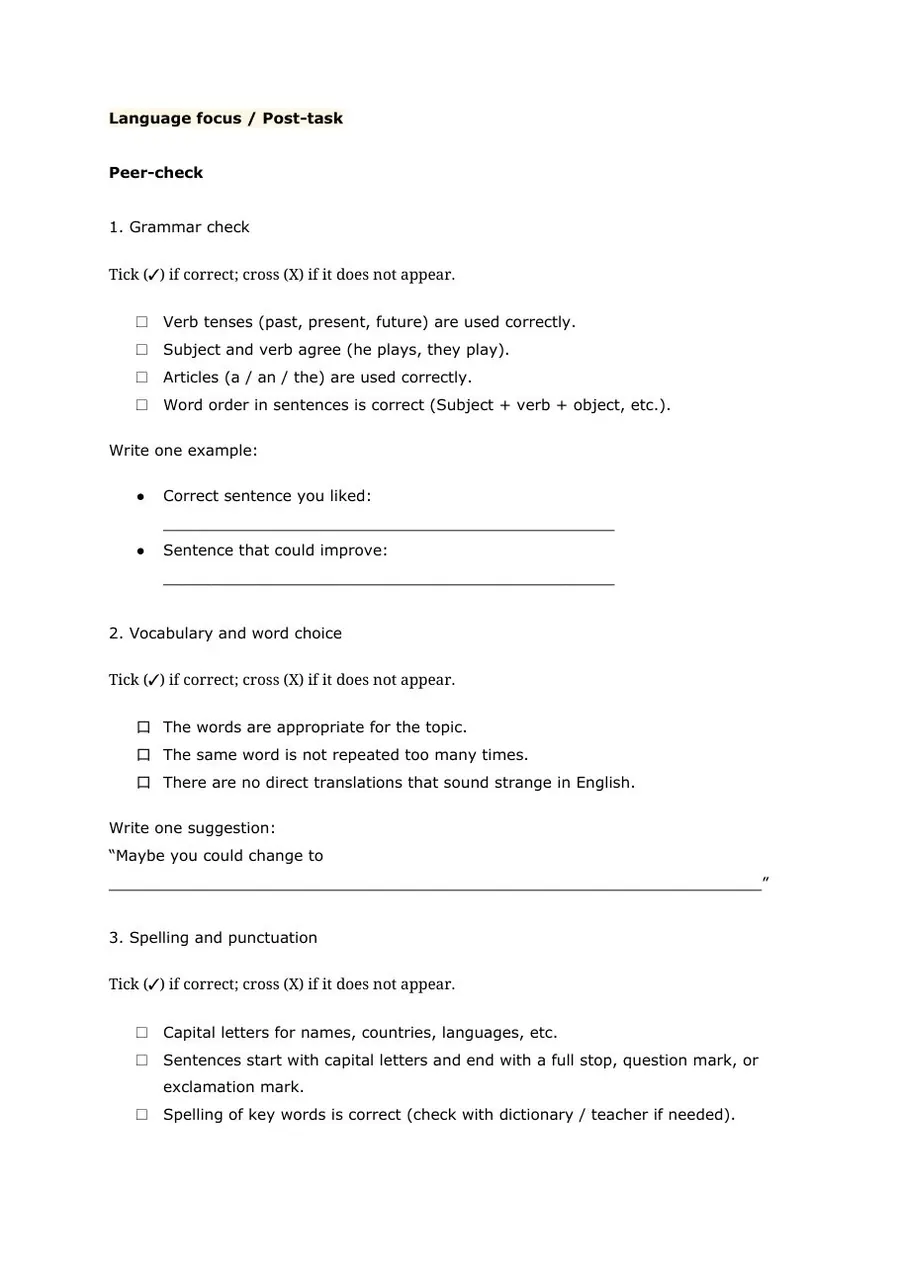
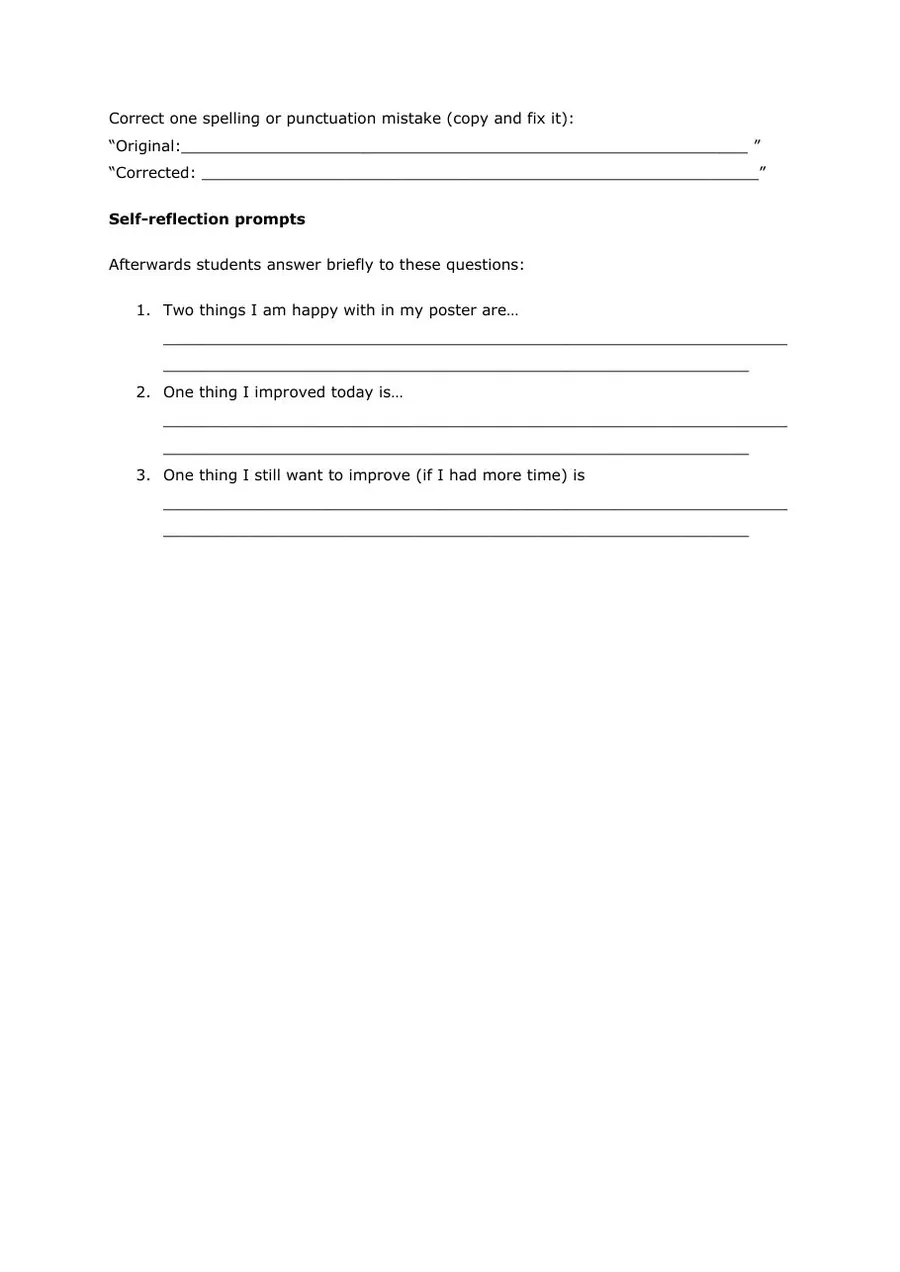
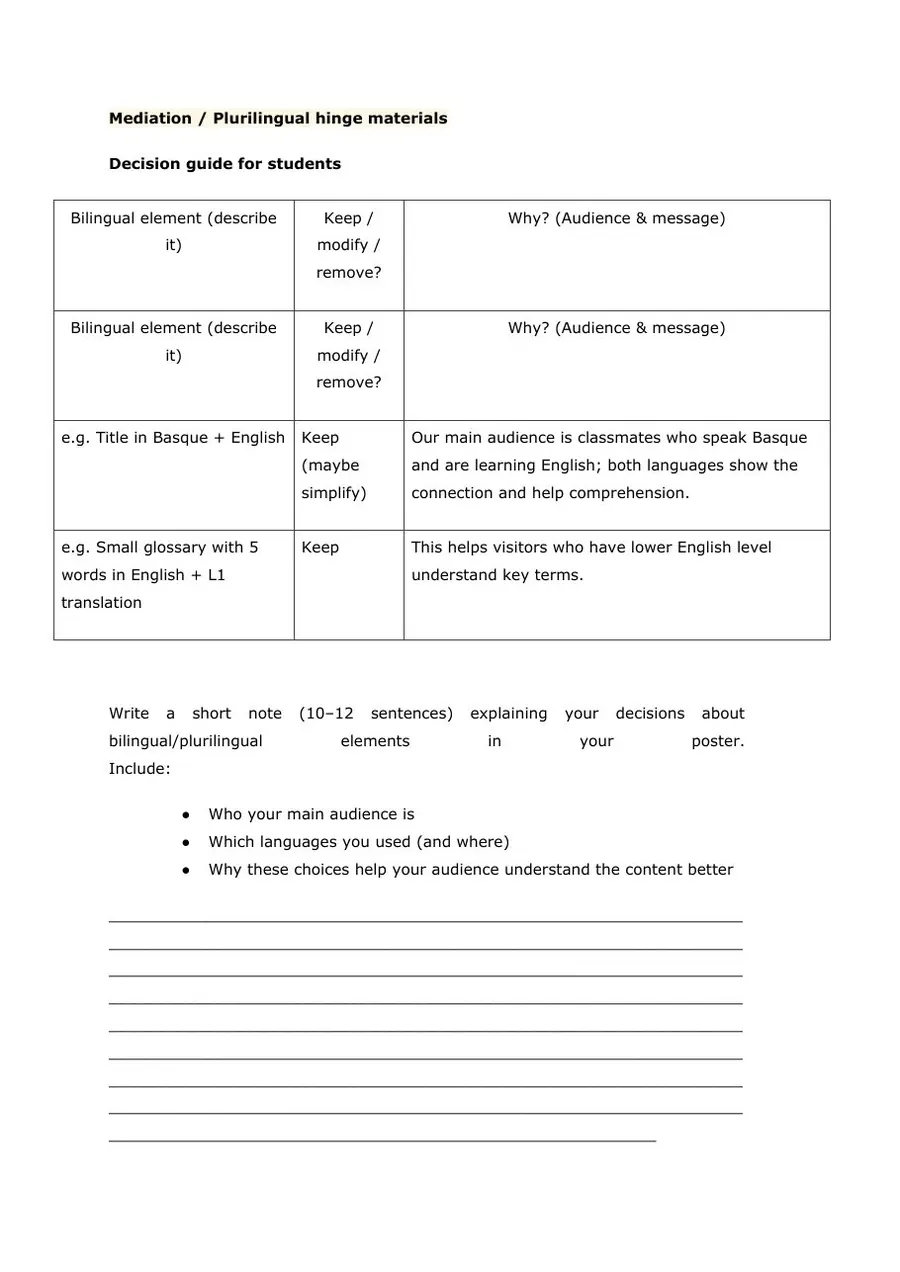
| 9 (Tech/Dig) | Poster finalization, peer check, bilingual decisions | 55 min |
| 10 (English) | Poster presentations, jury rubrics, reflection | 55 min |
| 11 (Tech/Dig) | Video scripting/recording/editing, mediation discussion | 55 min |
| 12 (Geo/History) | Self-assessment, reflection circle, submission/exhibition | 55 min |
Table 3. Session summary
The sequence of activities is organized into three phases: in the initial phase (sessions 1–3), prior knowledge is activated, the theme of Basque industrialization is introduced, and its historical and cultural significance is explored; in the development phase (sessions 4–8), students conduct inquiry, language learning, and collaborative tasks leading up to the creation of the final products; and in the final phase (sessions 9–12), they focus on production, presentation, reflection, and assessment.
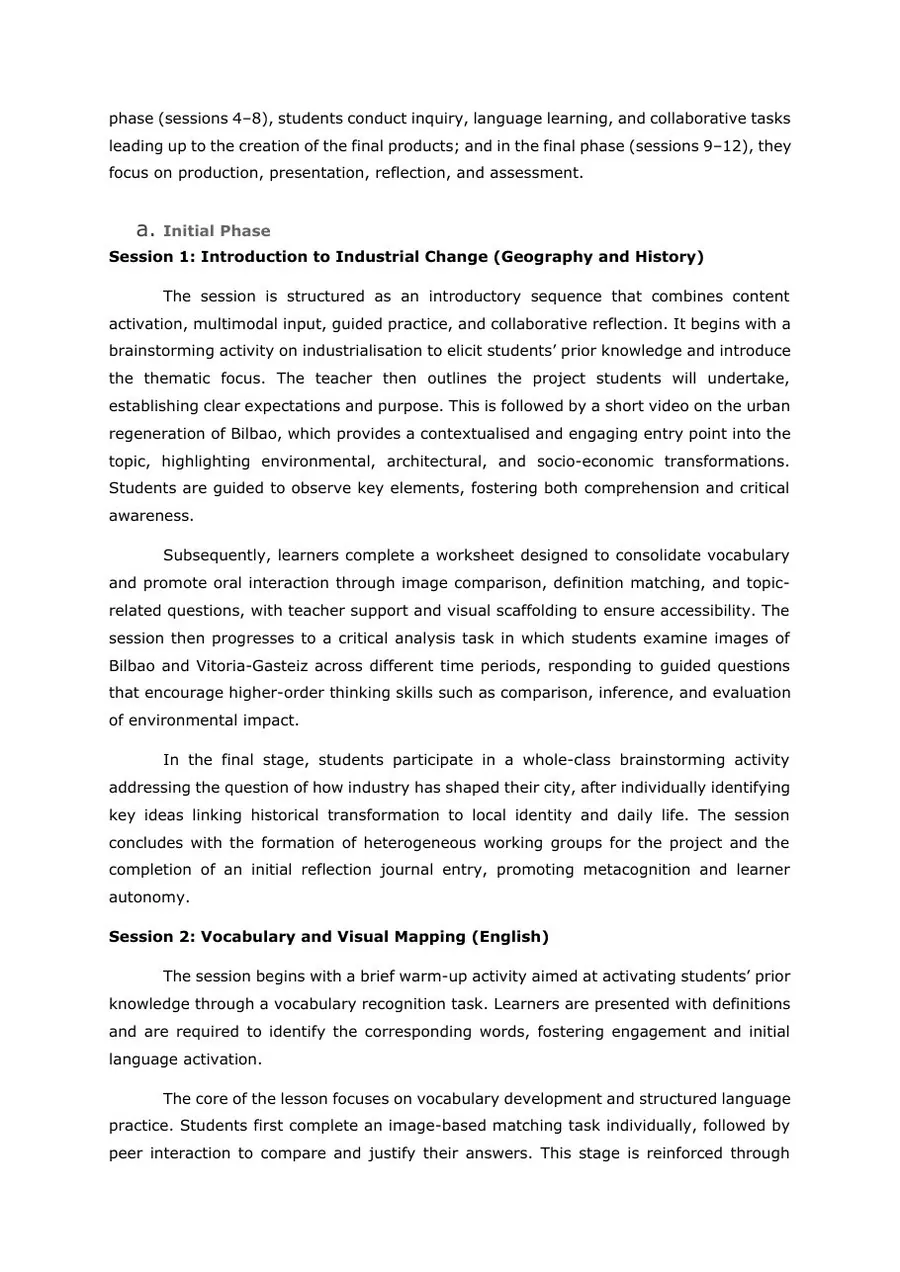
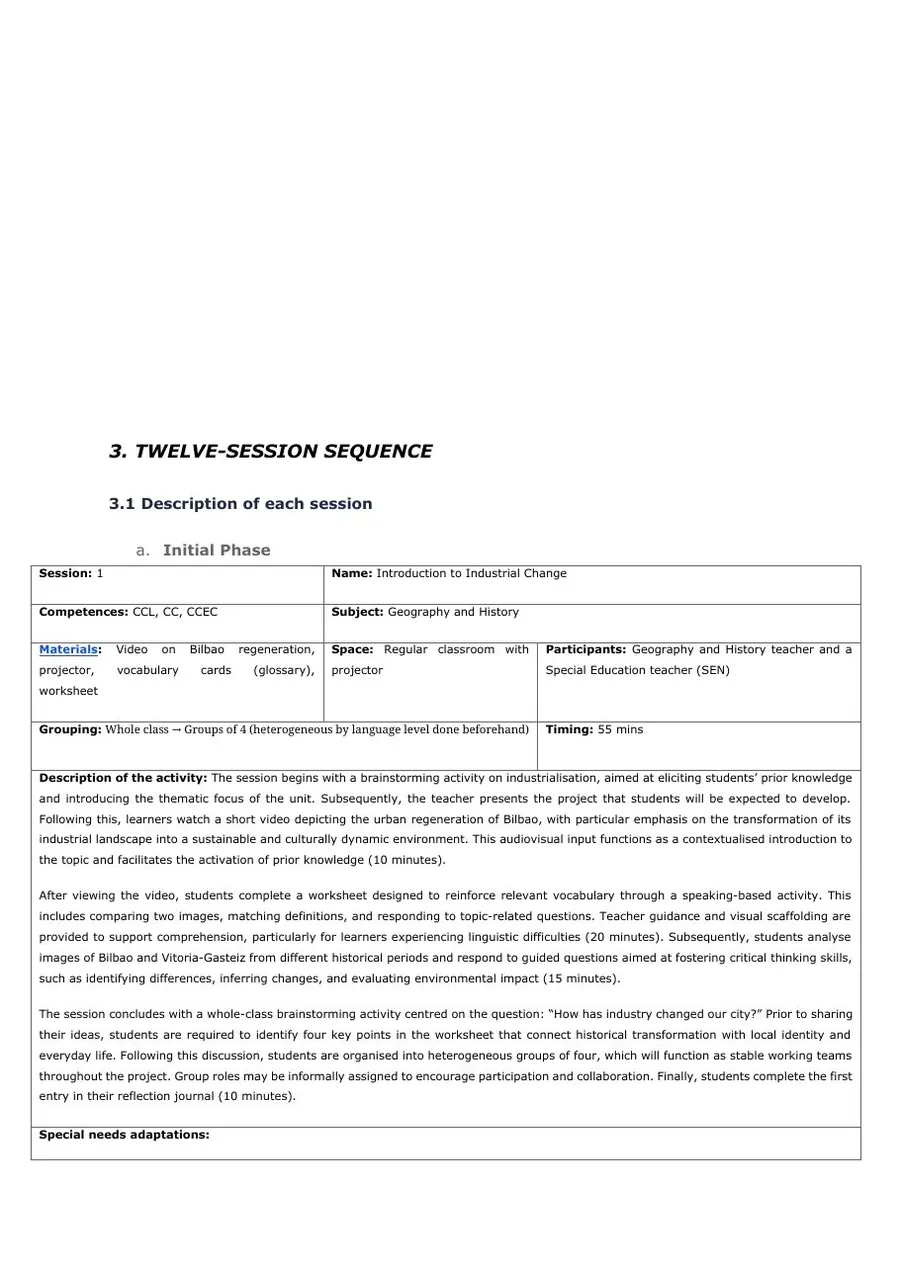
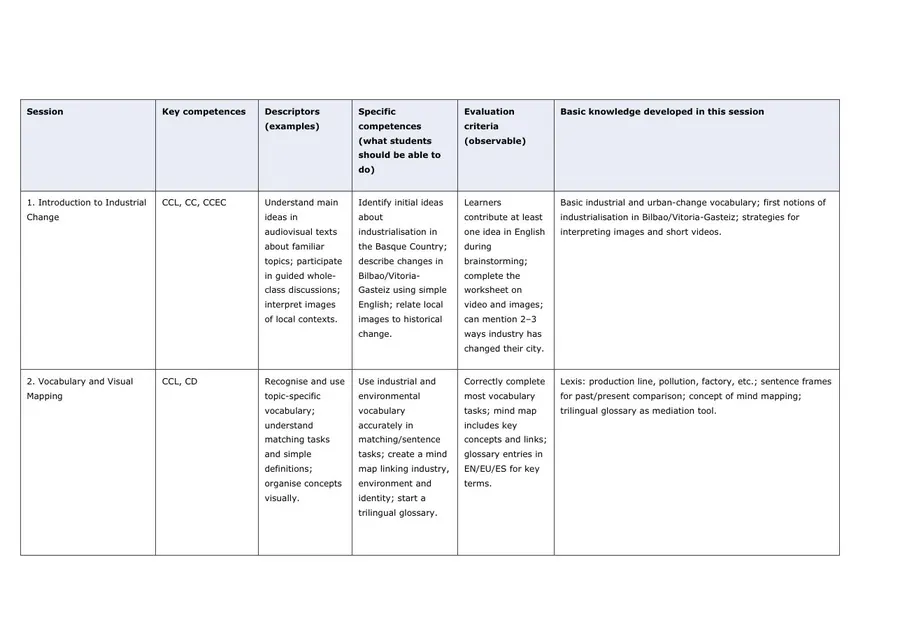
Session 1: Introduction to Industrial Change (Geography and History)
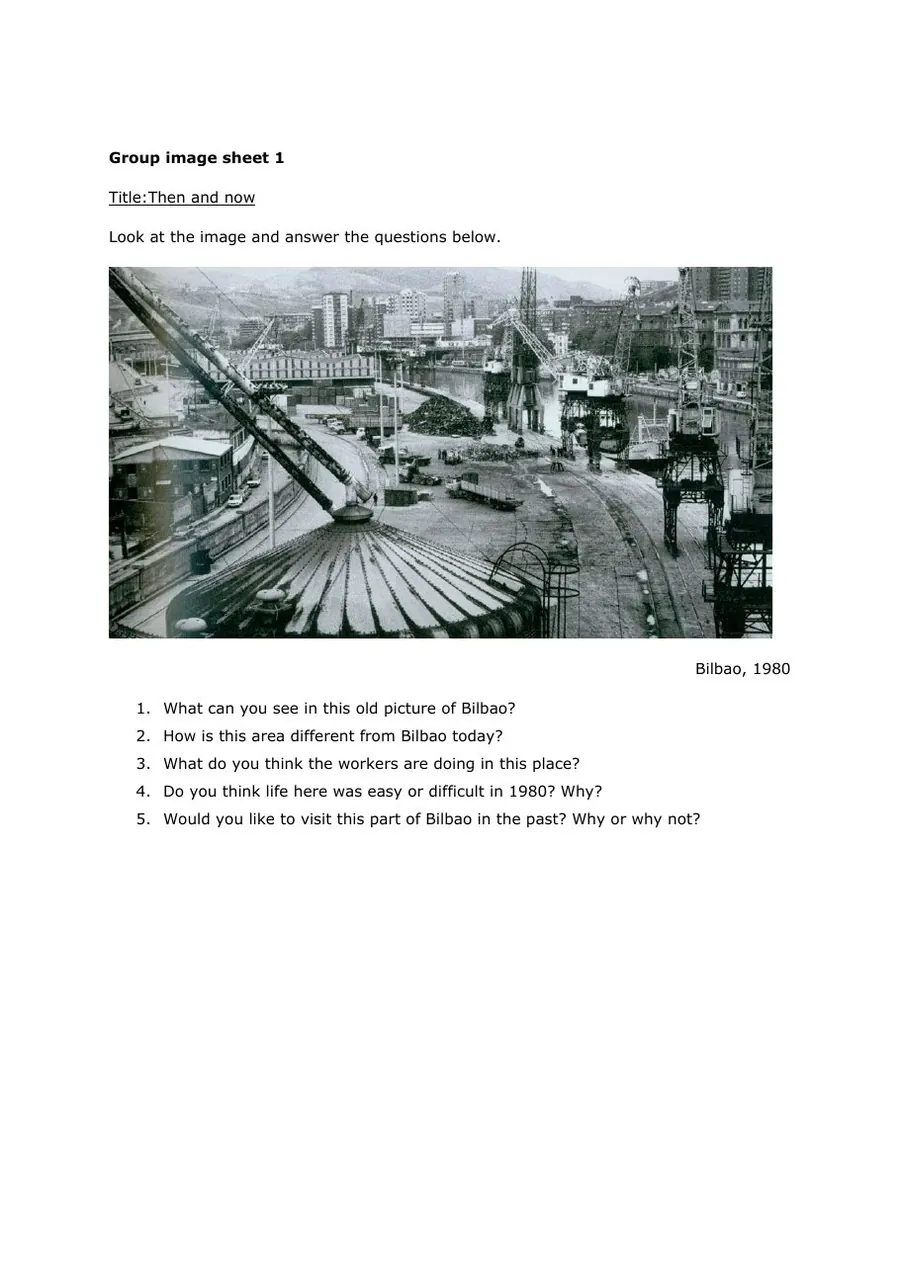
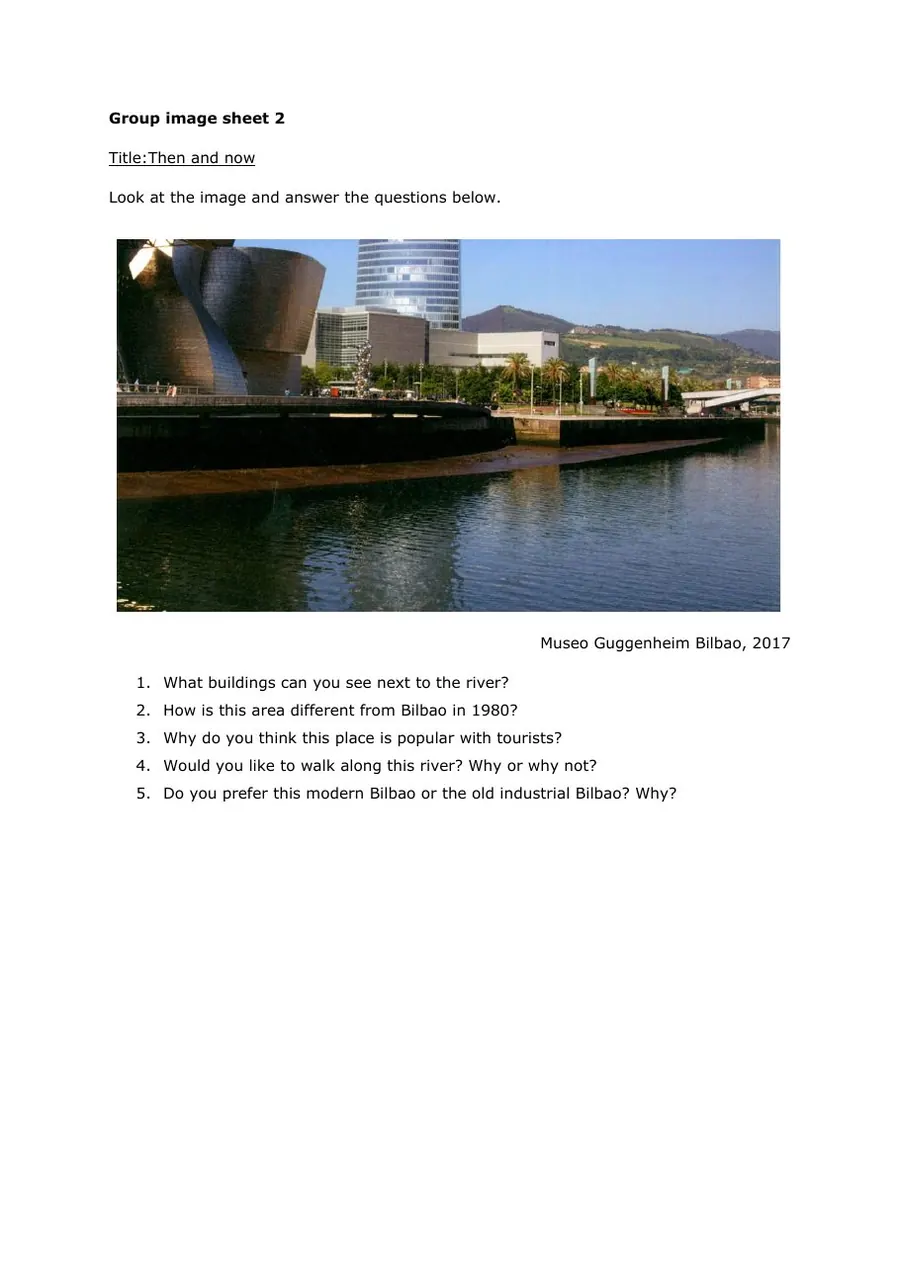
The session is structured as an introductory sequence that combines content activation, multimodal input, guided practice, and collaborative reflection. It begins with a brainstorming activity on industrialisation to elicit students’ prior knowledge and introduce the thematic focus. The teacher then outlines the project students will undertake, establishing clear expectations and purpose. This is followed by a short video on the urban regeneration of Bilbao, which provides a contextualised and engaging entry point into the topic, highlighting environmental, architectural, and socio-economic transformations. Students are guided to observe key elements, fostering both comprehension and critical awareness.
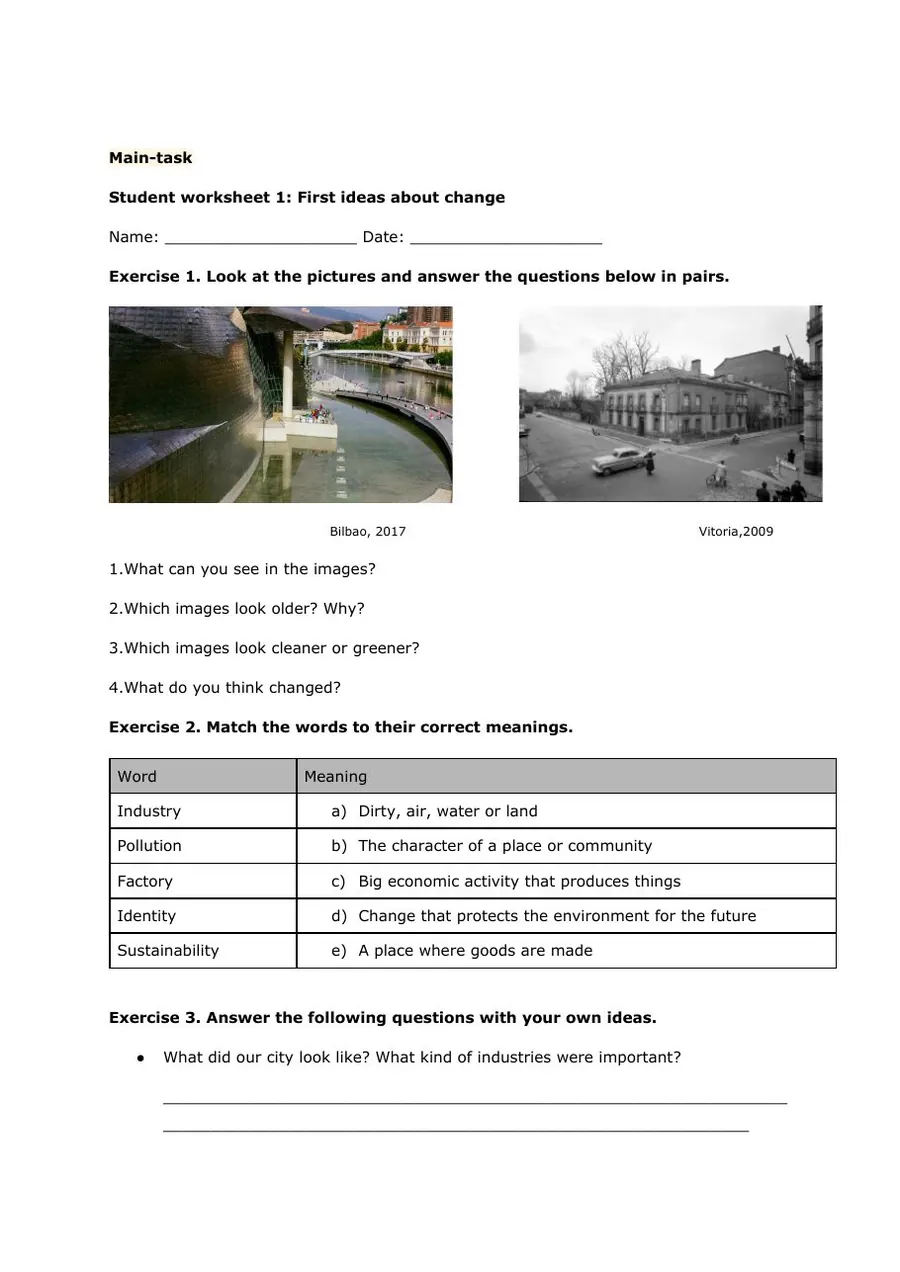
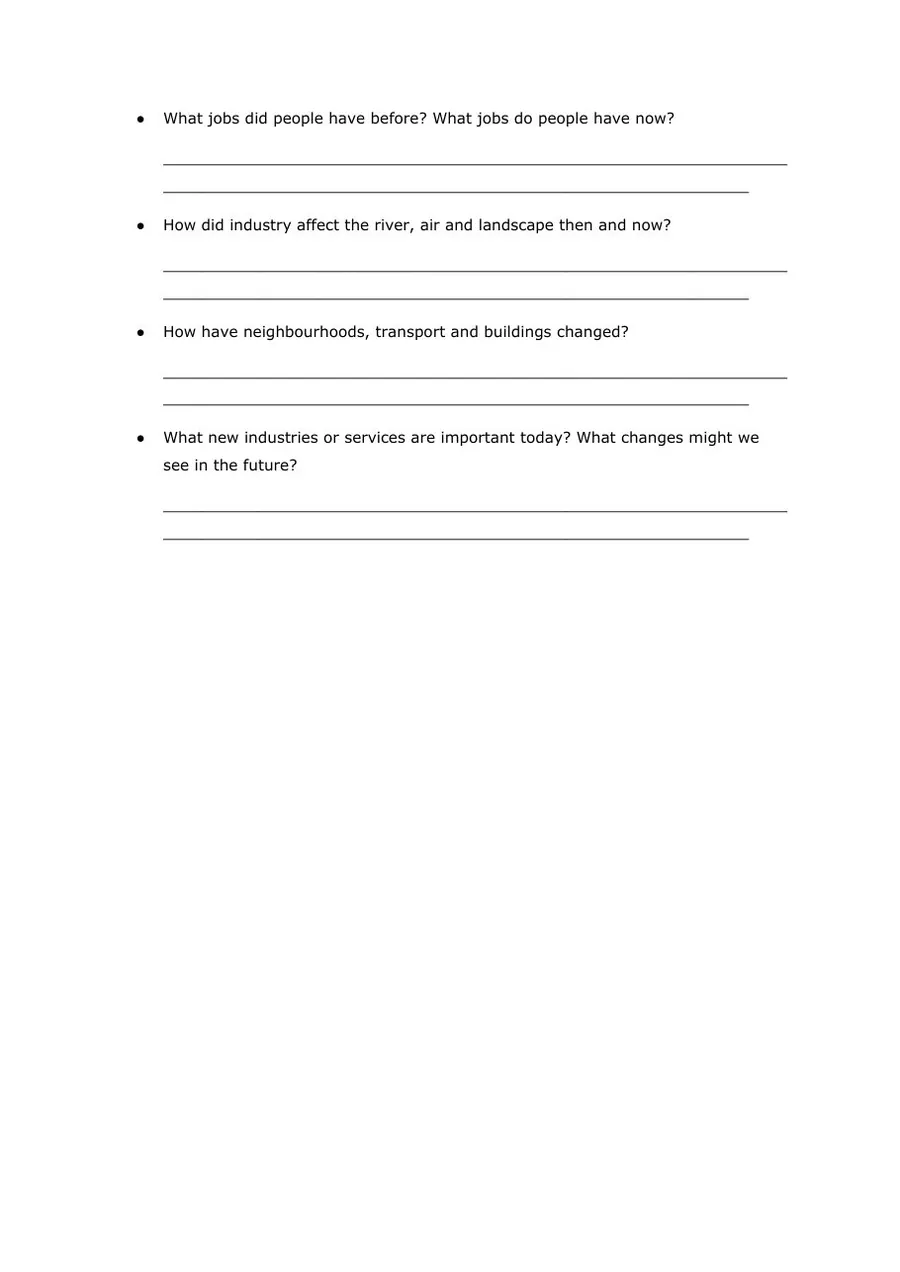
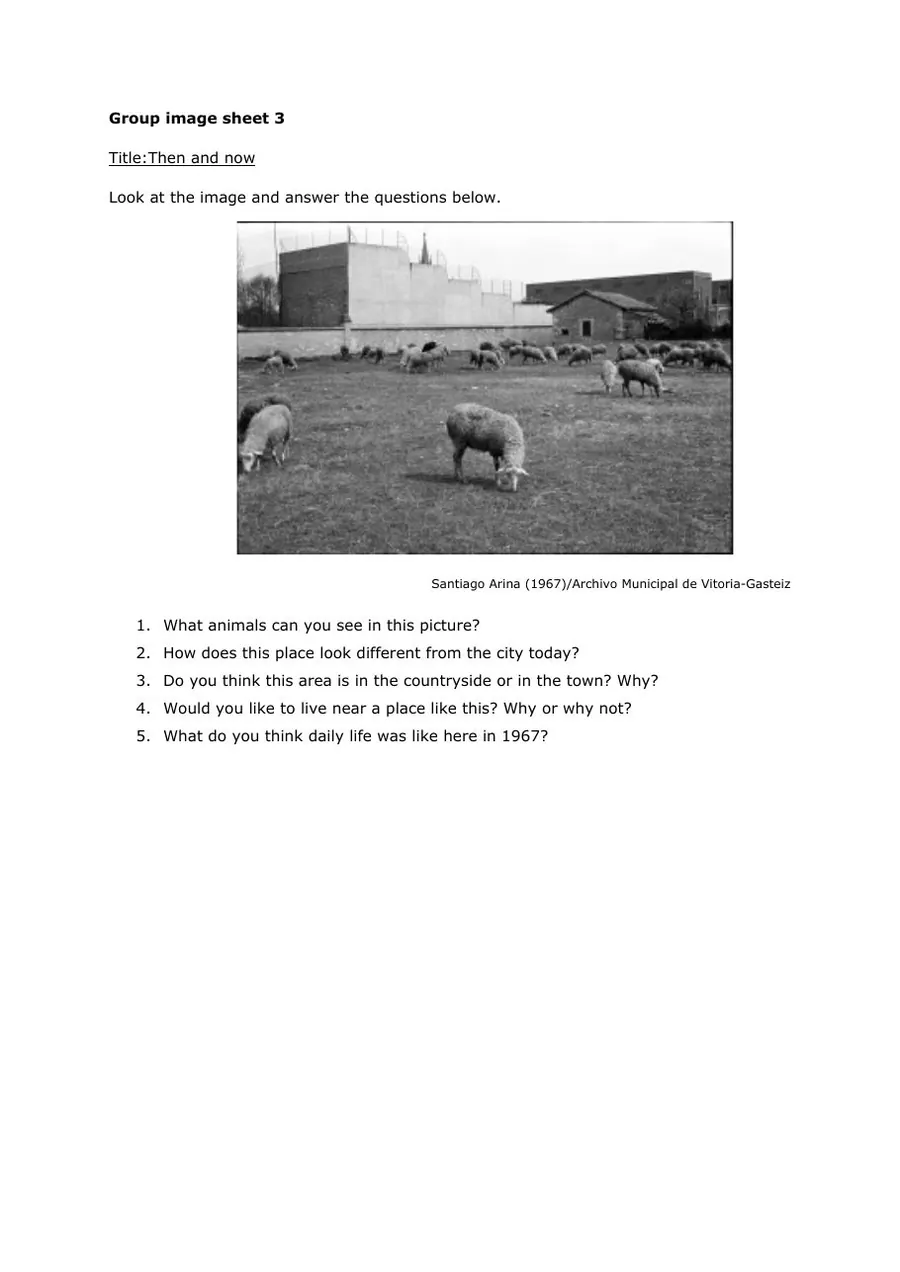
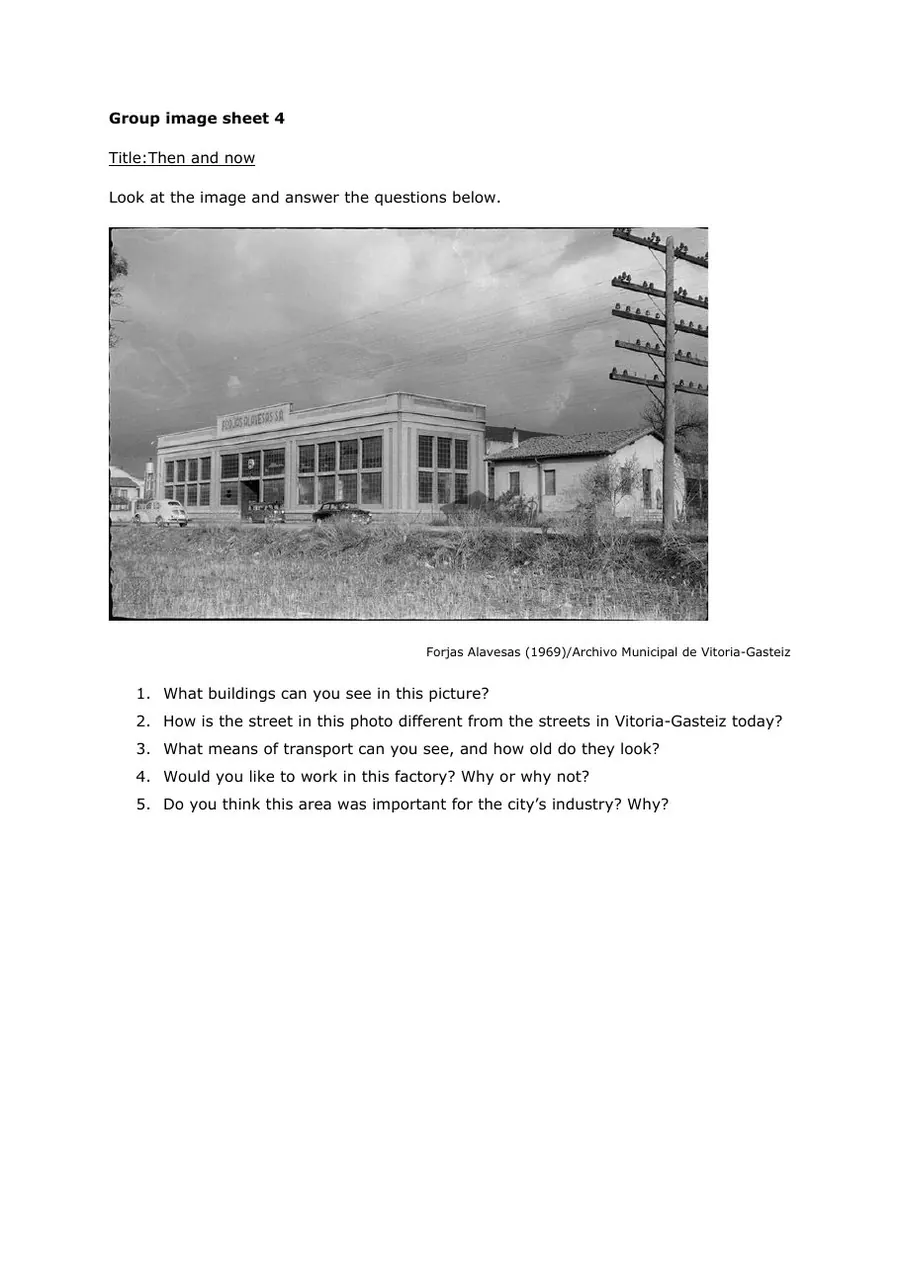
Subsequently, learners complete a worksheet designed to consolidate vocabulary and promote oral interaction through image comparison, definition matching, and topic-related questions, with teacher support and visual scaffolding to ensure accessibility. The session then progresses to a critical analysis task in which students examine images of Bilbao and Vitoria-Gasteiz across different time periods, responding to guided questions that encourage higher-order thinking skills such as comparison, inference, and evaluation of environmental impact.
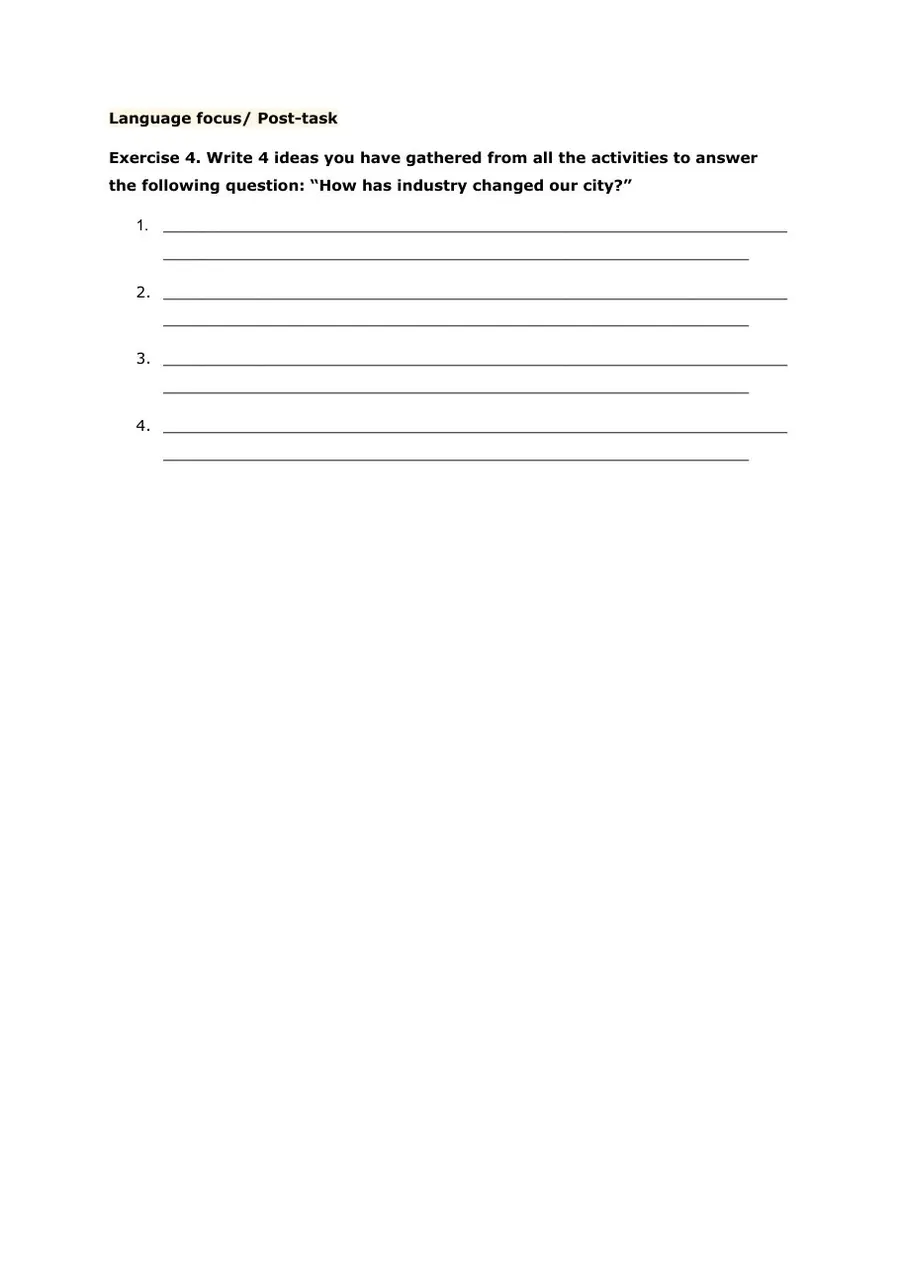
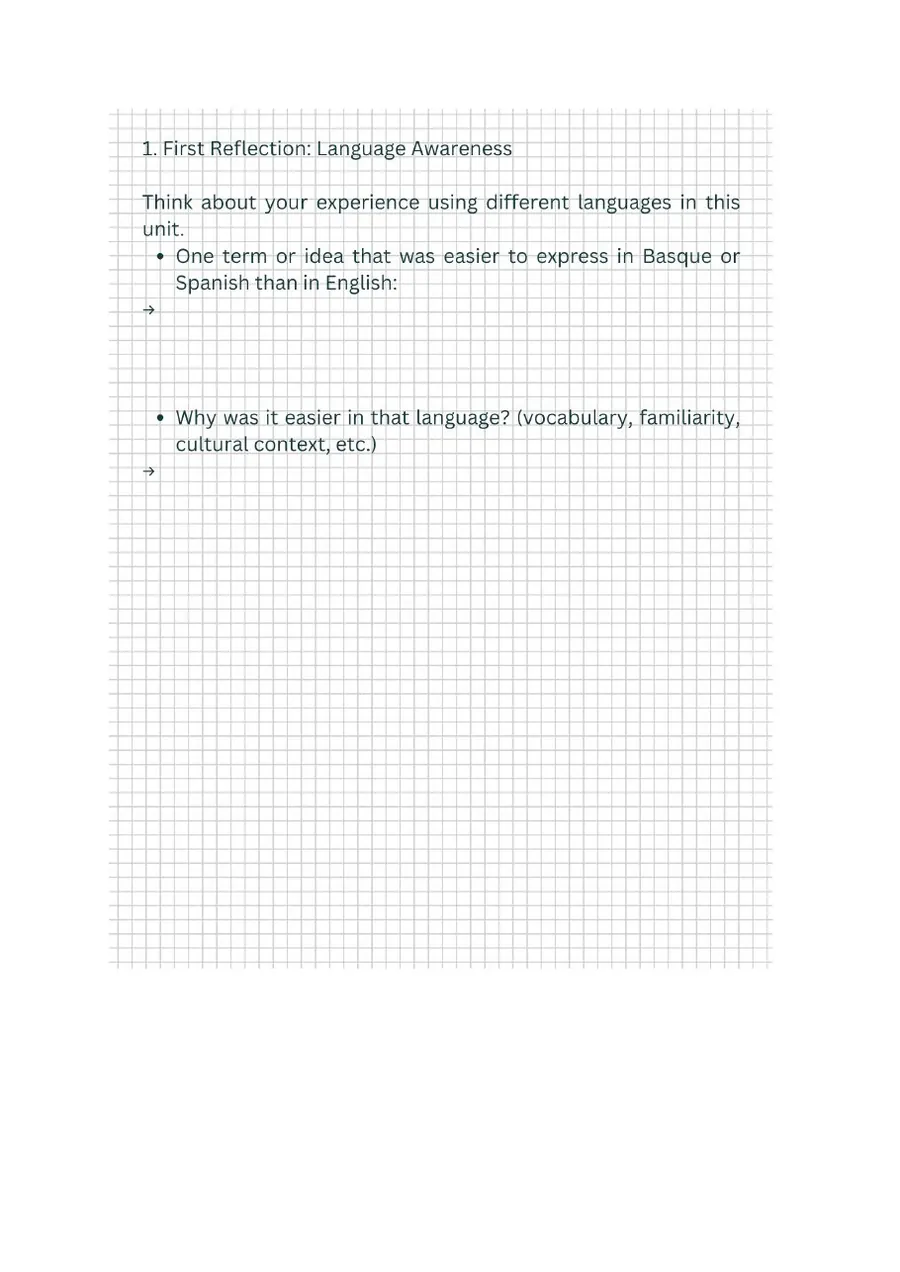
In the final stage, students participate in a whole-class brainstorming activity addressing the question of how industry has shaped their city, after individually identifying key ideas linking historical transformation to local identity and daily life. The session concludes with the formation of heterogeneous working groups for the project and the completion of an initial reflection journal entry, promoting metacognition and learner autonomy.
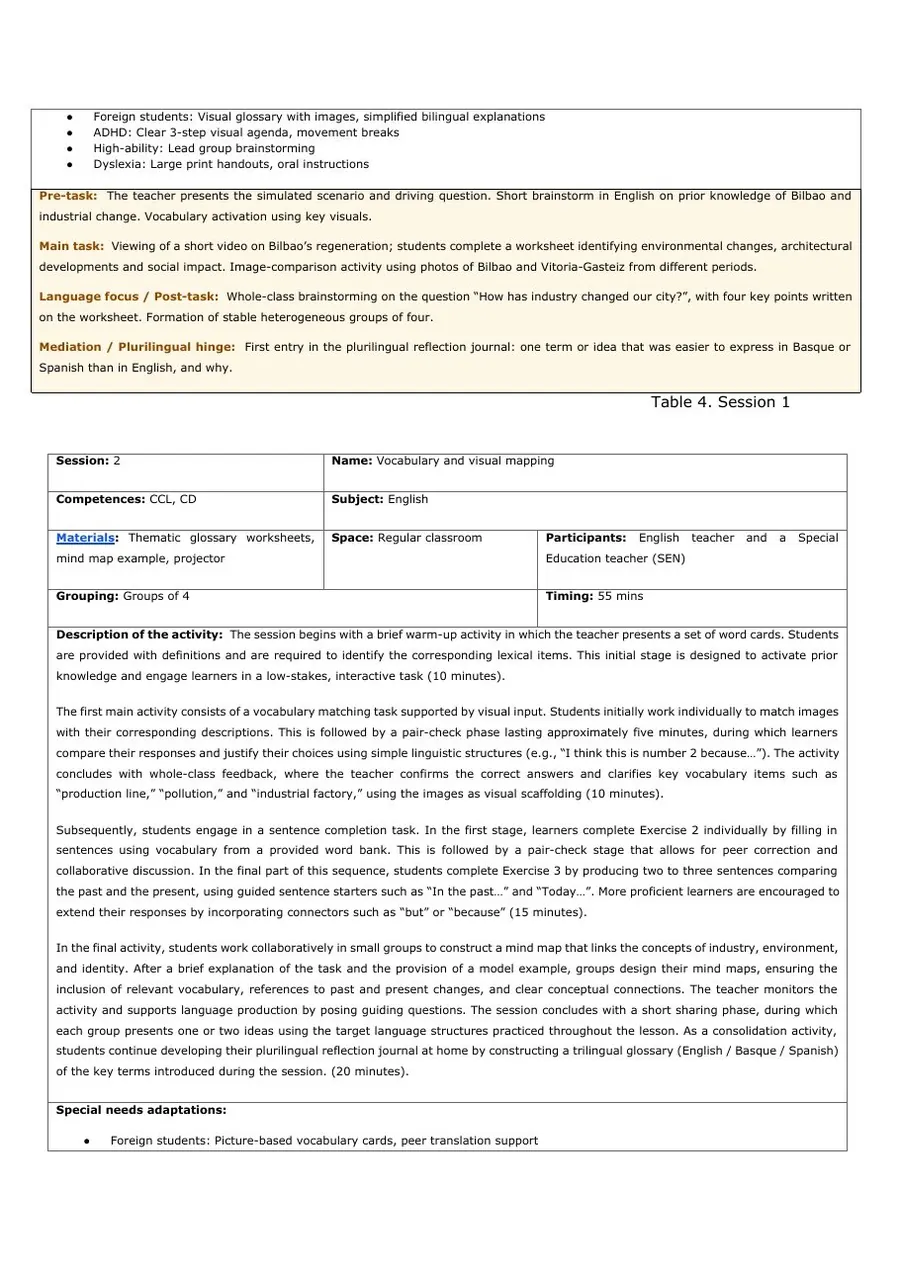
Session 2: Vocabulary and Visual Mapping (English)
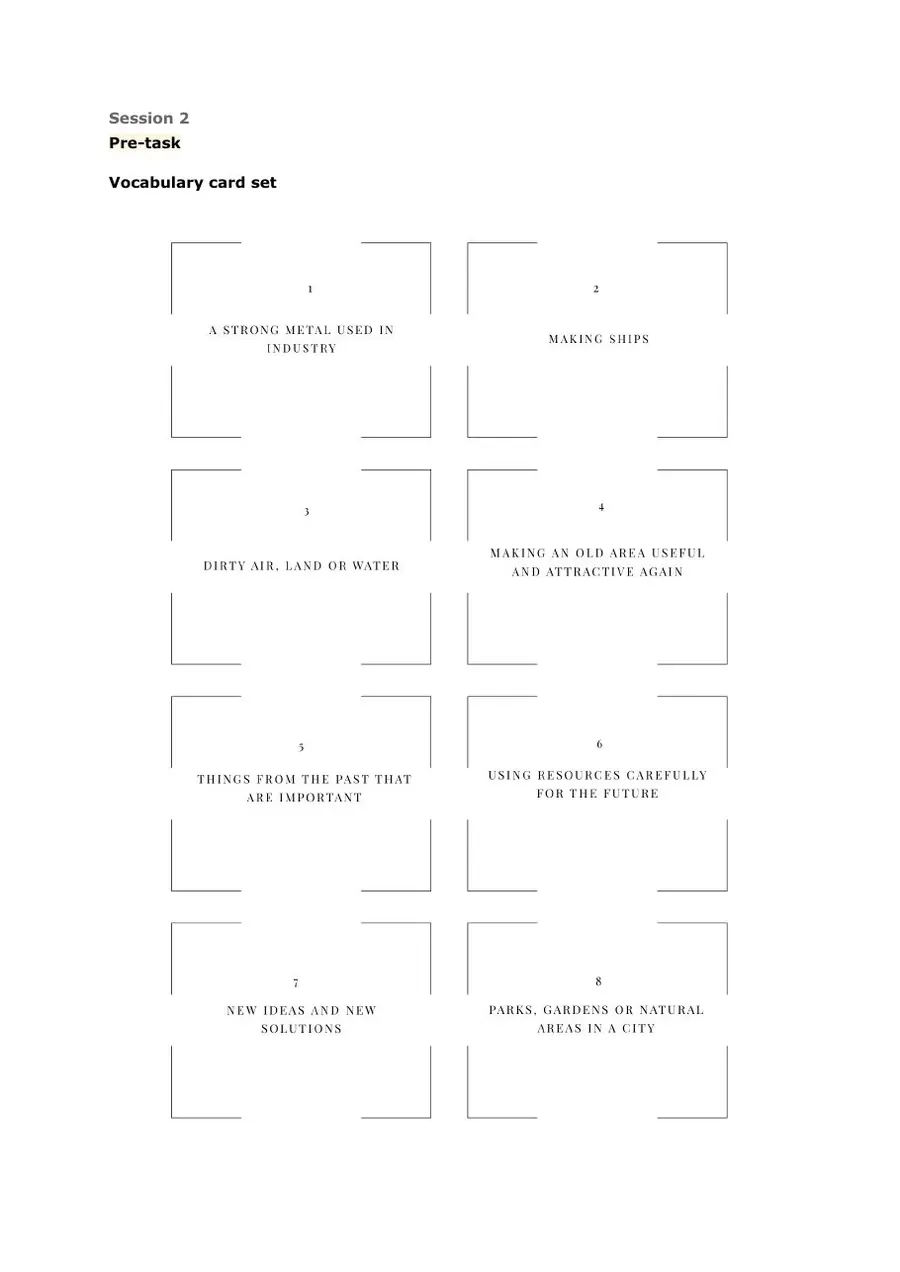
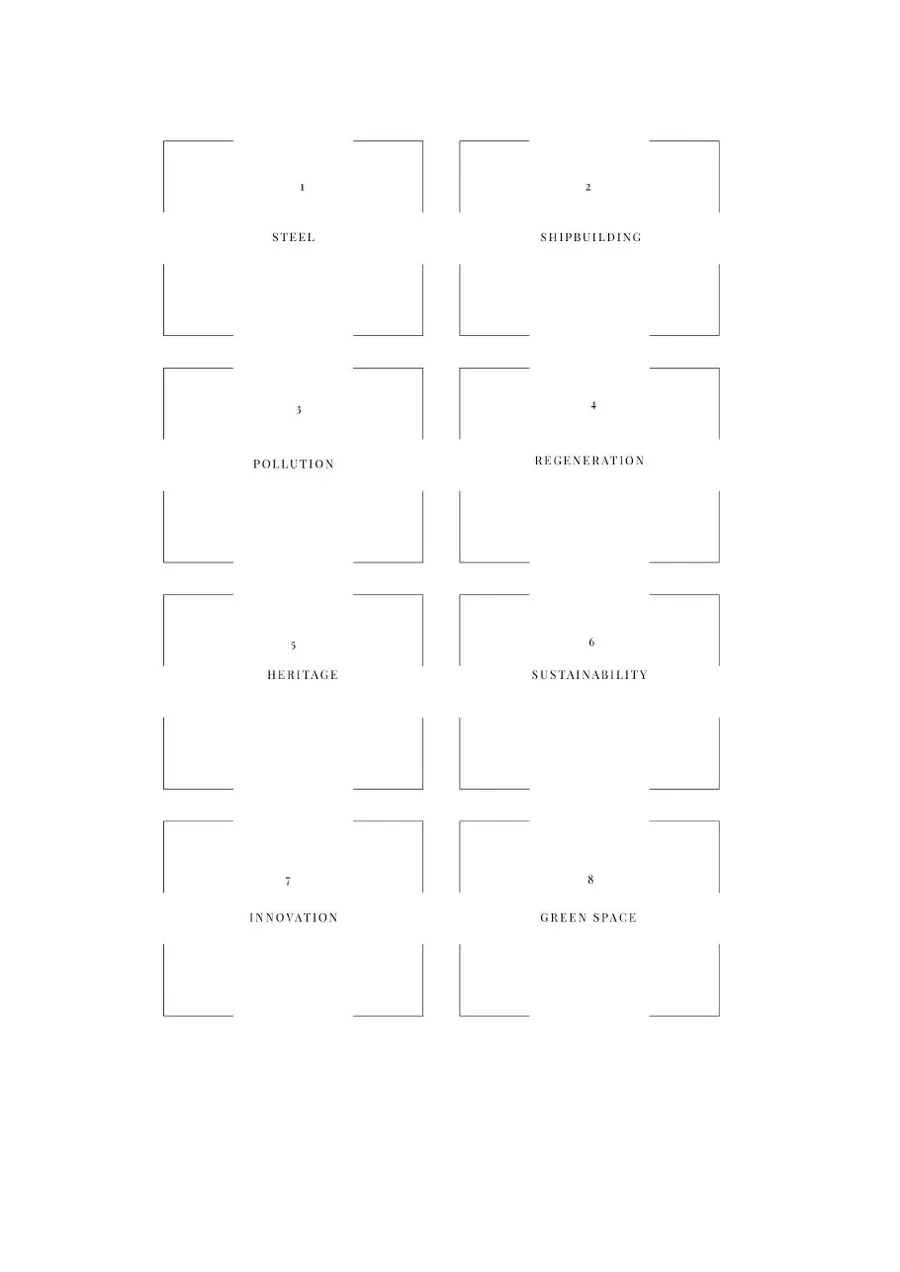
The session begins with a brief warm-up activity aimed at activating students’ prior knowledge through a vocabulary recognition task. Learners are presented with definitions and are required to identify the corresponding words, fostering engagement and initial language activation.
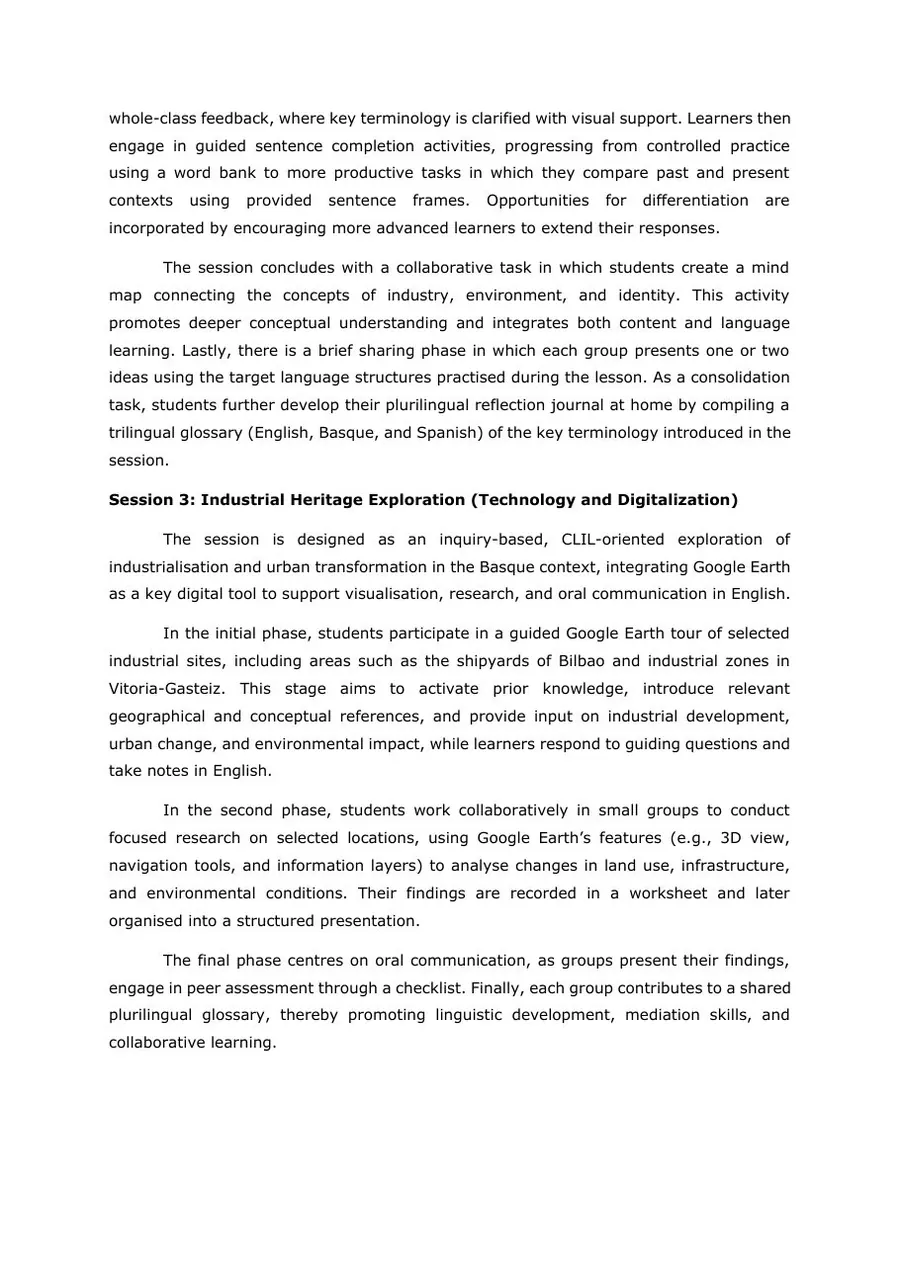
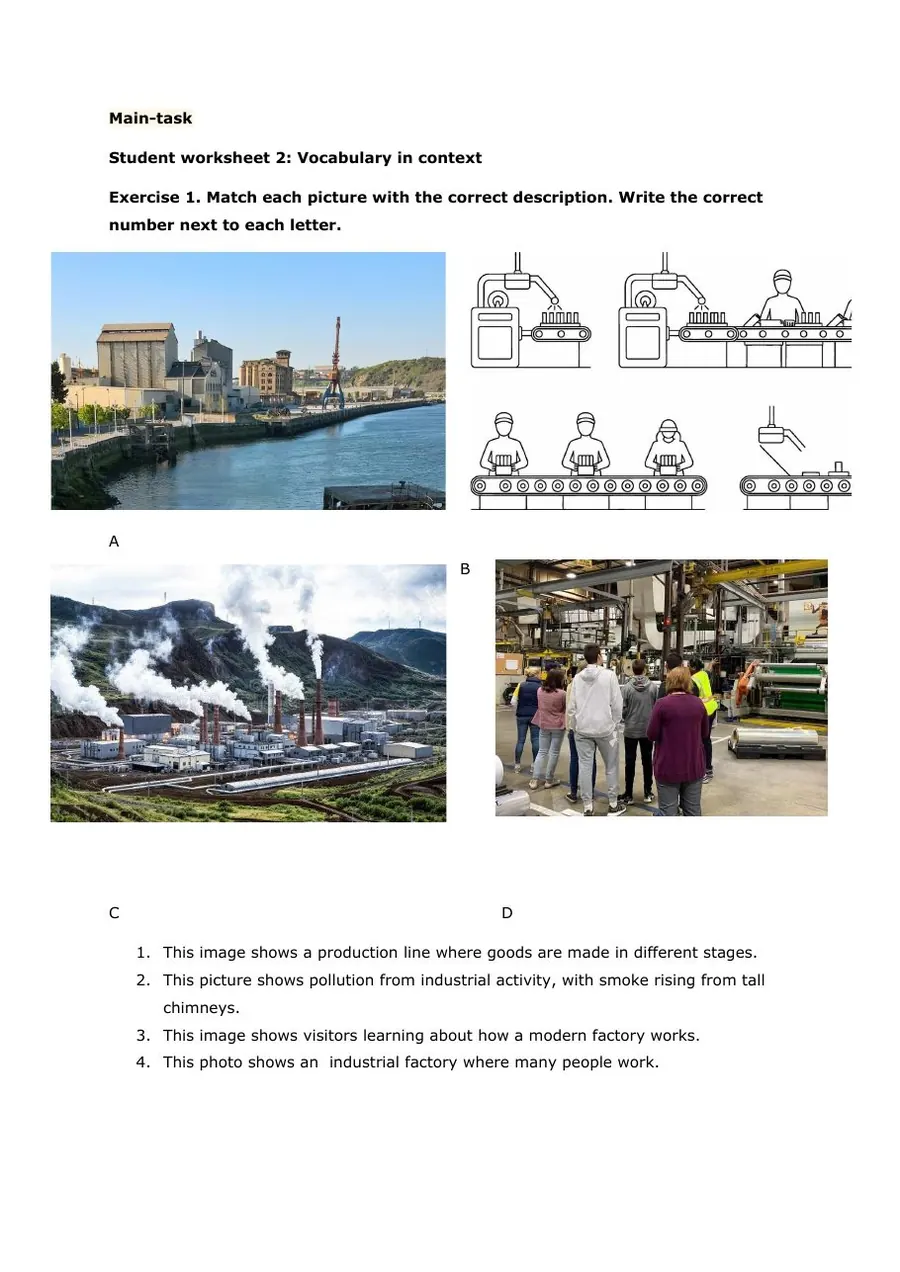
The core of the lesson focuses on vocabulary development and structured language practice. Students first complete an image-based matching task individually, followed by peer interaction to compare and justify their answers. This stage is reinforced through whole-class feedback, where key terminology is clarified with visual support. Learners then engage in guided sentence completion activities, progressing from controlled practice using a word bank to more productive tasks in which they compare past and present contexts using provided sentence frames. Opportunities for differentiation are incorporated by encouraging more advanced learners to extend their responses.
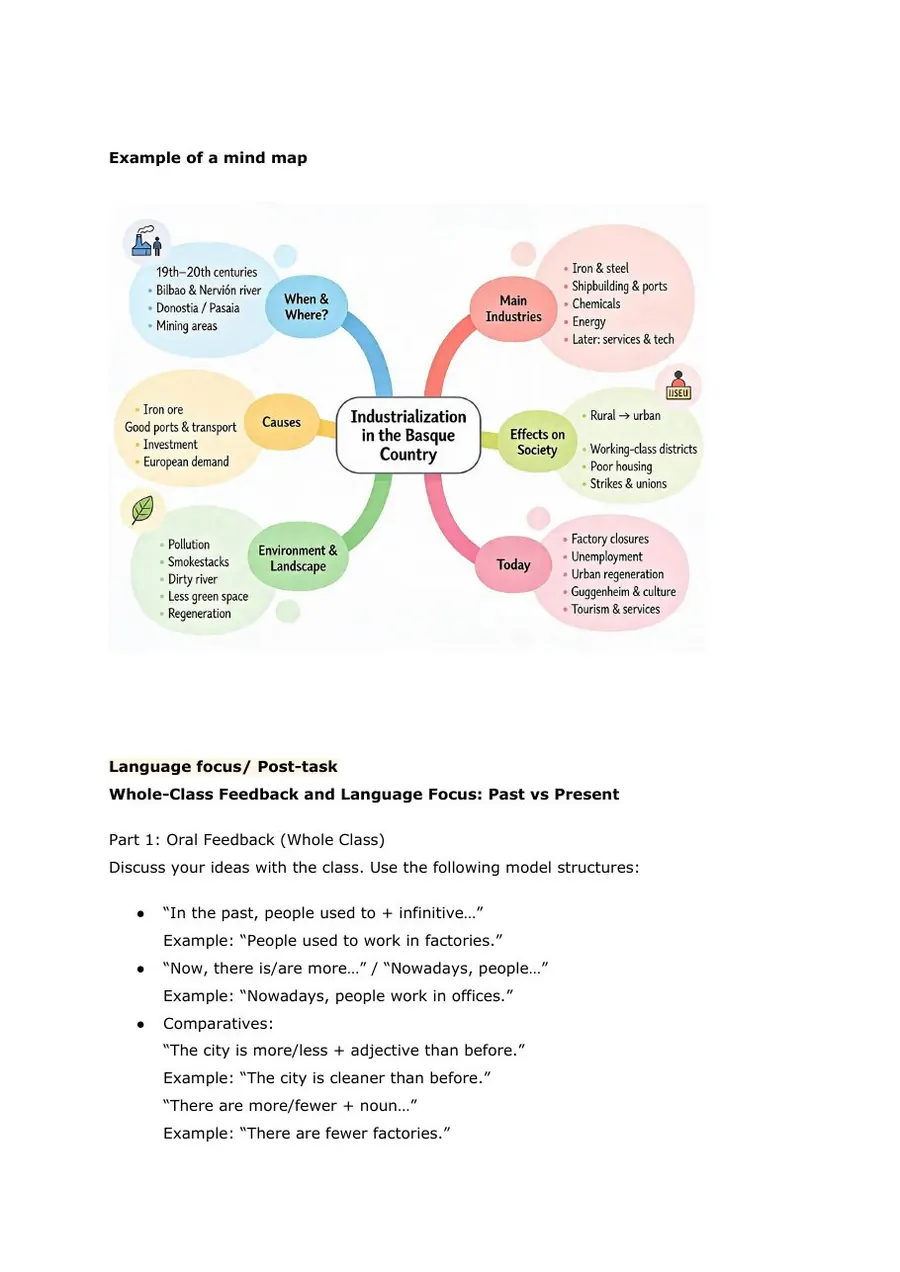
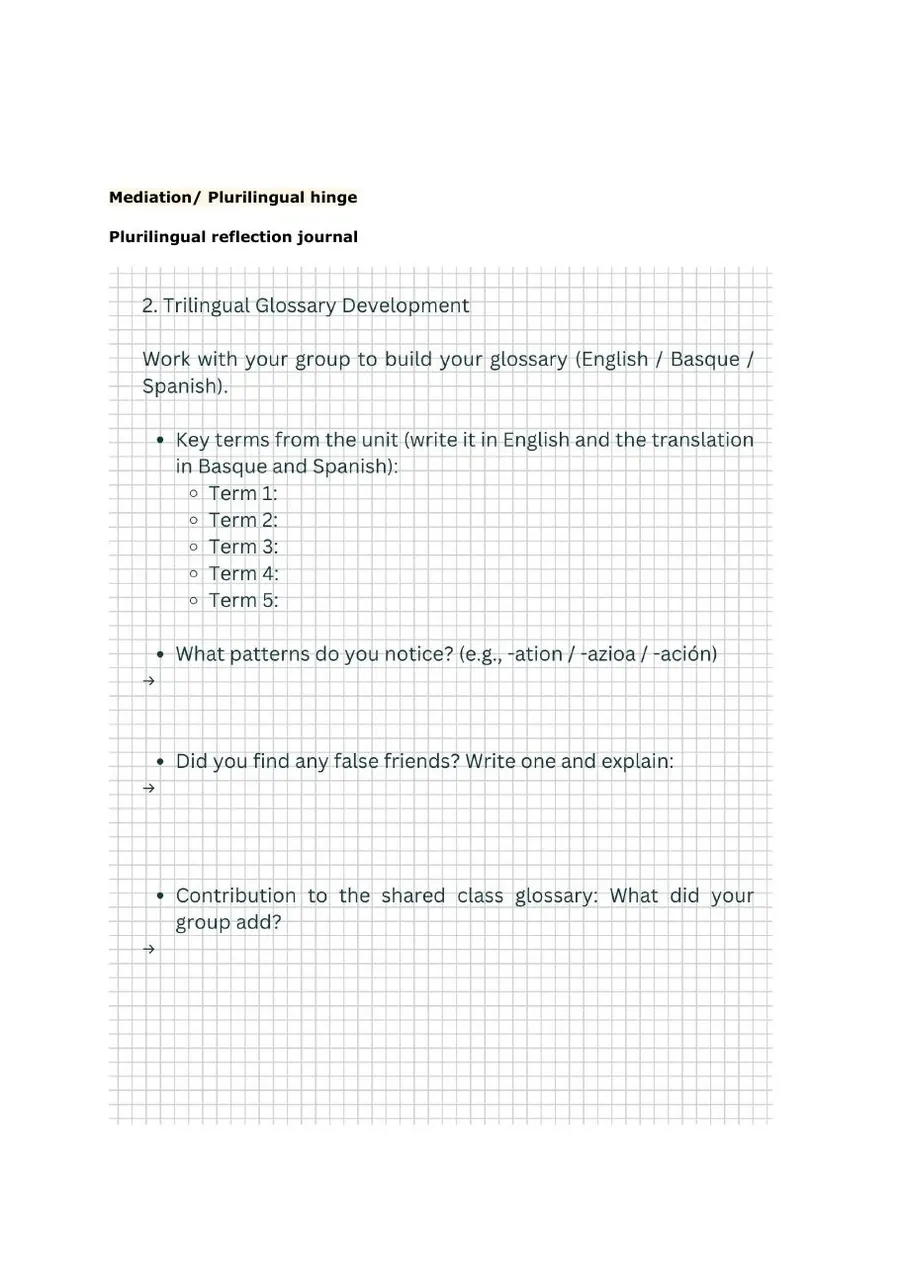
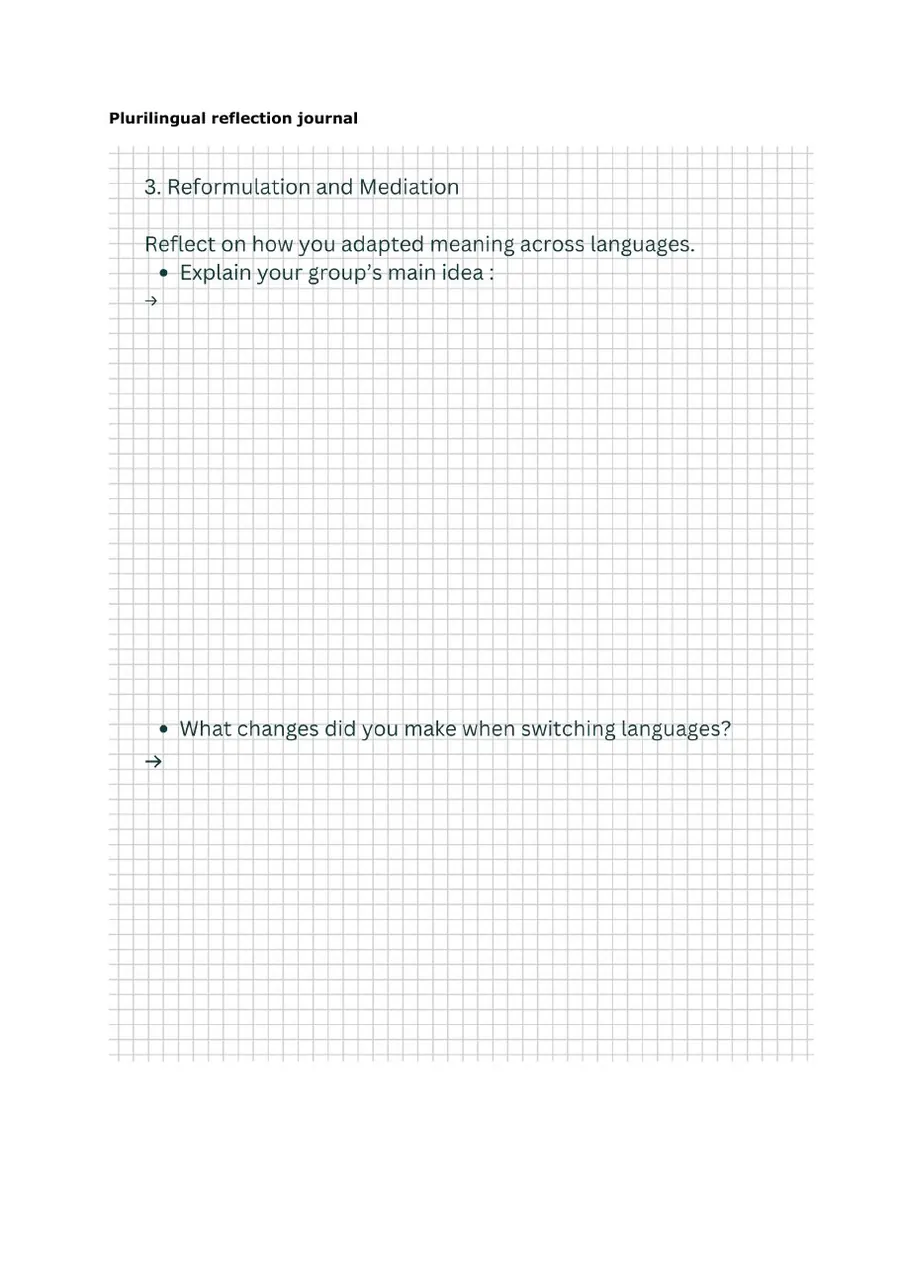
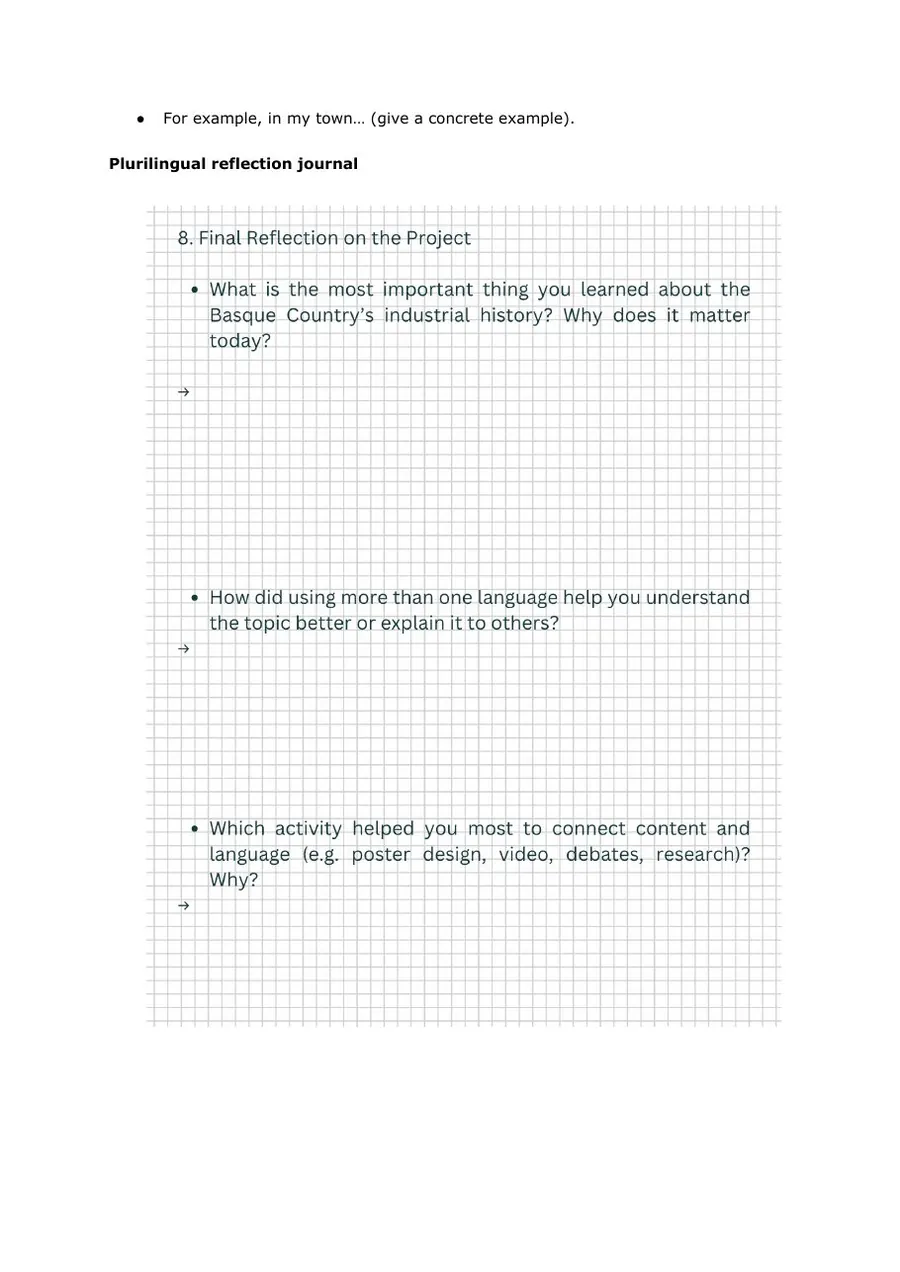
The session concludes with a collaborative task in which students create a mind map connecting the concepts of industry, environment, and identity. This activity promotes deeper conceptual understanding and integrates both content and language learning. Lastly, there is a brief sharing phase in which each group presents one or two ideas using the target language structures practised during the lesson. As a consolidation task, students further develop their plurilingual reflection journal at home by compiling a trilingual glossary (English, Basque, and Spanish) of the key terminology introduced in the session.
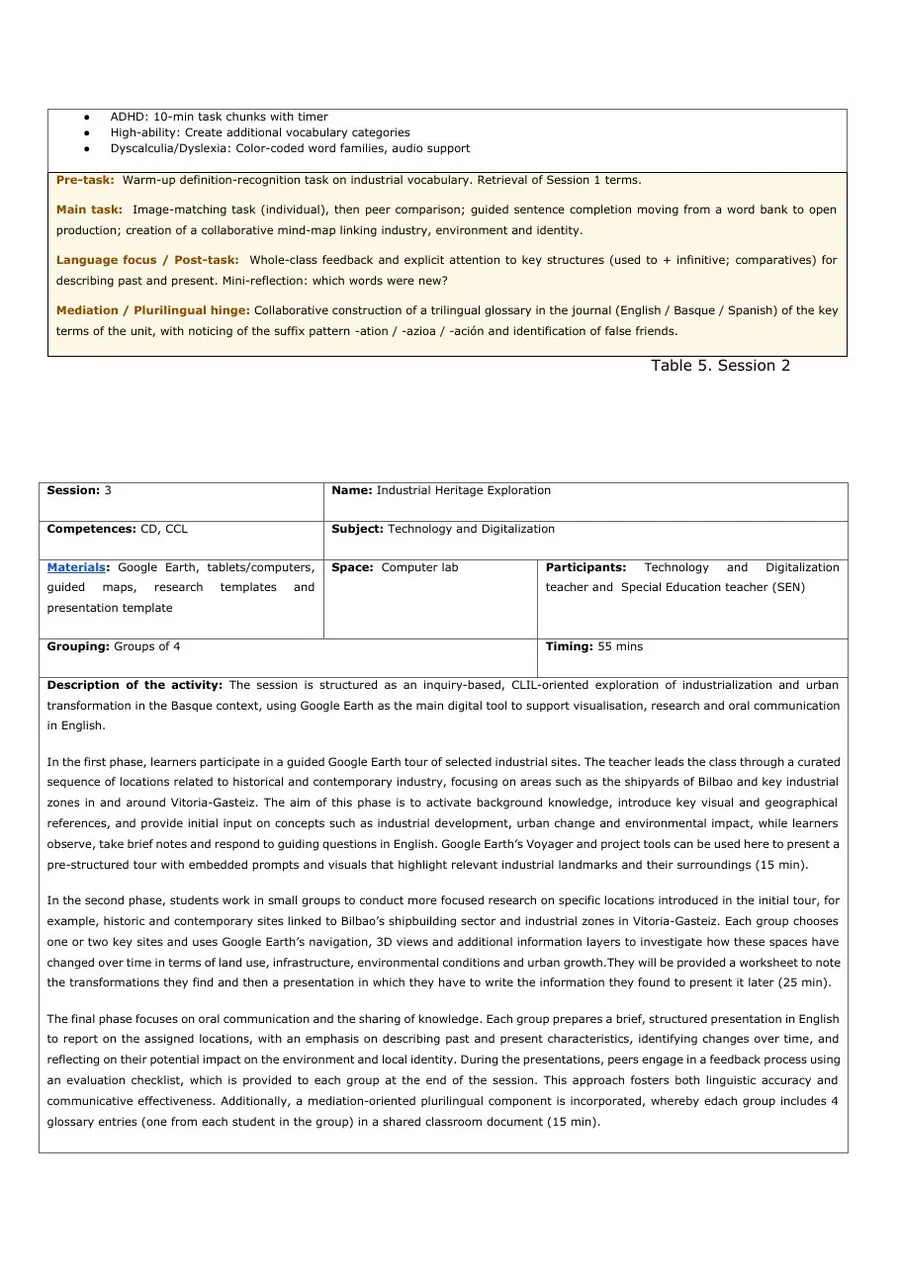
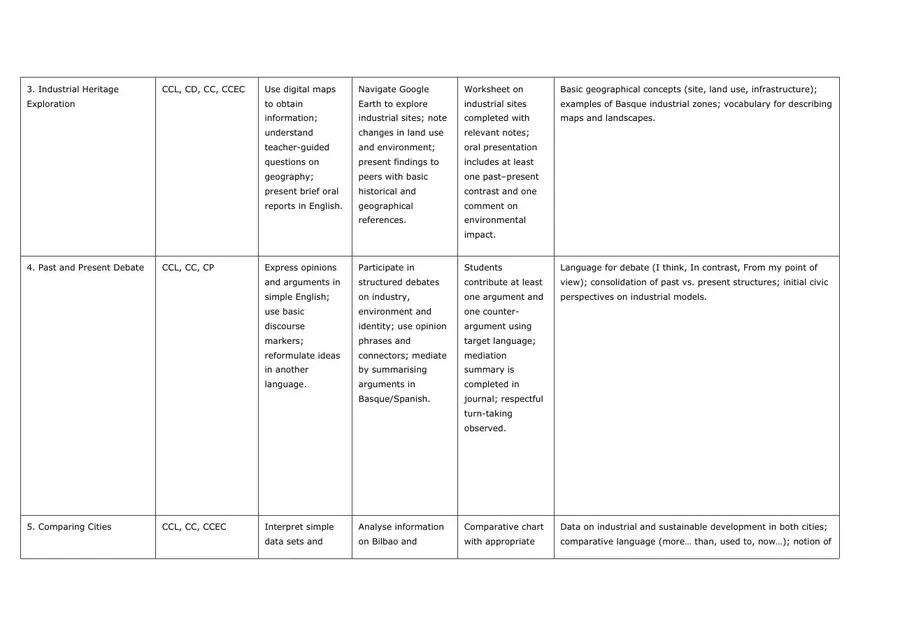
Session 3: Industrial Heritage Exploration (Technology and Digitalization)
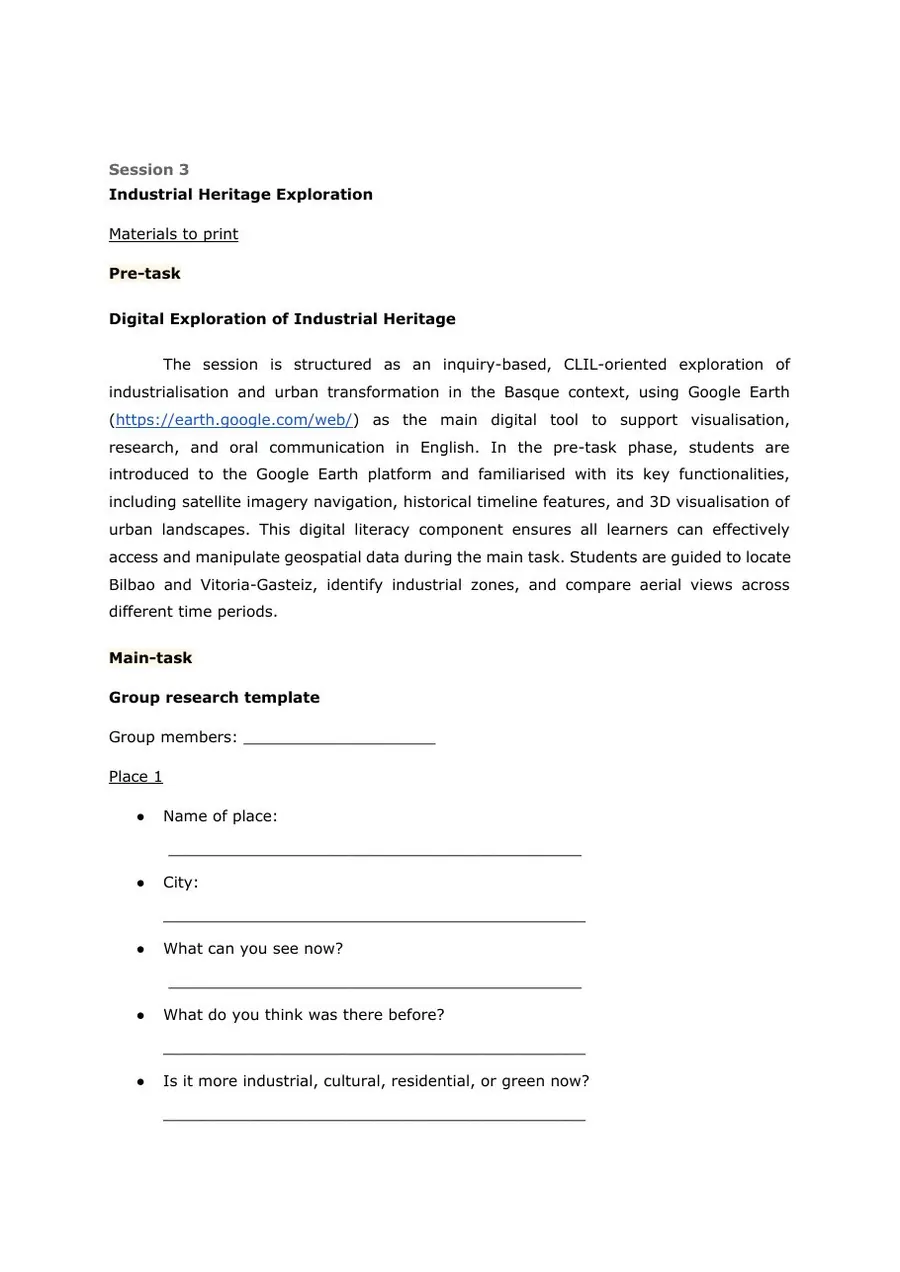
The session is designed as an inquiry-based, CLIL-oriented exploration of industrialisation and urban transformation in the Basque context, integrating Google Earth as a key digital tool to support visualisation, research, and oral communication in English.
In the initial phase, students participate in a guided Google Earth tour of selected industrial sites, including areas such as the shipyards of Bilbao and industrial zones in Vitoria-Gasteiz. This stage aims to activate prior knowledge, introduce relevant geographical and conceptual references, and provide input on industrial development, urban change, and environmental impact, while learners respond to guiding questions and take notes in English.
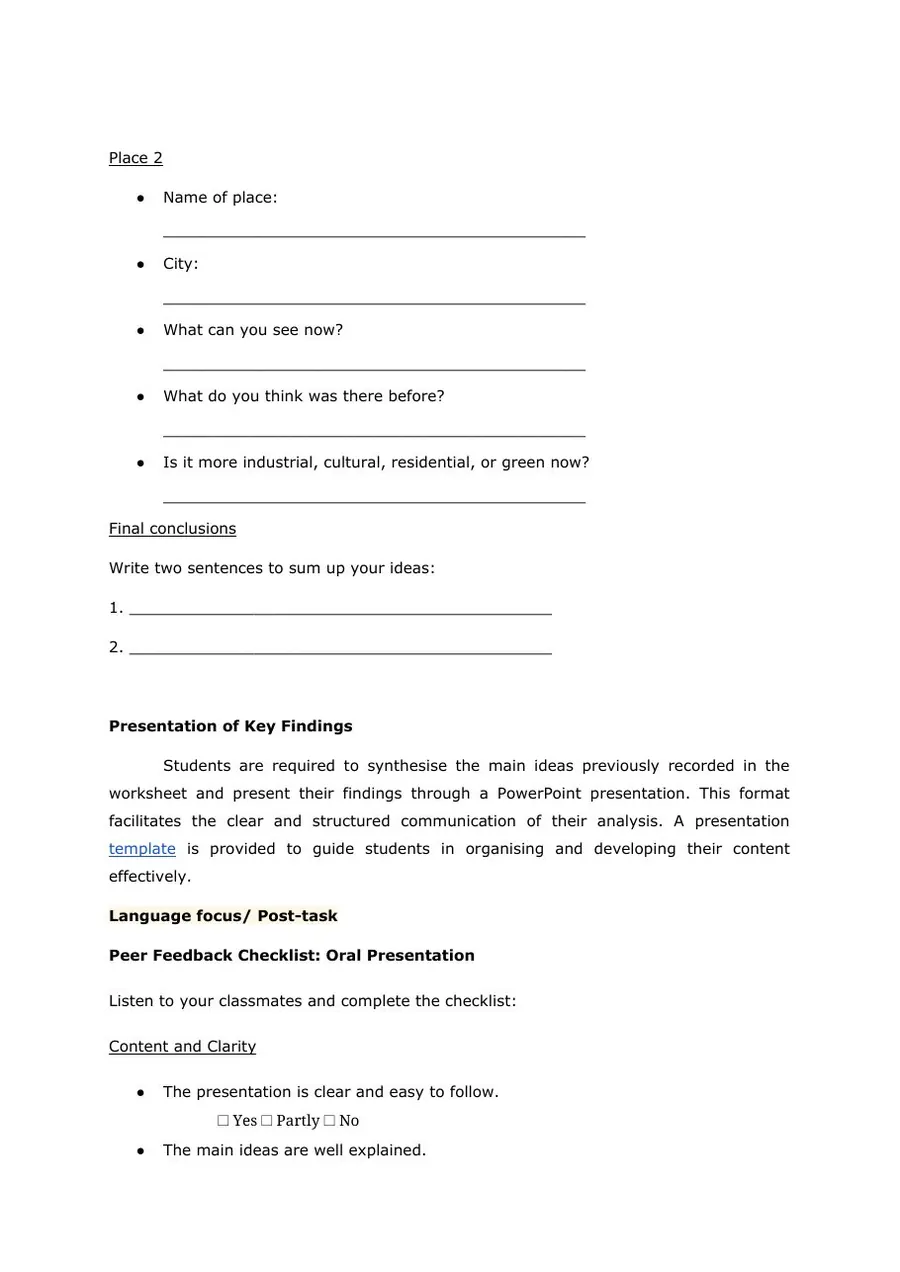
In the second phase, students work collaboratively in small groups to conduct focused research on selected locations, using Google Earth’s features (e.g., 3D view, navigation tools, and information layers) to analyse changes in land use, infrastructure, and environmental conditions. Their findings are recorded in a worksheet and later organised into a structured presentation.
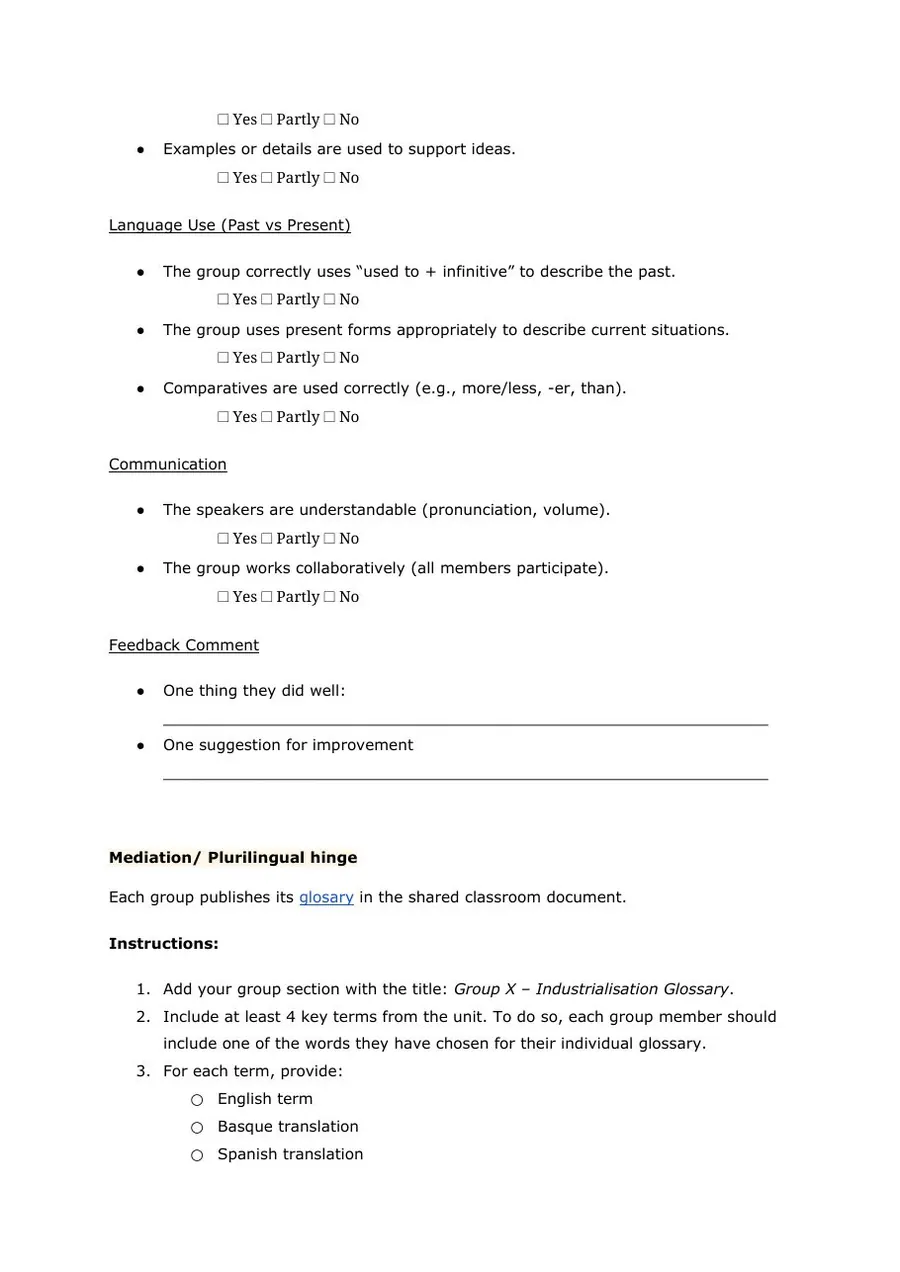
The final phase centres on oral communication, as groups present their findings, engage in peer assessment through a checklist. Finally, each group contributes to a shared plurilingual glossary, thereby promoting linguistic development, mediation skills, and collaborative learning.
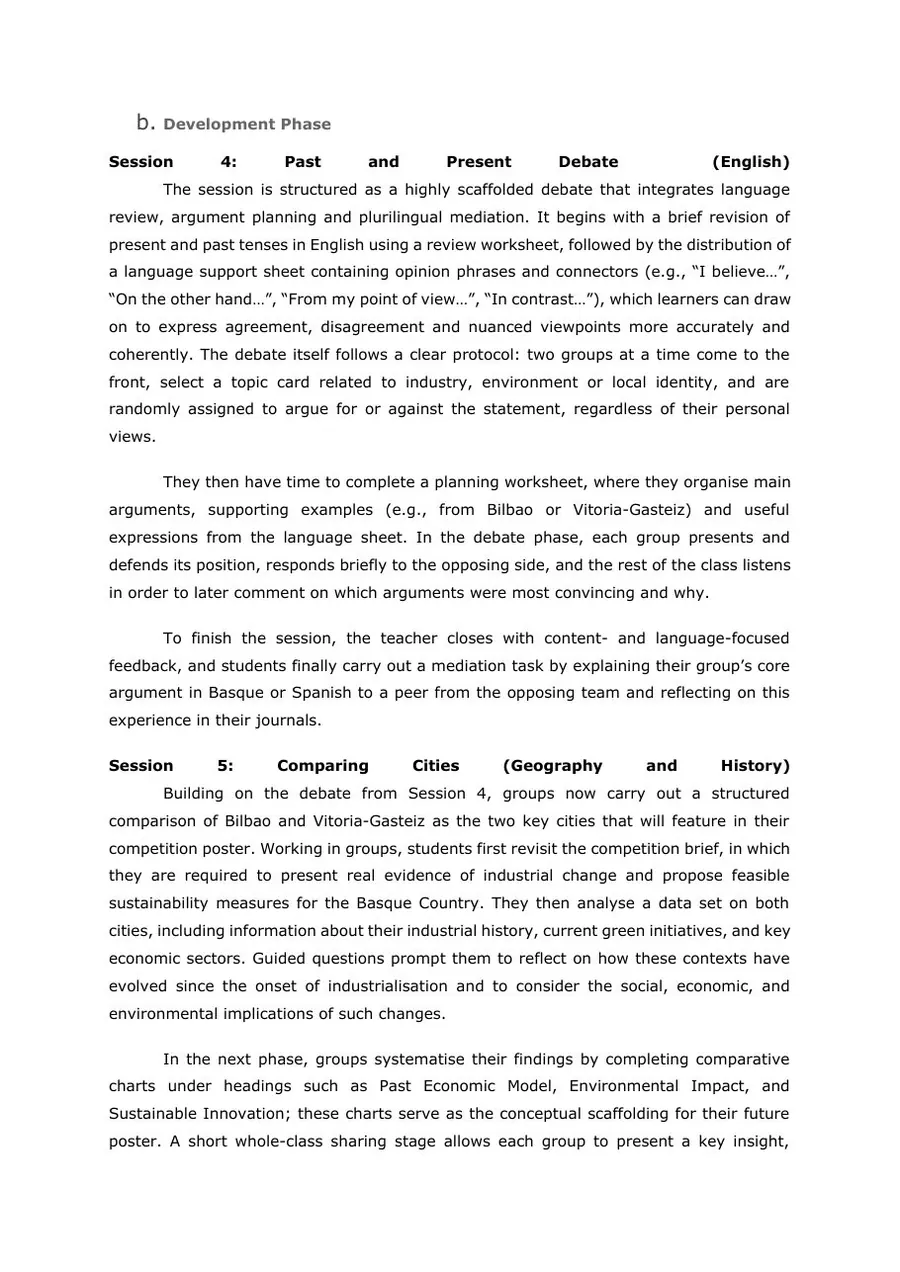
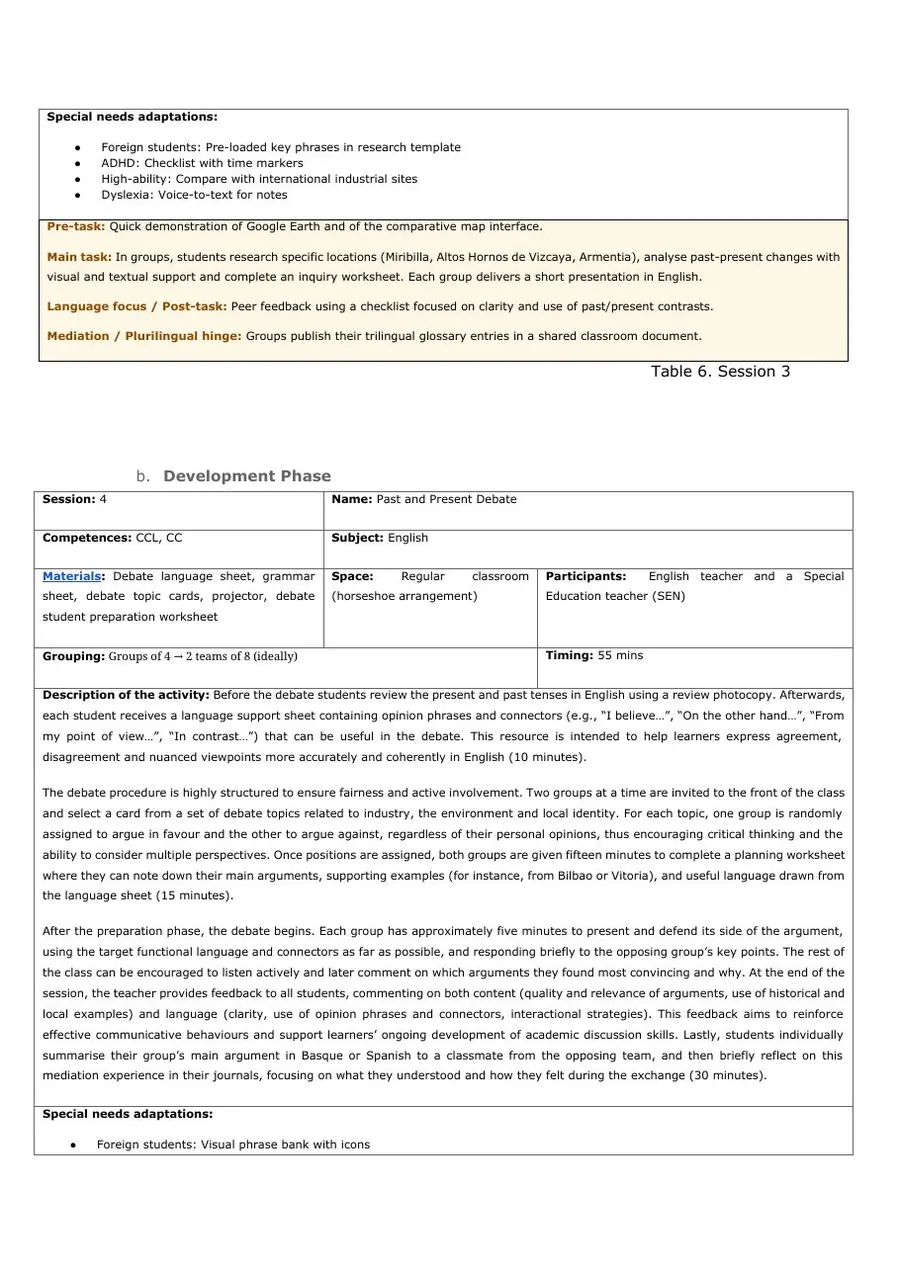
Session 4: Past and Present Debate (English)
The session is structured as a highly scaffolded debate that
integrates language review, argument planning and plurilingual
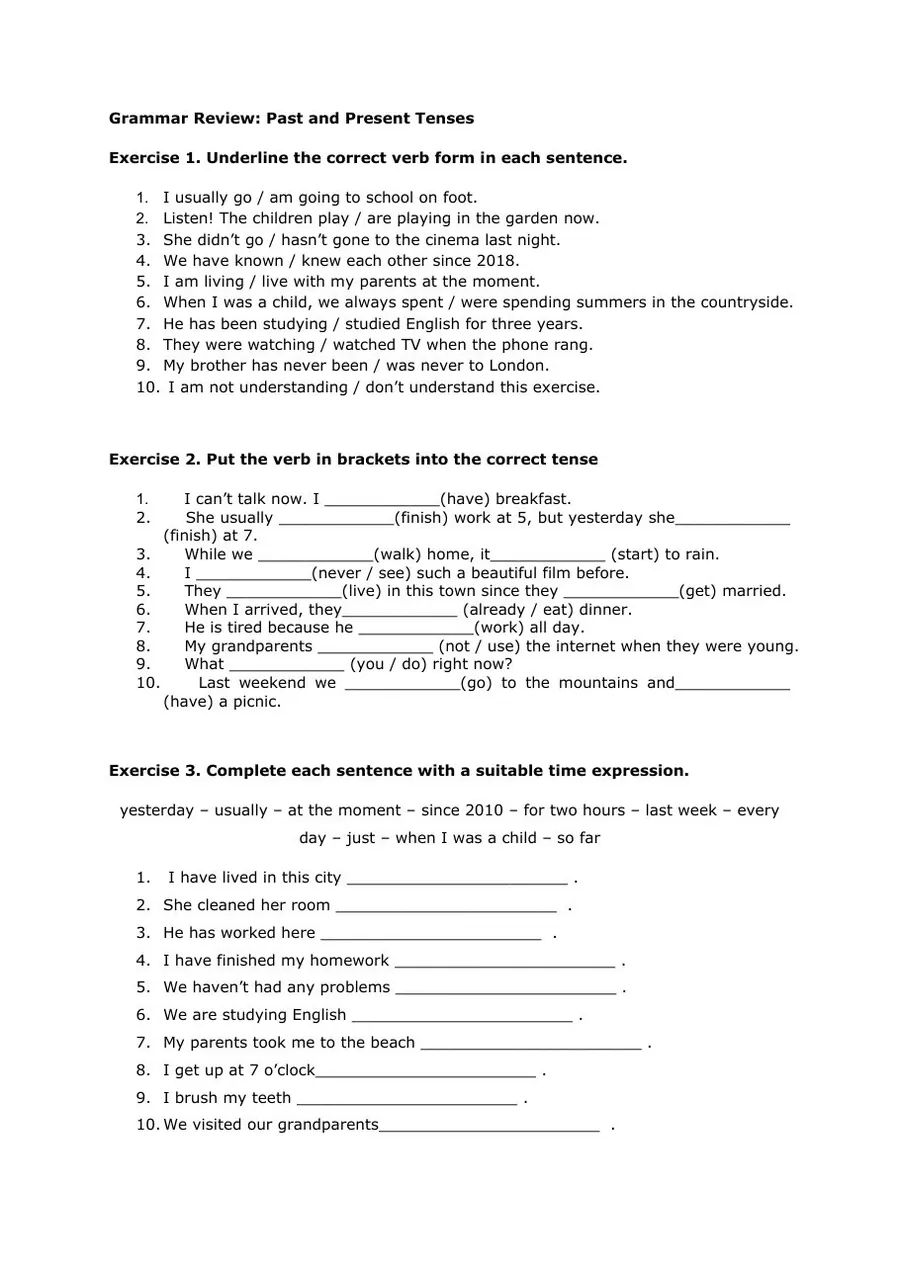
mediation. It begins with a brief revision of present and past tenses in
English using a review worksheet, followed by the distribution of a
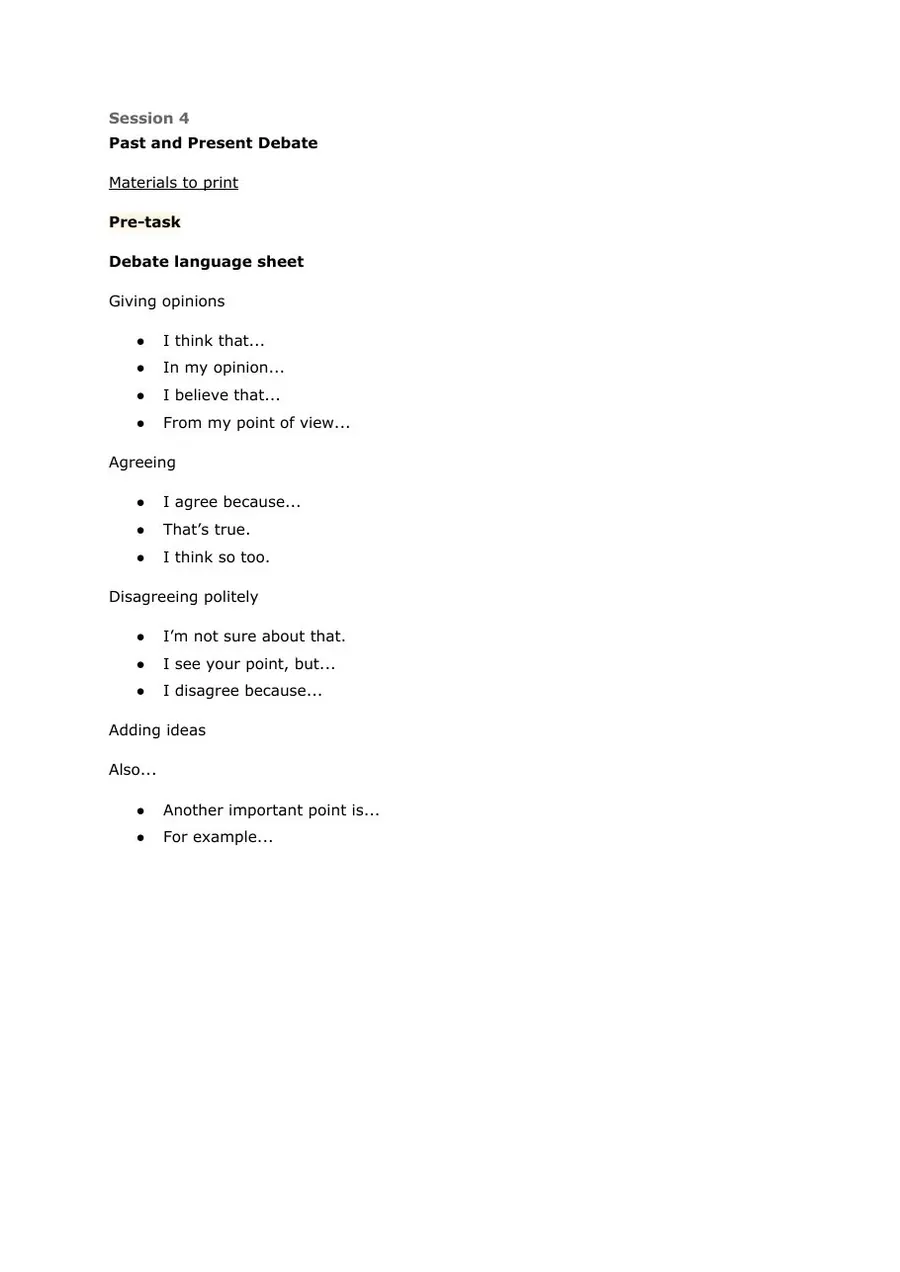
language support sheet containing opinion phrases and connectors (e.g.,
“I believe…”, “On the other hand…”, “From my point of view…”, “In
contrast…”), which learners can draw on to express agreement,
disagreement and nuanced viewpoints more accurately and coherently. The
debate itself follows a clear protocol: two groups at a time come to the
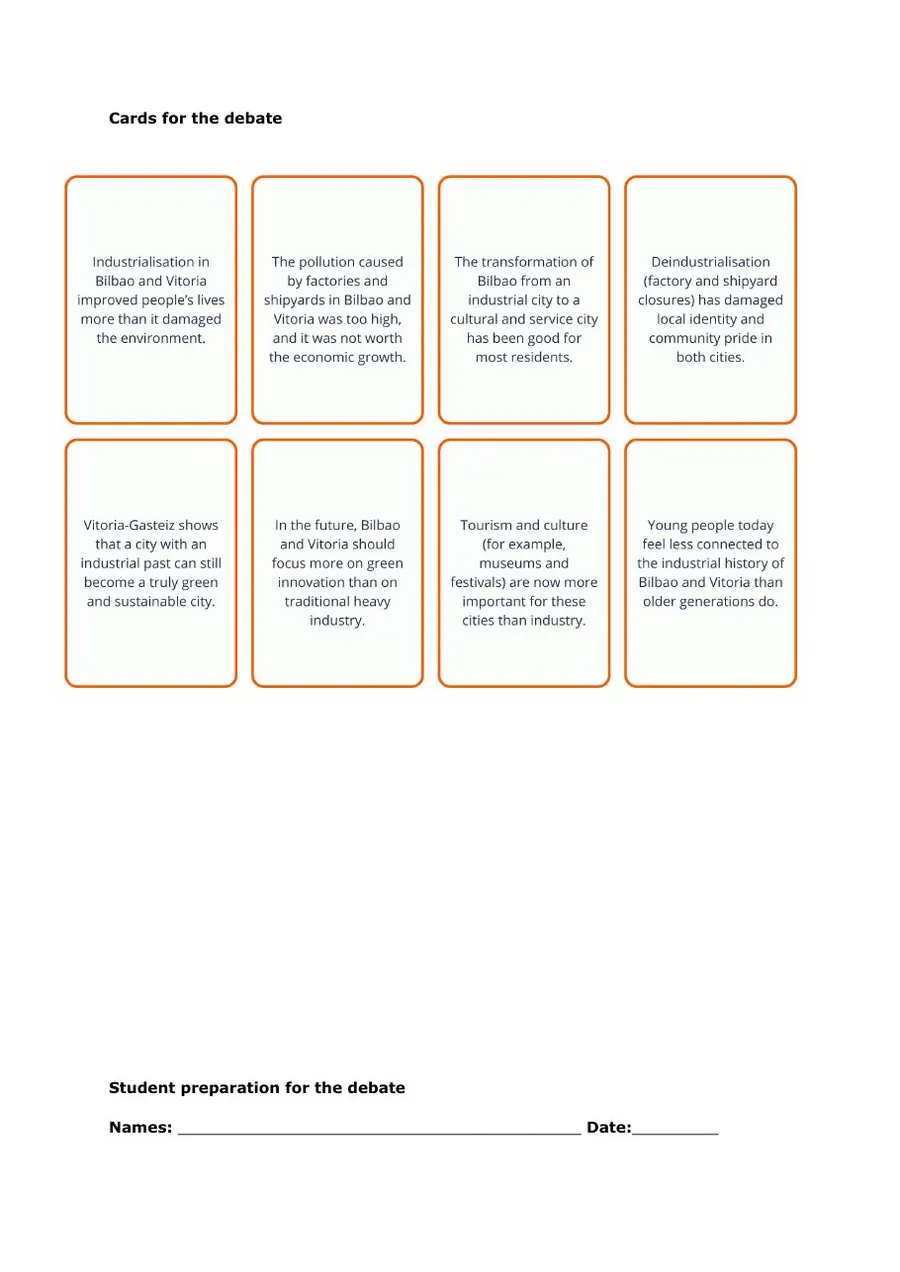
front, select a topic card related to industry, environment or local
identity, and are randomly assigned to argue for or against the
statement, regardless of their personal views.
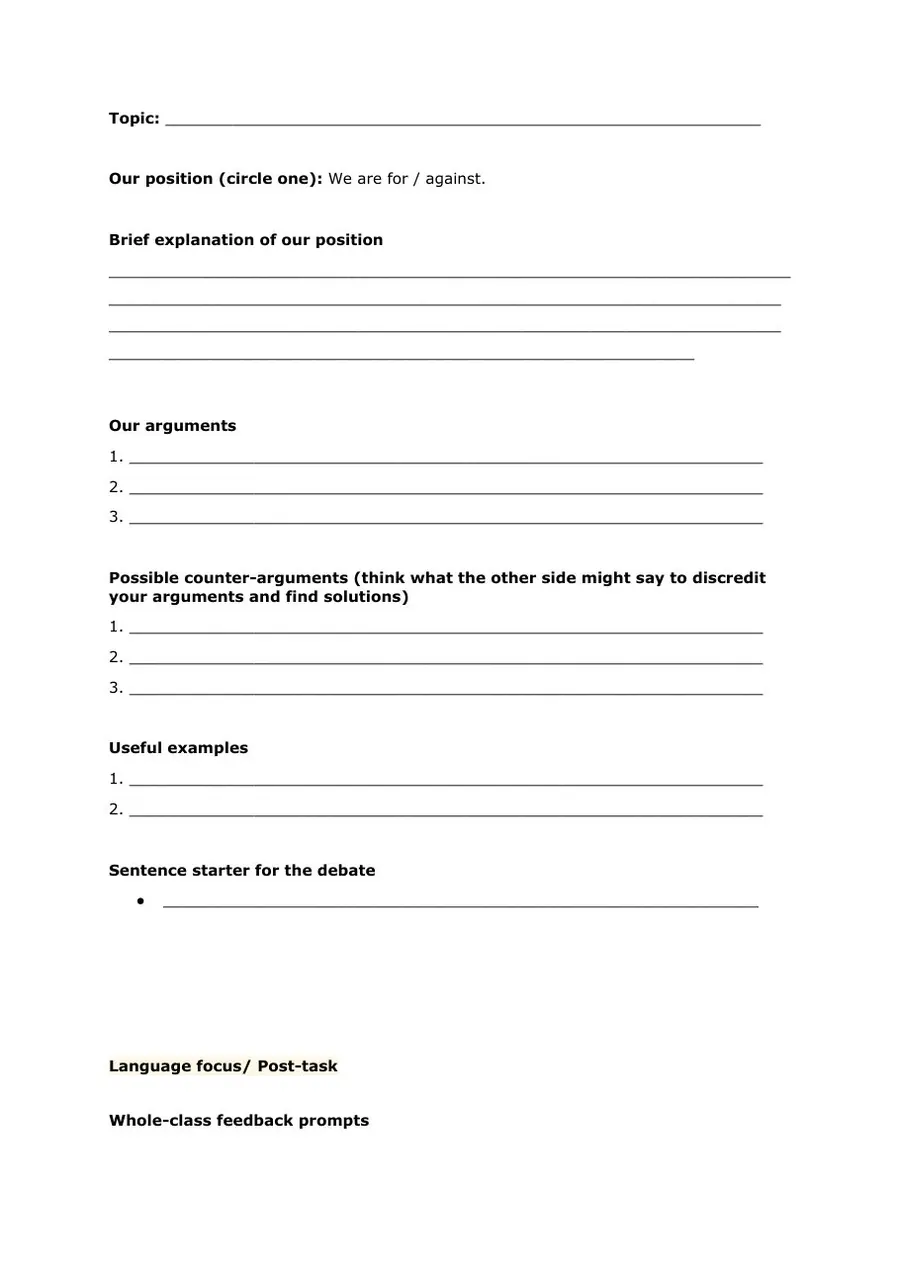
They then have time to complete a planning worksheet, where they organise main arguments, supporting examples (e.g., from Bilbao or Vitoria-Gasteiz) and useful expressions from the language sheet. In the debate phase, each group presents and defends its position, responds briefly to the opposing side, and the rest of the class listens in order to later comment on which arguments were most convincing and why.
To finish the session, the teacher closes with content- and language-focused feedback, and students finally carry out a mediation task by explaining their group’s core argument in Basque or Spanish to a peer from the opposing team and reflecting on this experience in their journals.
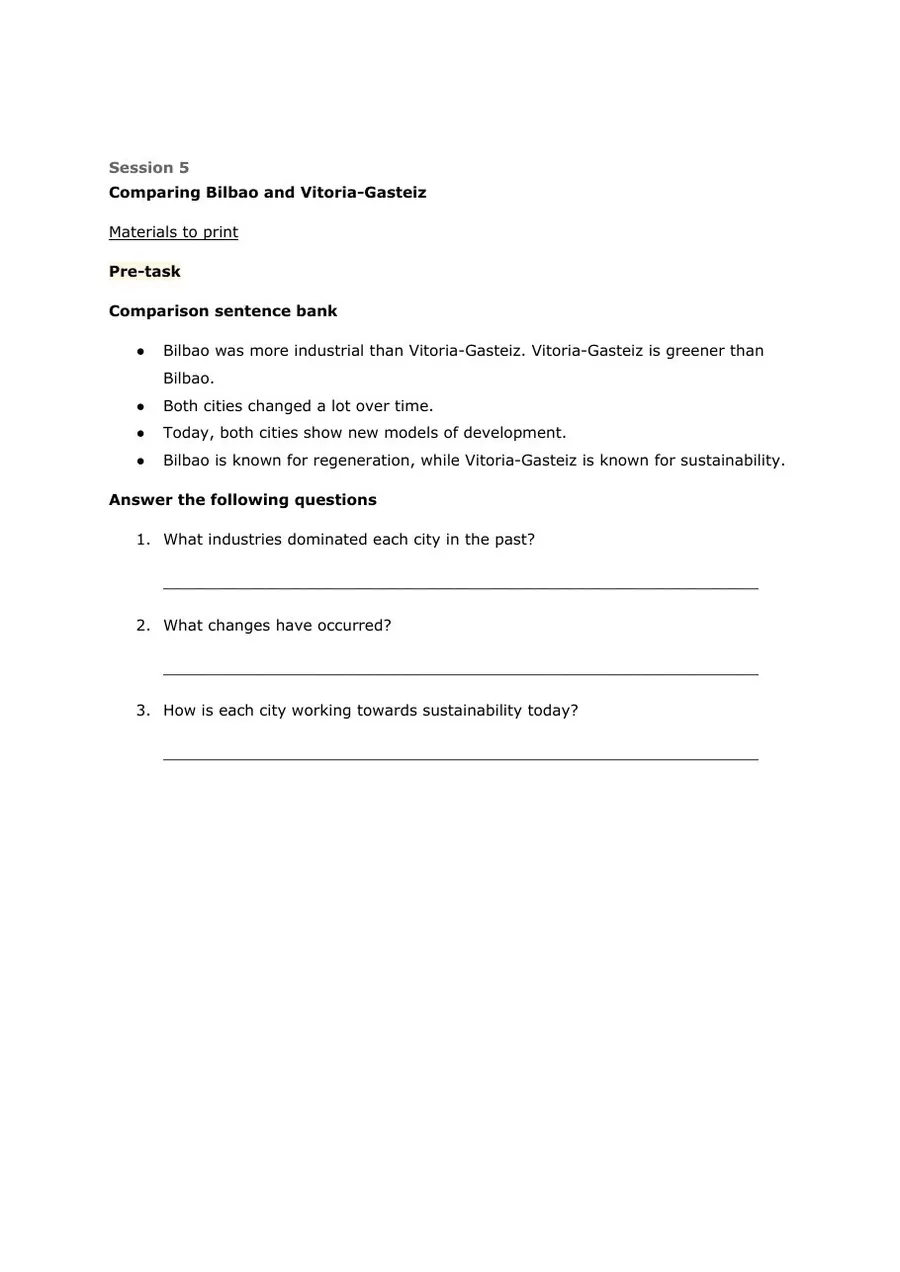
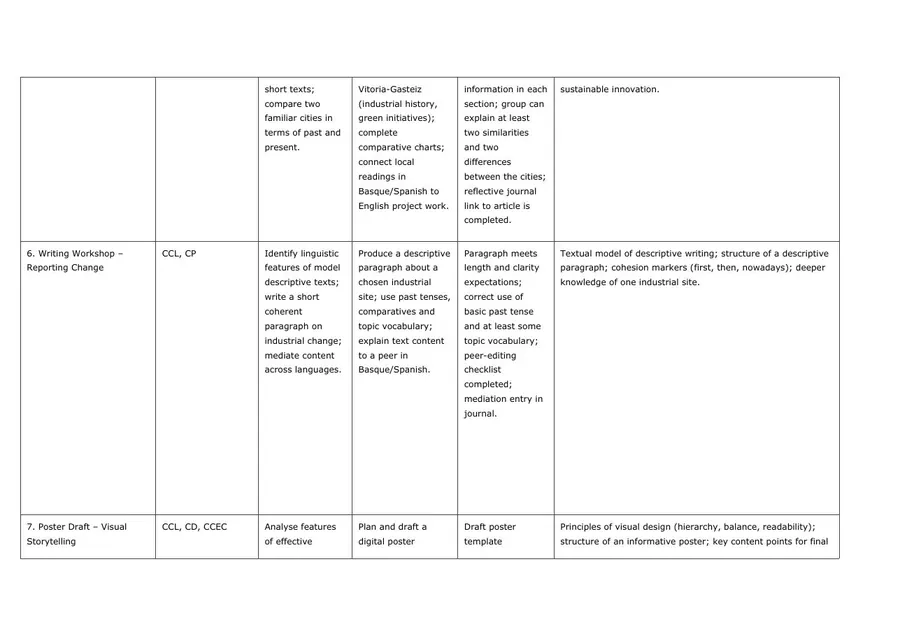
Session 5: Comparing Cities (Geography and History)
Building on the debate from Session 4, groups now carry out a
structured comparison of Bilbao and Vitoria-Gasteiz as the two key
cities that will feature in their competition poster. Working in groups,
students first revisit the competition brief, in which they are required
to present real evidence of industrial change and propose feasible
sustainability measures for the Basque Country. They then analyse a data
set on both cities, including information about their industrial
history, current green initiatives, and key economic sectors. Guided
questions prompt them to reflect on how these contexts have evolved
since the onset of industrialisation and to consider the social,
economic, and environmental implications of such changes.
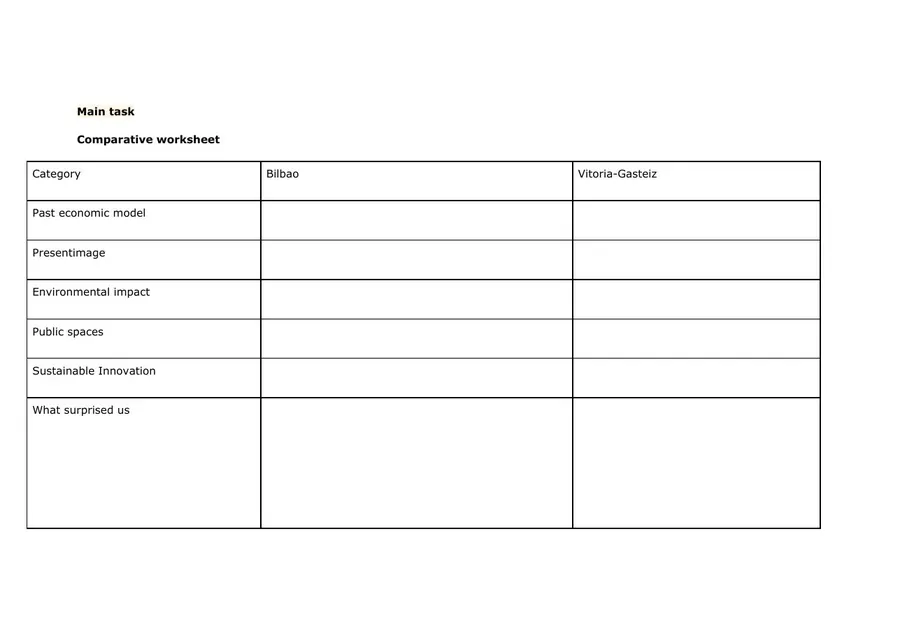
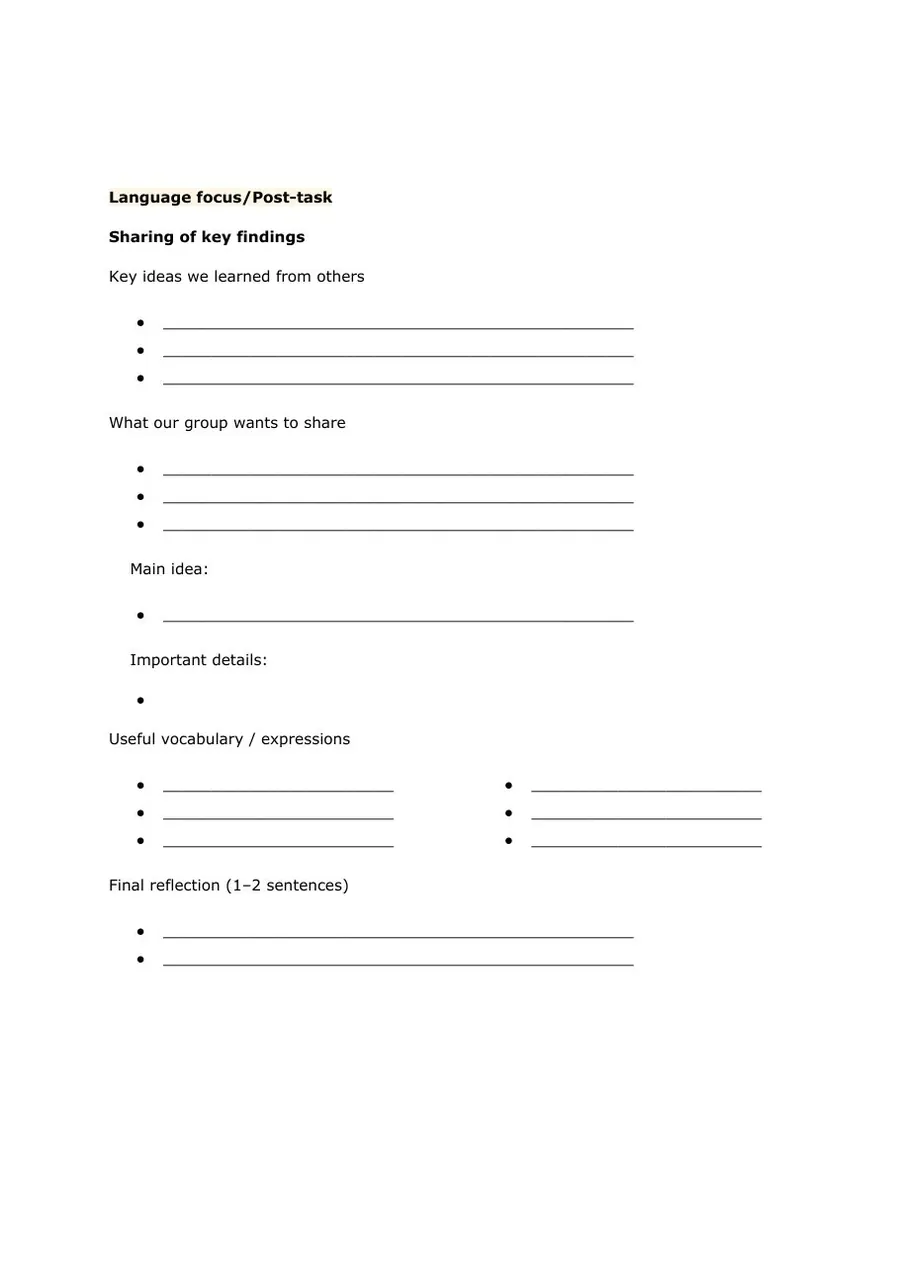
In the next phase, groups systematise their findings by completing comparative charts under headings such as Past Economic Model, Environmental Impact, and Sustainable Innovation; these charts serve as the conceptual scaffolding for their future poster. A short whole-class sharing stage allows each group to present a key insight, reinforcing peer learning and providing opportunities for the teacher to highlight relevant academic vocabulary and useful language structures.
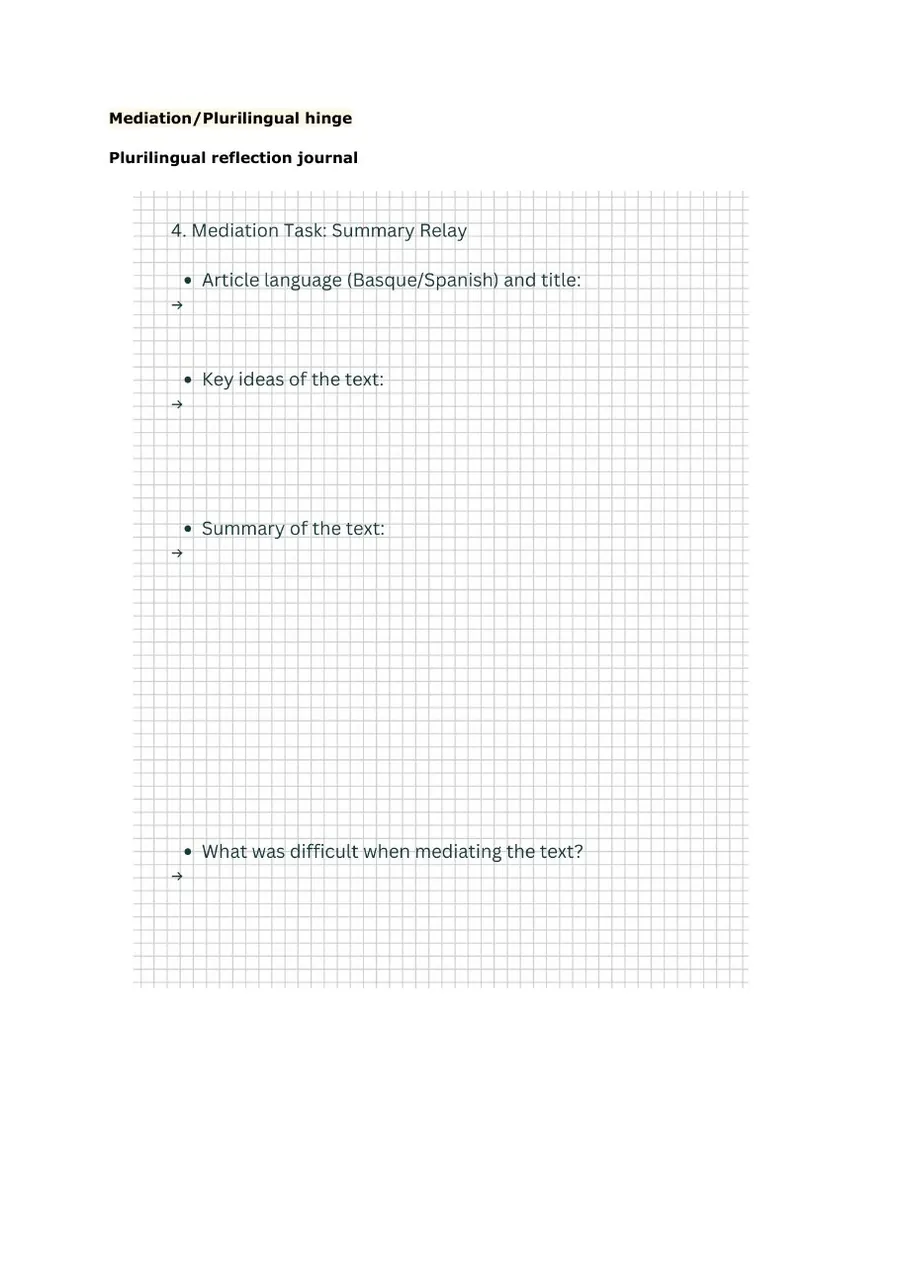
The session concludes with a plurilingual component, as each group selects an article in Basque or Spanish and writes a brief reflective journal entry connecting the reading to their project work.
Session 6: Writing Workshop – Reporting Change
(English)
This session is designed to develop students’ written
production skills for the creation of clear, accurate captions and
explanatory texts for a competition poster on industrial transformation.
It begins with a teacher-led modelling phase, in which learners analyse
two sample descriptive texts about the transformation of industrial
sites in the Basque Country. Through guided discussion, they identify
key linguistic features such as the use of past tenses to describe
former industrial functions, comparative structures to contrast past and
present, and subject-specific vocabulary related to industry, urban
change, and environmental impact. The teacher also draws attention to
effective sentence patterns and cohesive devices that students can
appropriate in their own writing. In the next phase, each student writes
an individual descriptive paragraph on an industrial site of their
choice from Bilbao or Vitoria-Gasteiz, supported by a writing frame that
scaffolds organisation and encourages the integration of target
language. The teacher provides formative feedback focused on clarity,
accuracy, and alignment with the poster’s communicative purpose. The
session ends with a peer-editing activity using a structured checklist,
followed by a plurilingual mediation task in which students explain
their text in English to a partner, reformulate it in Basque or Spanish,
and record the key ideas in their reflection journals.
Session 7: Poster Draft – Visual Storytelling (Technology and
Digitalization)
This session is devoted to guiding students through the initial
design of their competition poster for the “From Iron to Innovation”
project. In the first phase, learners collaboratively analyse two or
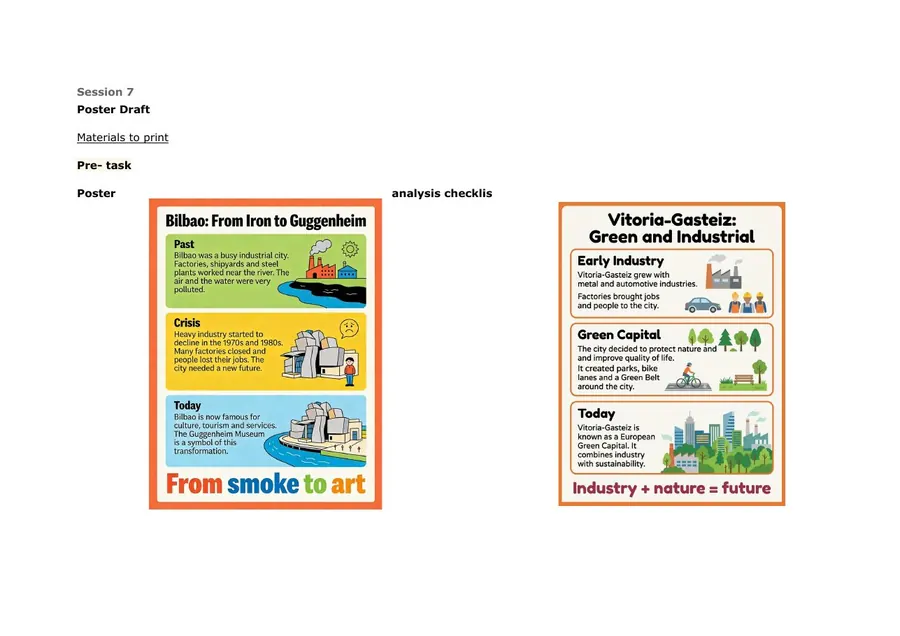
three examples of effective informative posters and, with teacher
guidance, identify key features such as clear visual hierarchy, an
appropriate balance between images and text, coherence of the overall
message, and the use of accessible language suitable for an external
audience. They then discuss how these principles can be transferred to
their own competition entry.
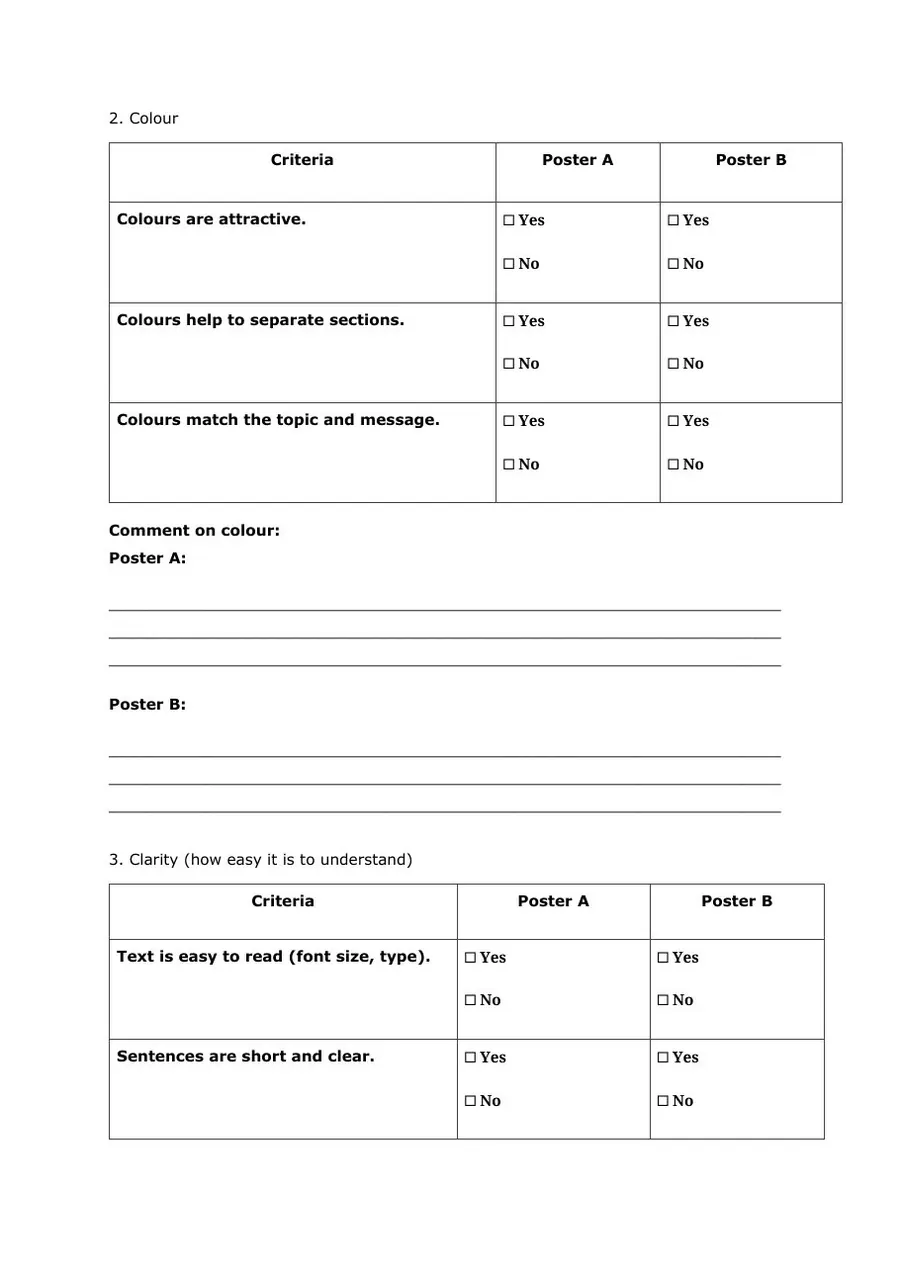
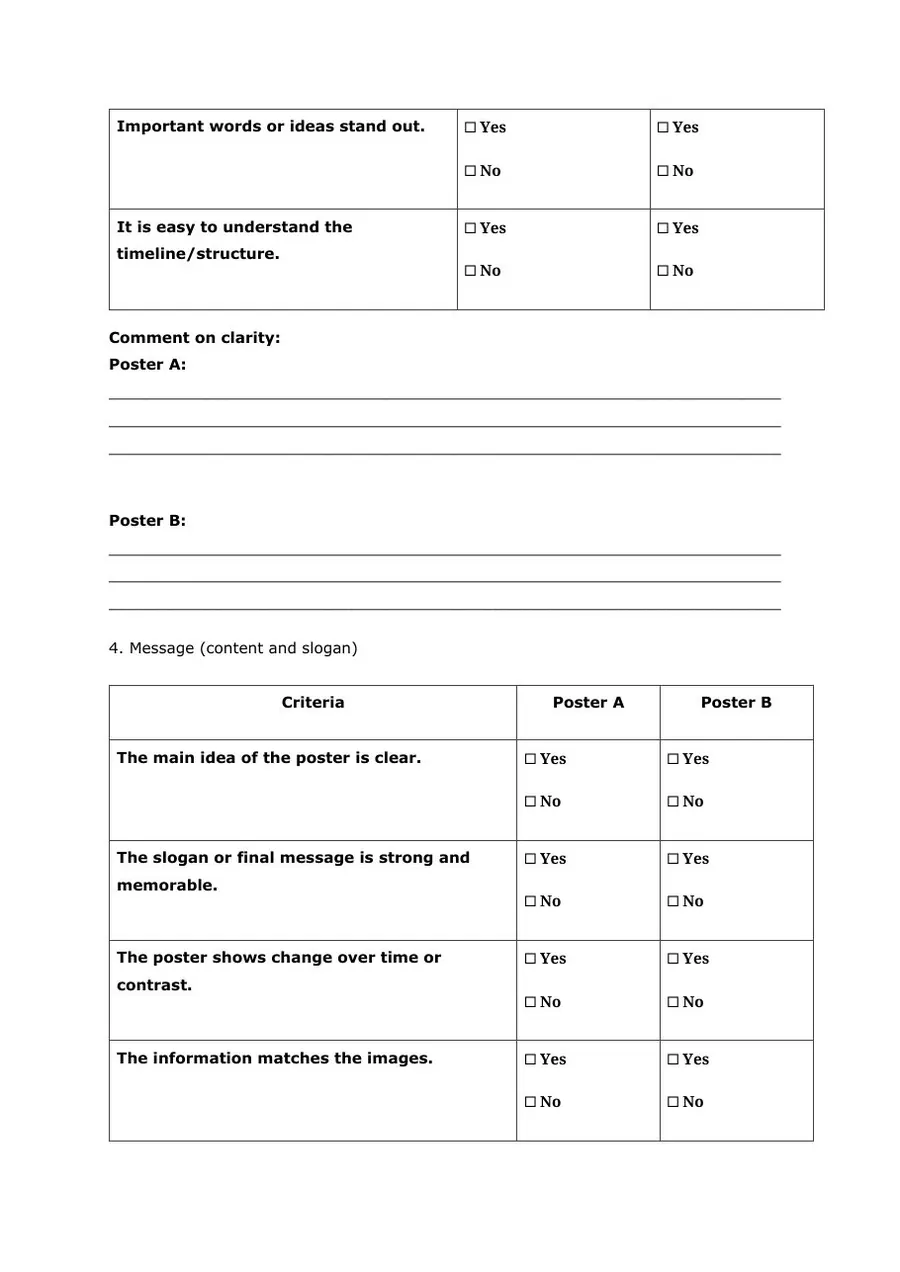
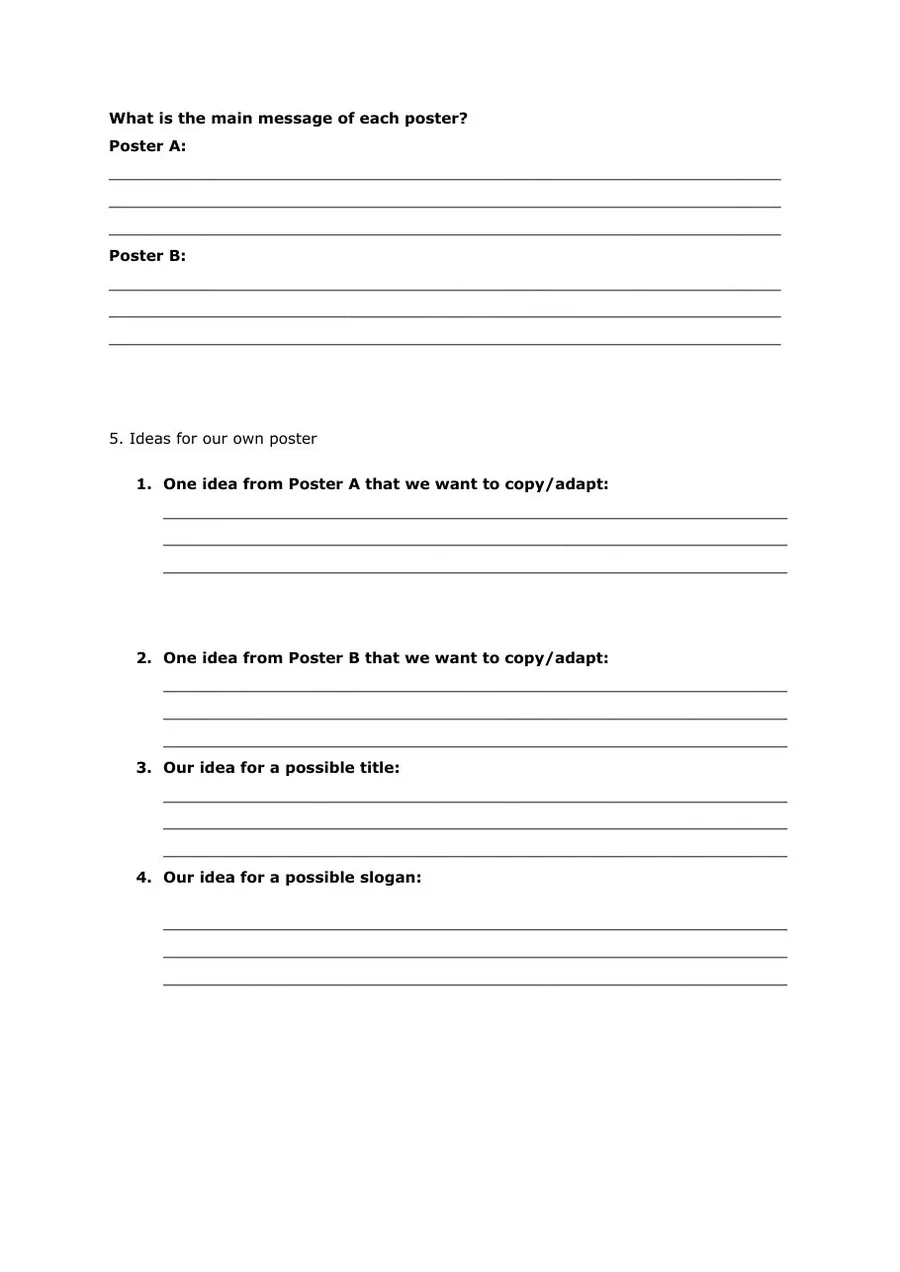
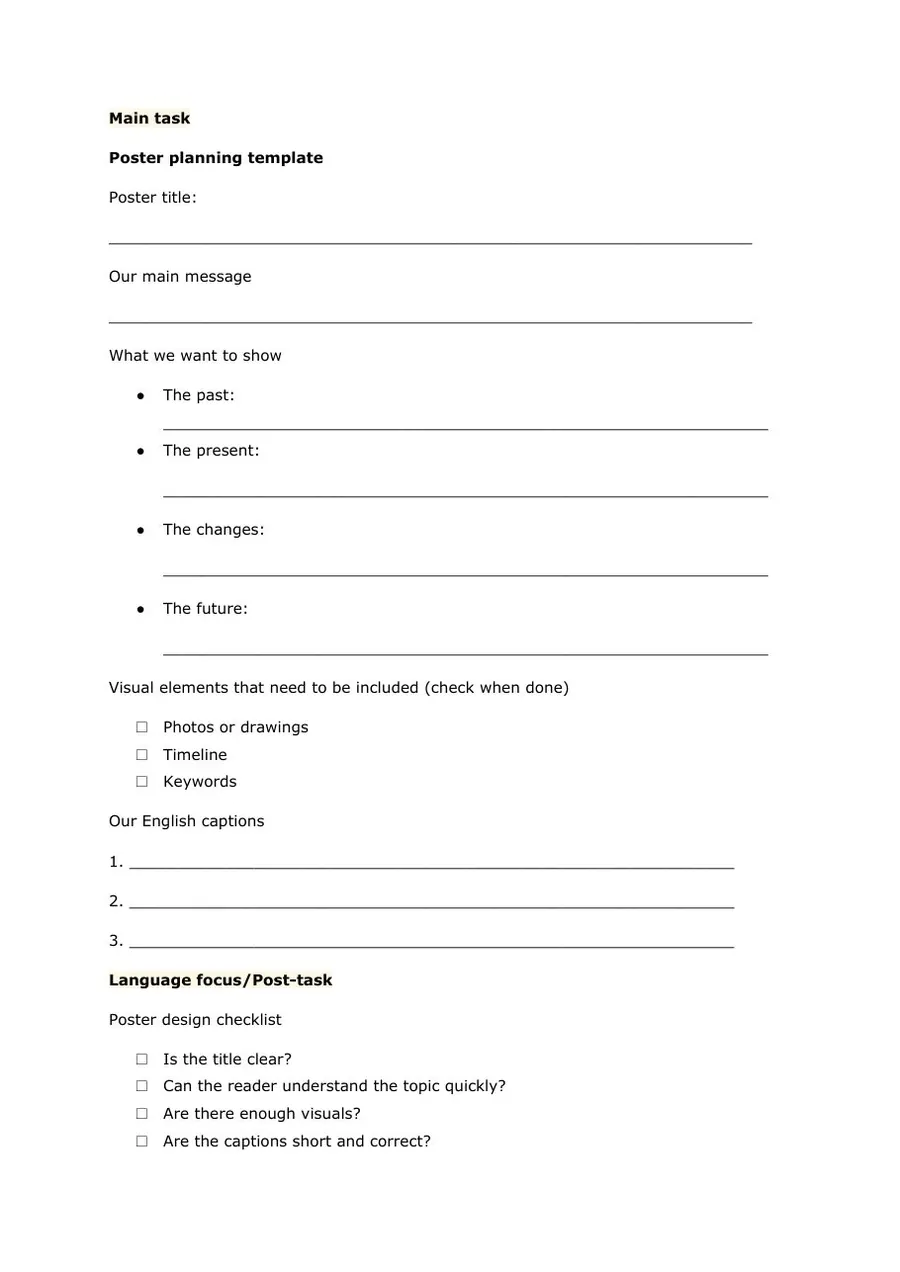
In the second phase, groups begin drafting their poster using a planning template that requires them to include a title, a visual representation of past industrialisation in the Basque Country, a comparison with the current sustainable context, and at least two concrete proposals to enhance sustainability in Bilbao or Vitoria-Gasteiz. All captions and explanatory texts are produced in English, drawing on the descriptive paragraphs developed in Session 6. Throughout this stage, the teacher provides support with layout, lexis and visual choices.
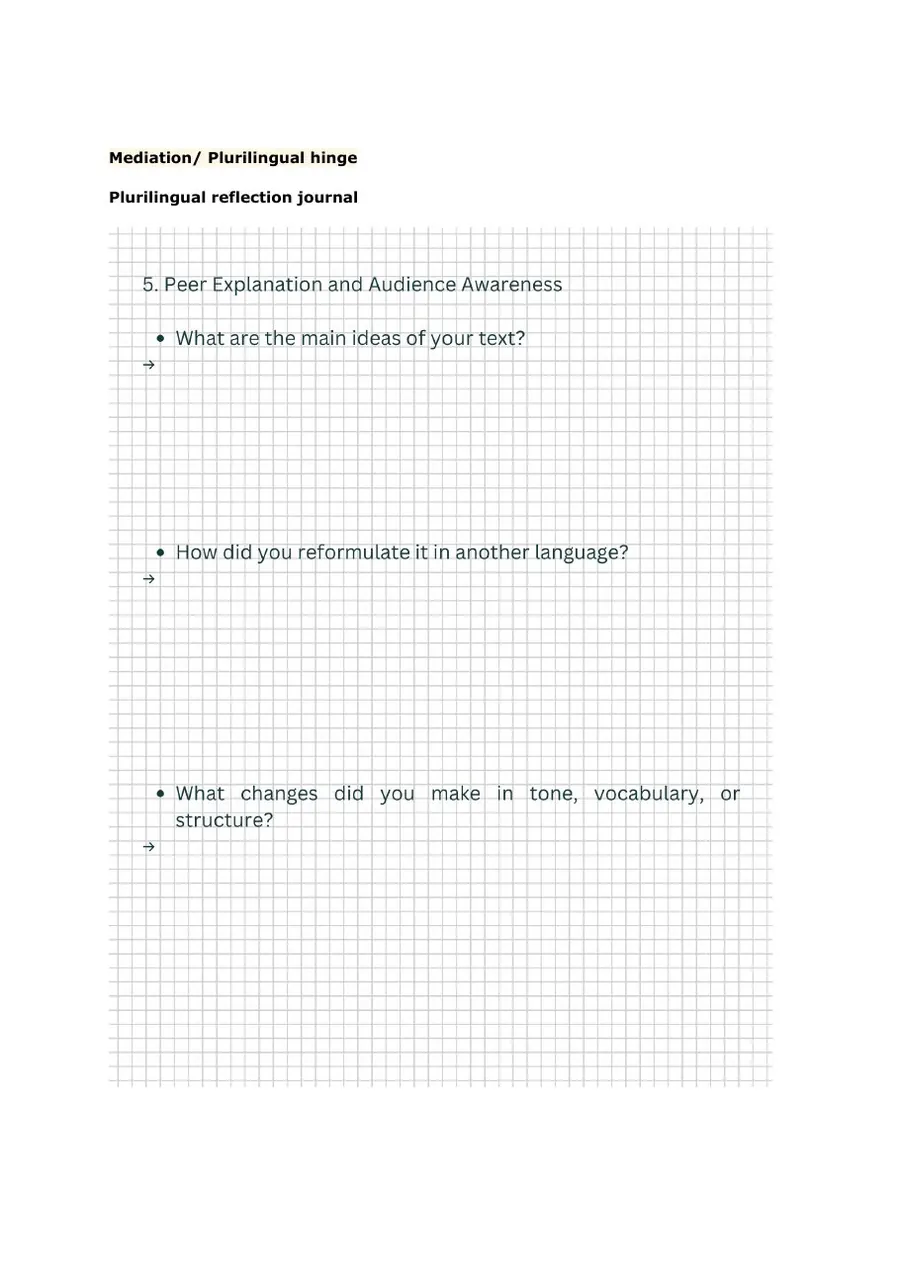
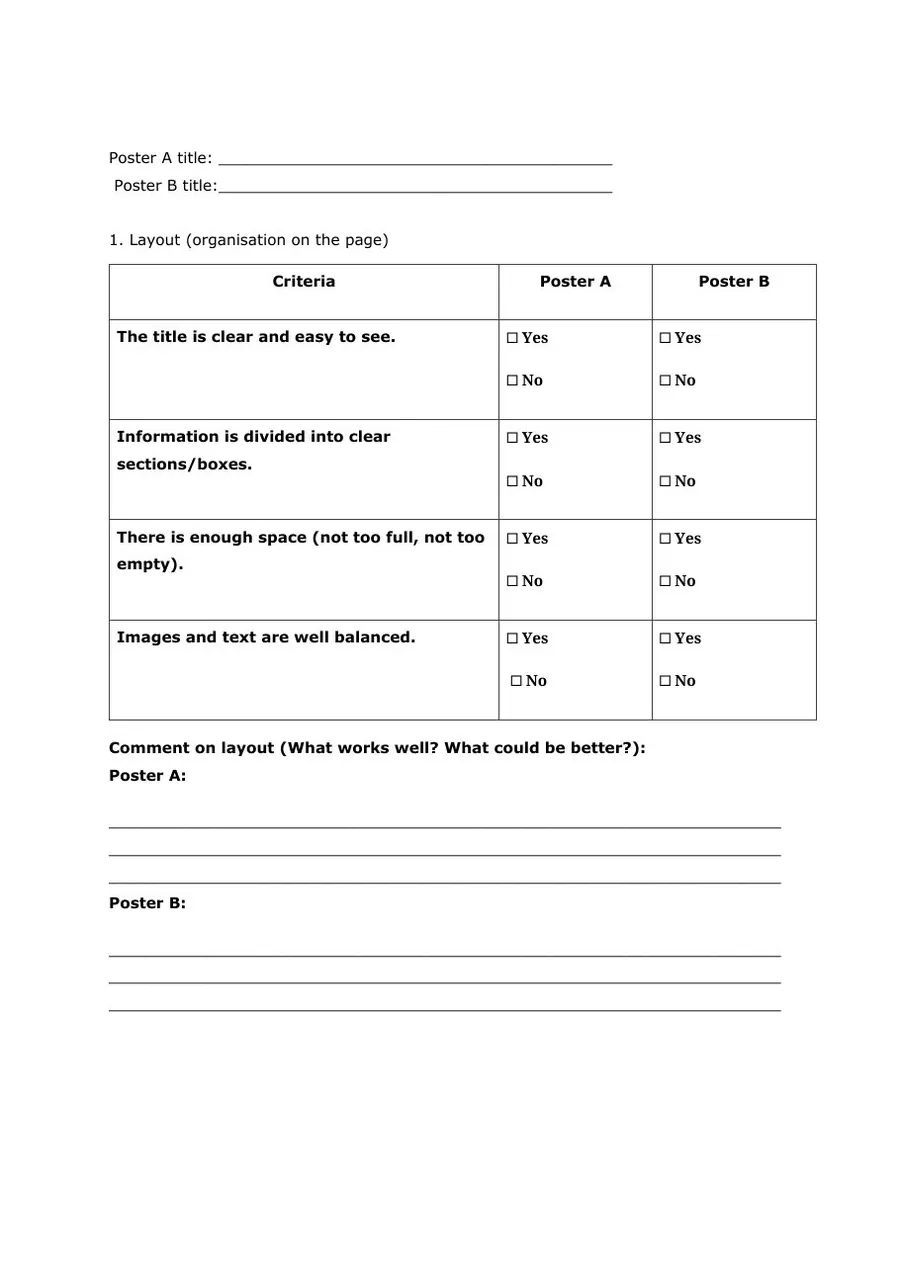
The session concludes with a peer feedback rotation, in which groups display their drafts, receive structured comments via a feedback checklist, and record both useful suggestions and strategic language decisions in their reflection journals.
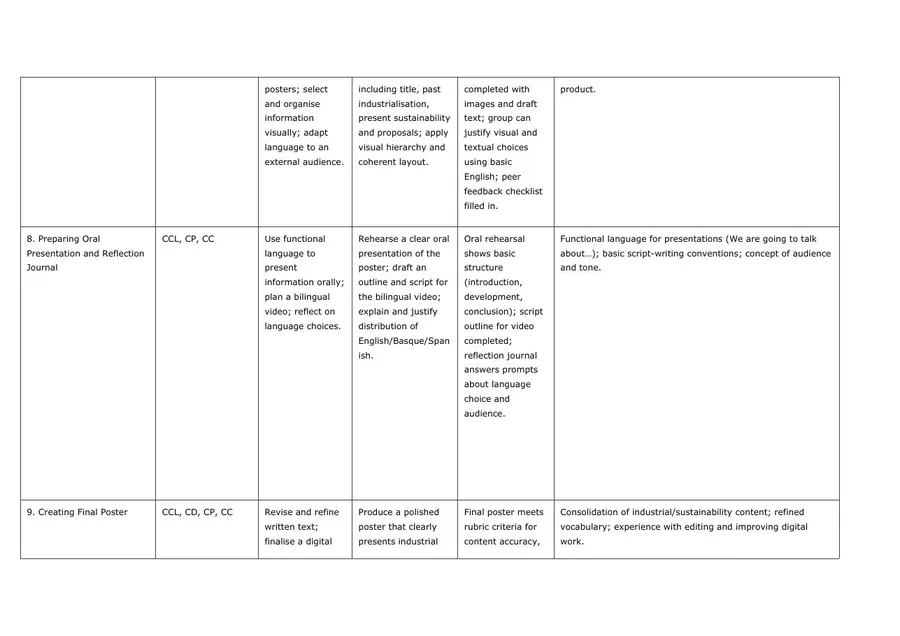
Session 8: Preparing Oral Presentation and Reflection Journal
(English)
This session is designed to prepare students for both the oral
presentation of their poster and the bilingual video they will submit to
the Basque Government competition. In the first phase, the teacher
introduces key functional language for presentations and video scripts,
including expressions for introducing the poster, describing change over
time, and making proposals for sustainability. Attention is also given
to adapting the message for an external audience, such as competition
judges, so that students consider clarity, tone and communicative
impact.
In the second phase, groups rehearse their oral poster presentation using the target structures, receiving peer feedback based on a checklist focusing on clarity, confidence and language accuracy, while simultaneously beginning to draft the script for their bilingual video and deciding how to distribute English and Basque/Spanish across different sections.
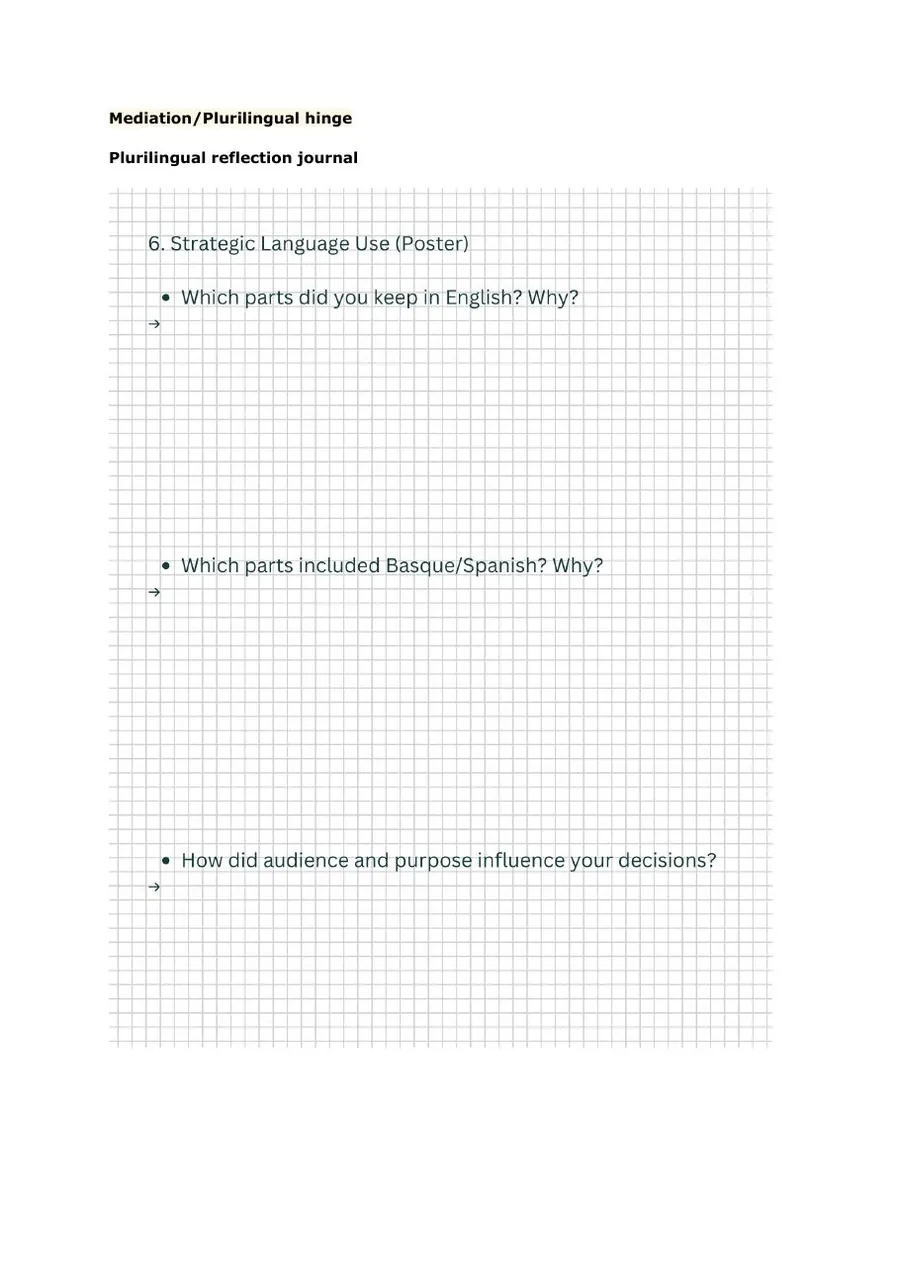
The last phase of the session foregrounds metacognition and plurilingual competence: students complete a structured reflection on how and why they have used English, Basque and Spanish for different tasks and audiences throughout the project, and how language choice has influenced understanding and effectiveness. They then write a journal entry analysing their own bilingual video product, justifying linguistic and stylistic decisions and considering how their work represents local identities for wider audiences.
Session 9: Creating Final Poster (Technology and
Digitalization)
This session is devoted to finalising the competition poster,
integrating both peer feedback from the previous session and the
teacher’s formative guidance. In the initial phase, groups revise the
textual content, layout and visual elements of their poster to ensure
that their message is clear, coherent and persuasive. The poster must
explicitly address three core dimensions: a historically grounded
account of industrialisation in the Basque Country with specific
references to Bilbao and Vitoria-Gasteiz; a comparison with present-day
sustainable innovations; and at least two concrete, realistic proposals
for a more sustainable future. Particular emphasis is placed on the
accuracy and clarity of the English language used, including titles,
captions, connectors and sustainability-related vocabulary, with the
teacher providing targeted language support as needed.
In the final stage, students conduct a focused peer check on linguistic accuracy and overall clarity before making and justifying decisions concerning any bilingual or plurilingual elements of the poster. By explicitly linking their language choices to the needs and expectations of an external audience, including competition judges, learners consolidate an authentic communicative purpose and understand language selection as an integral aspect of meaning-making within the multimodal product.
Session 10: Poster Presentation and Classroom Exhibition
(English)
This session is structured as a simulated competition in which
groups formally present their posters to the class as if submitting them
to the Basque Government. At the outset, the teacher briefly revisits
the assessment criteria and provides useful presentation phrases to
support clarity and academic style.
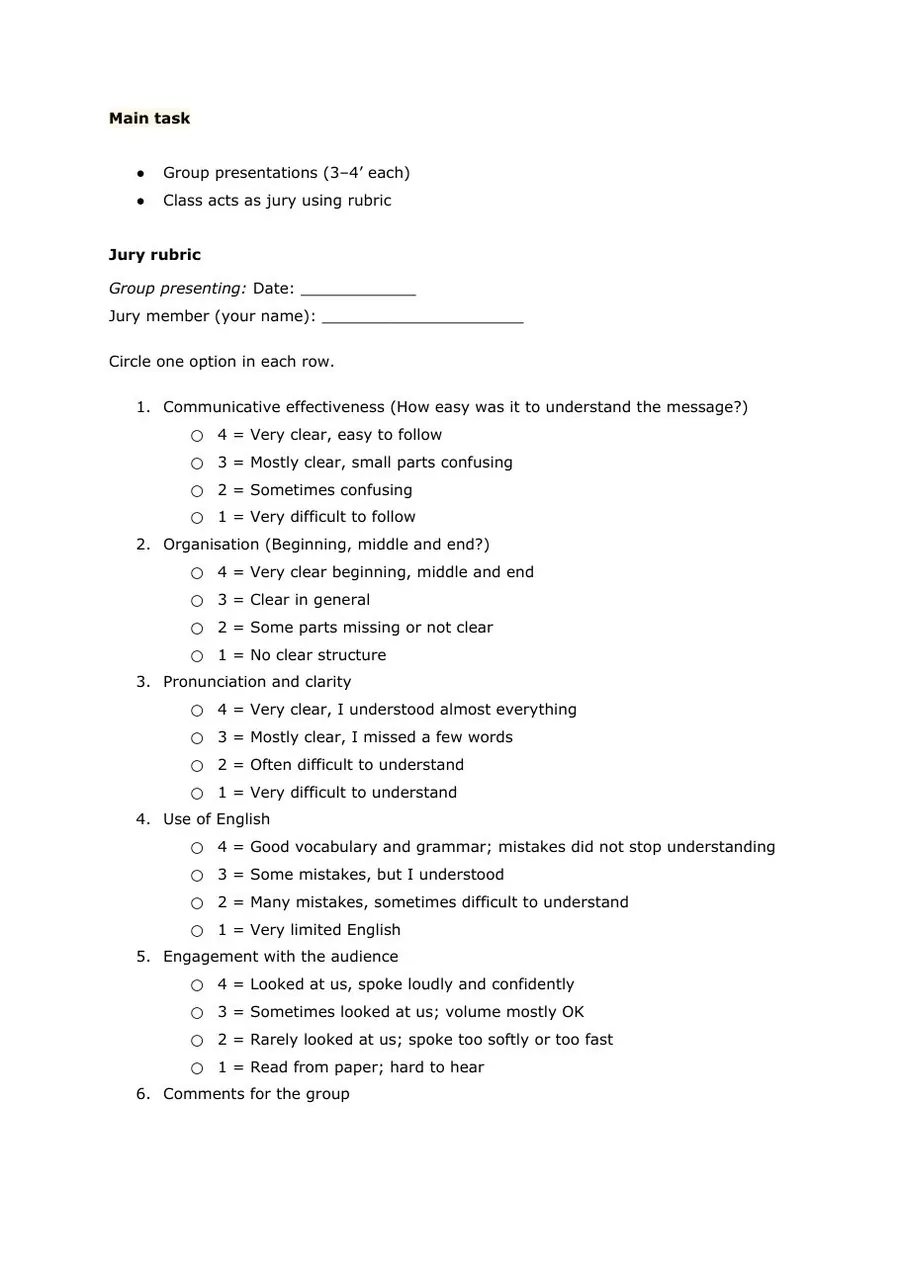
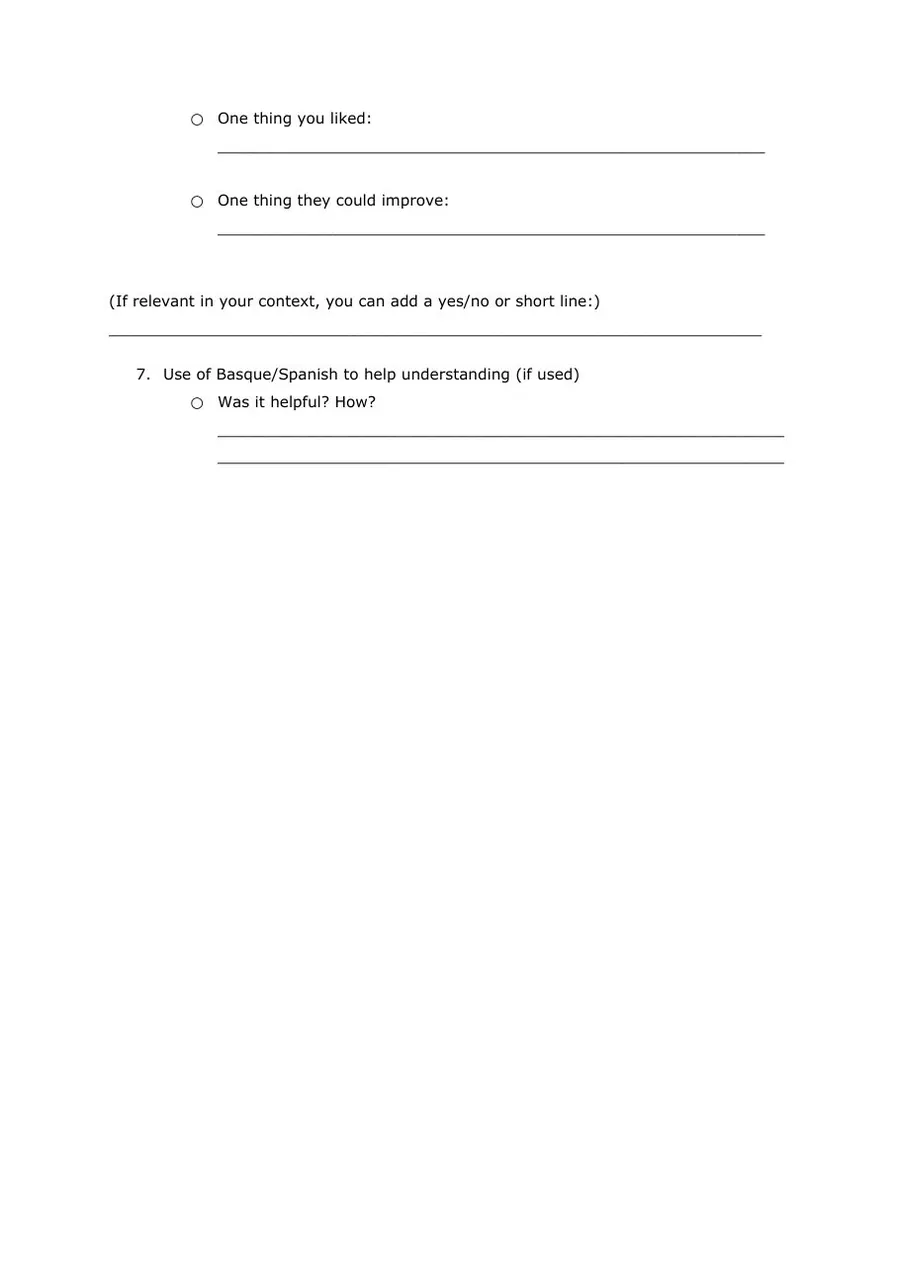
Each group then has around five minutes to present, in English, the core components of their work: the historical industrial transformation represented on the poster, the comparison between past and present industrialisation in Bilbao and Vitoria-Gasteiz, and the sustainability proposals they have formulated. Students are encouraged to speak confidently, avoid reading directly from their notes, and interact with their audience. While listening, classmates act as a jury, completing an evaluation rubric focused on clarity of content, language use, and the persuasiveness of the sustainability proposals, and asking at least one question at the end of each presentation to promote spontaneous interaction. The teacher collects the rubrics and offers brief whole-class feedback, highlighting effective examples of content and language.
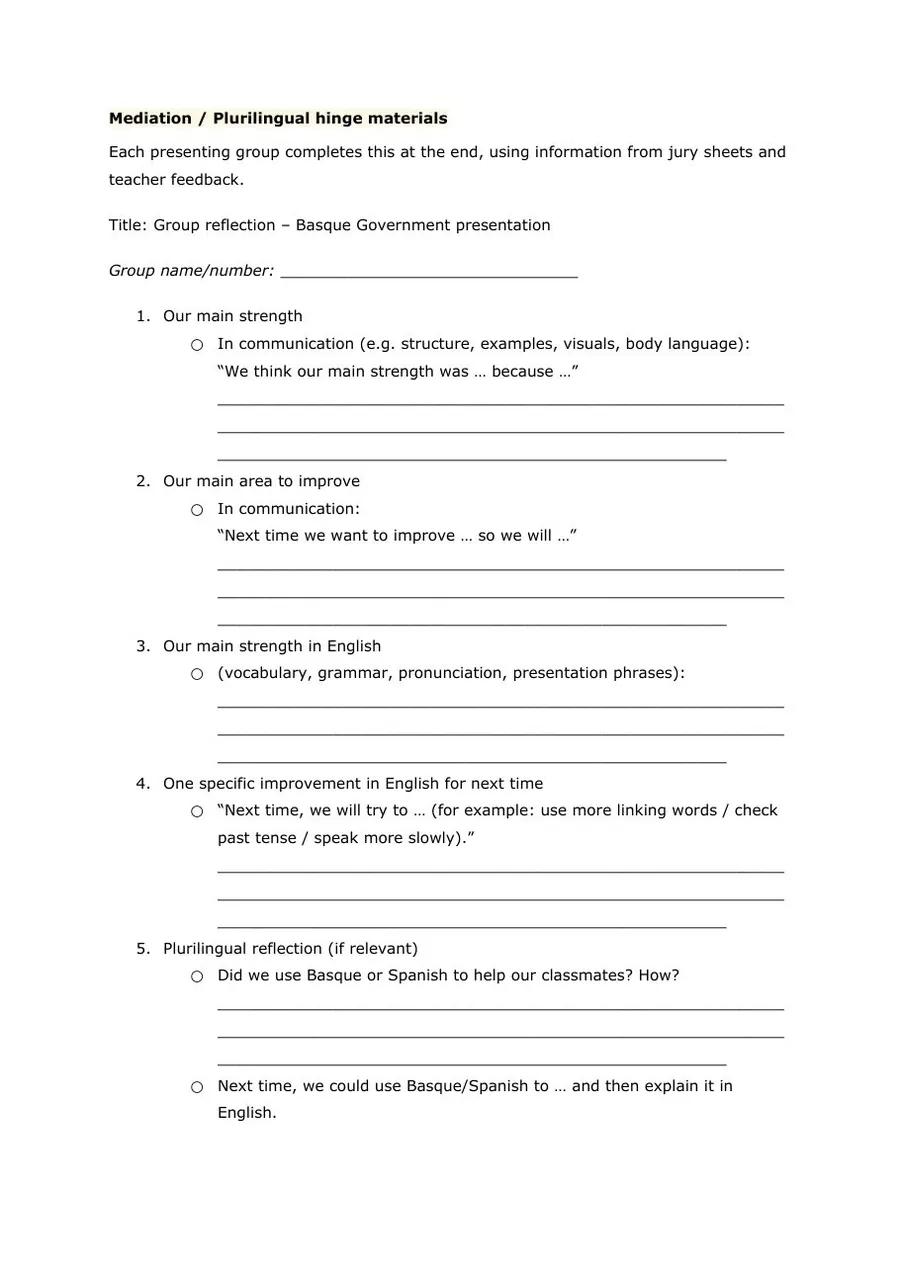
Finally, groups complete a reflection sheet drawing on peer feedback, and the posters are displayed under the collective title “From Iron to Innovation,” acknowledging students’ engagement with Basque industrial heritage and sustainability.
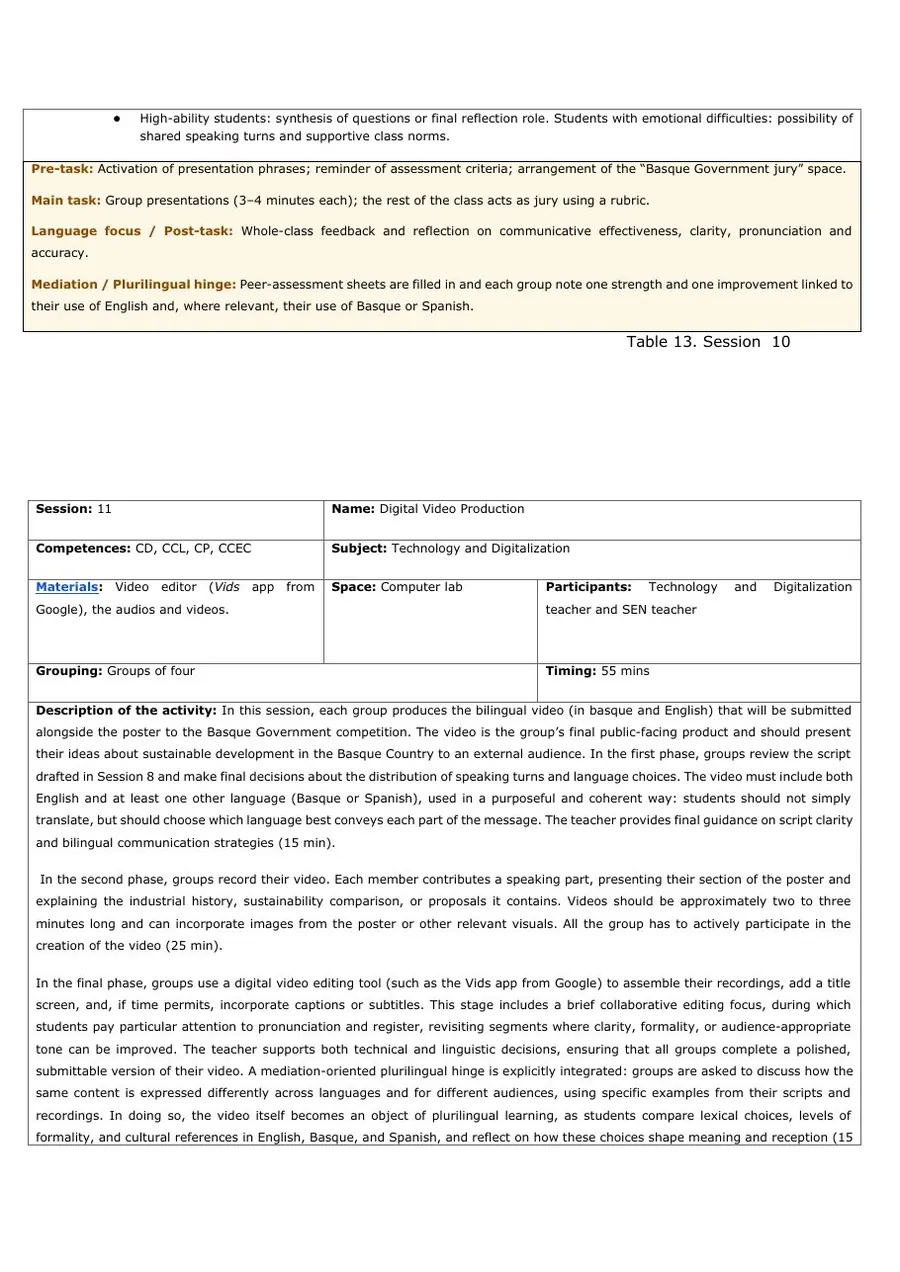
Session 11: Digital Production-Bilingual Video (Technology
and Digitalization)
This session is devoted to the production of a bilingual
(Basque–English) video to be submitted alongside the competition poster,
functioning as the group’s final public-facing product on sustainable
development in the Basque Country. In the initial phase, groups revisit
and refine the script drafted in the previous session, clarifying
content, allocating speaking turns, and making deliberate decisions
about when to use English and when to use Basque or Spanish. Rather than
relying on direct translation, students are encouraged to select the
language that best conveys each part of their message, while the teacher
provides final guidance on script clarity and effective bilingual
communication strategies.
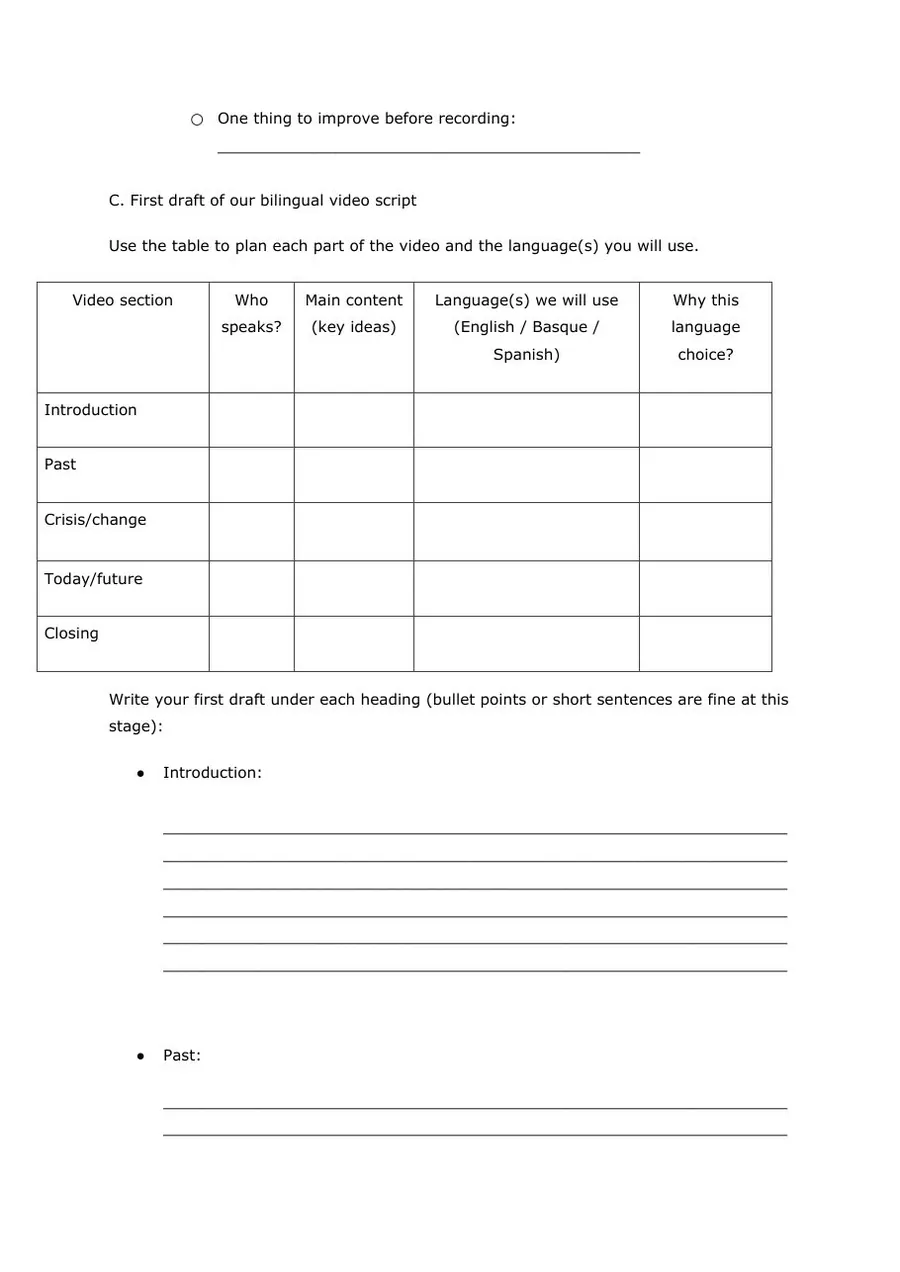
In the second phase, groups record their video, ensuring that each member contributes an oral segment linked to a specific section of the poster, such as industrial history, sustainability comparisons, or proposed measures. Videos are expected to last approximately two to three minutes and may incorporate still images from the poster or other relevant visuals, with all group members actively engaged in the recording process.
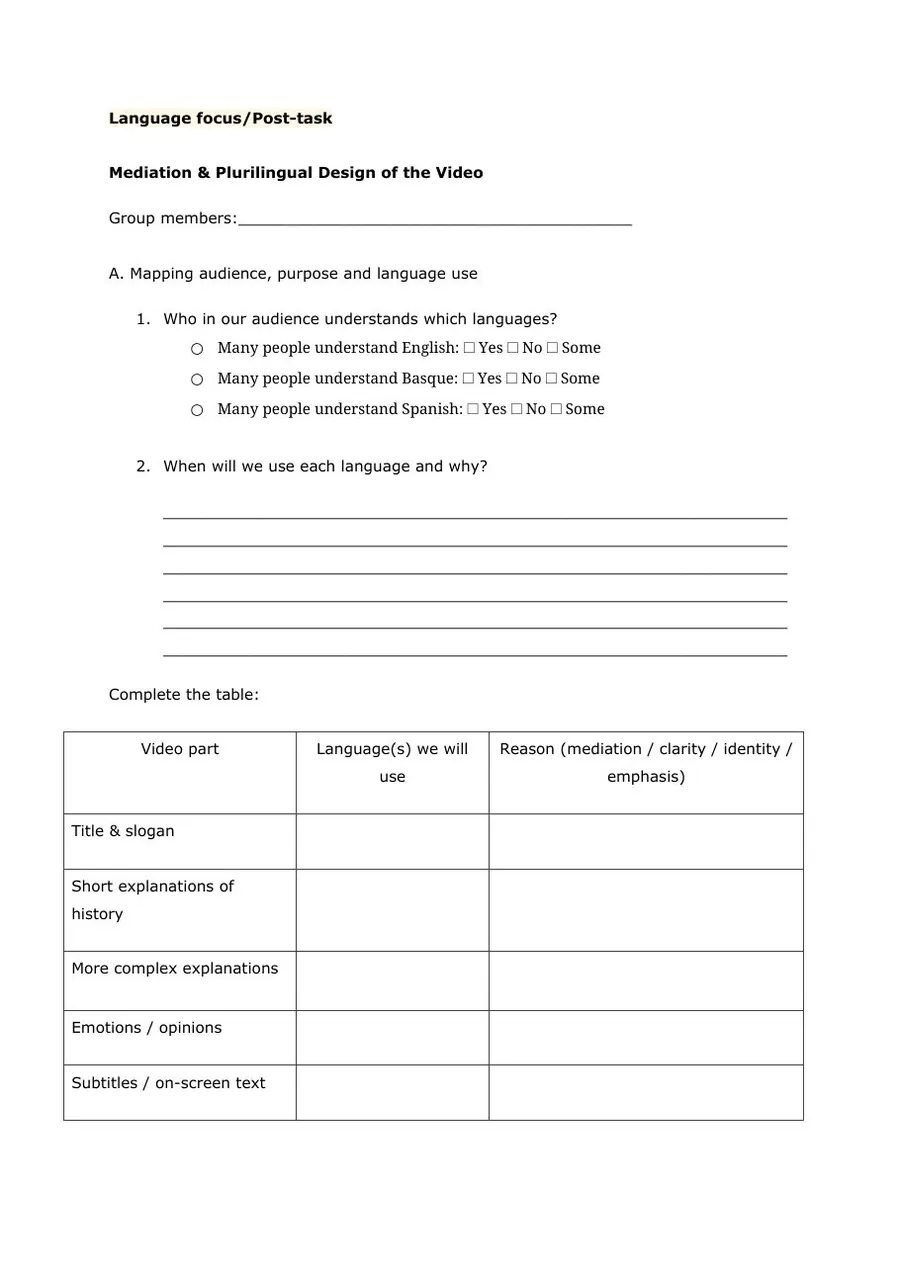
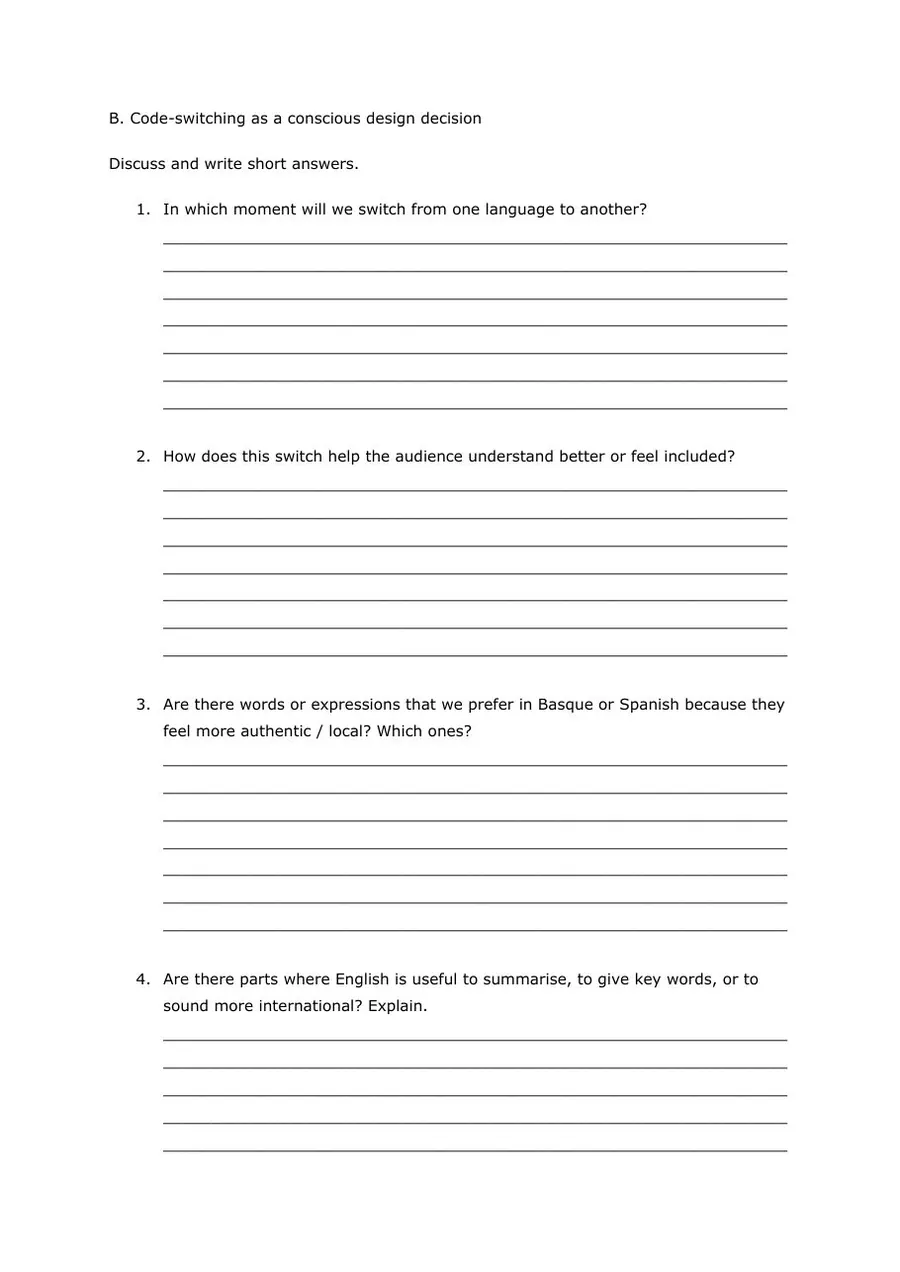
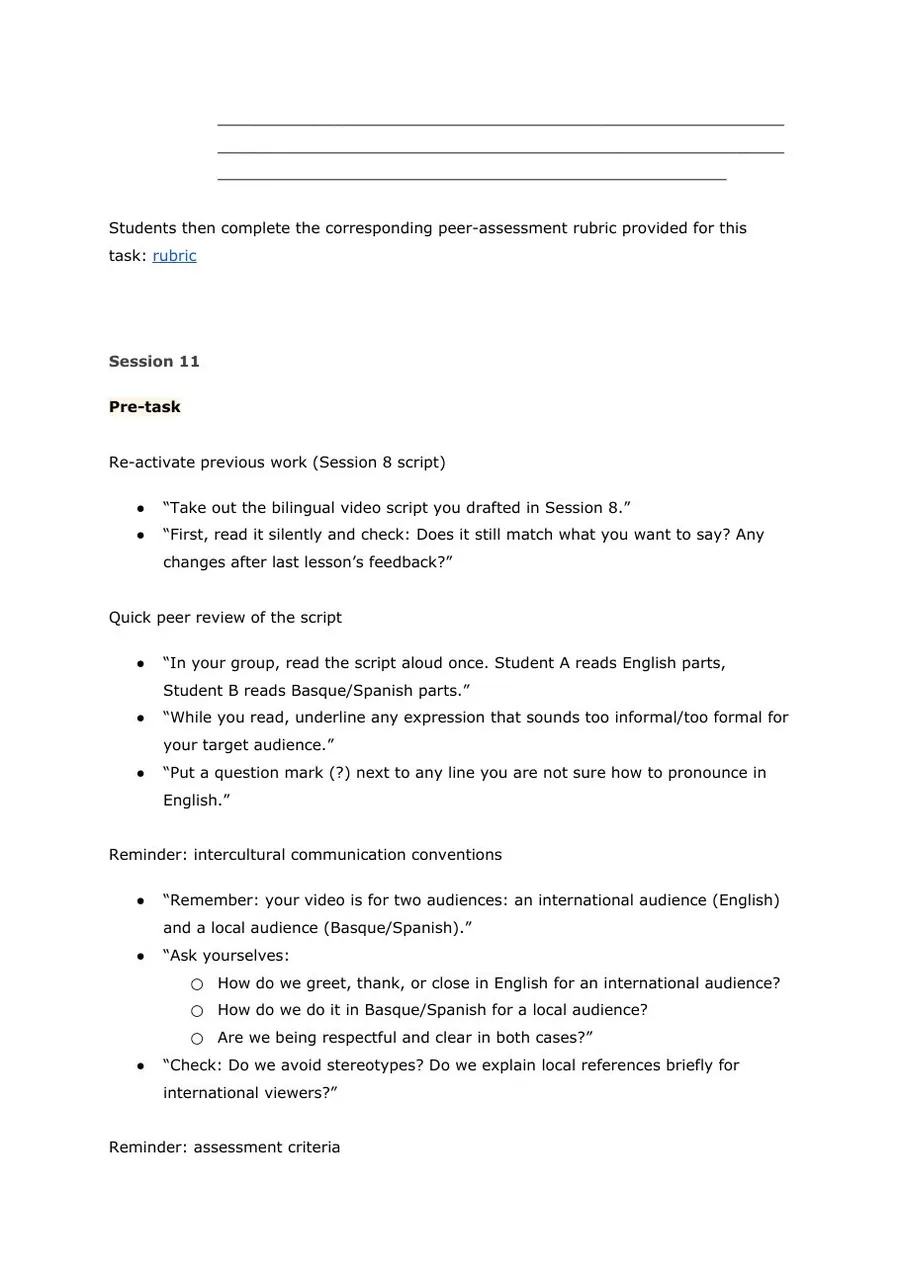
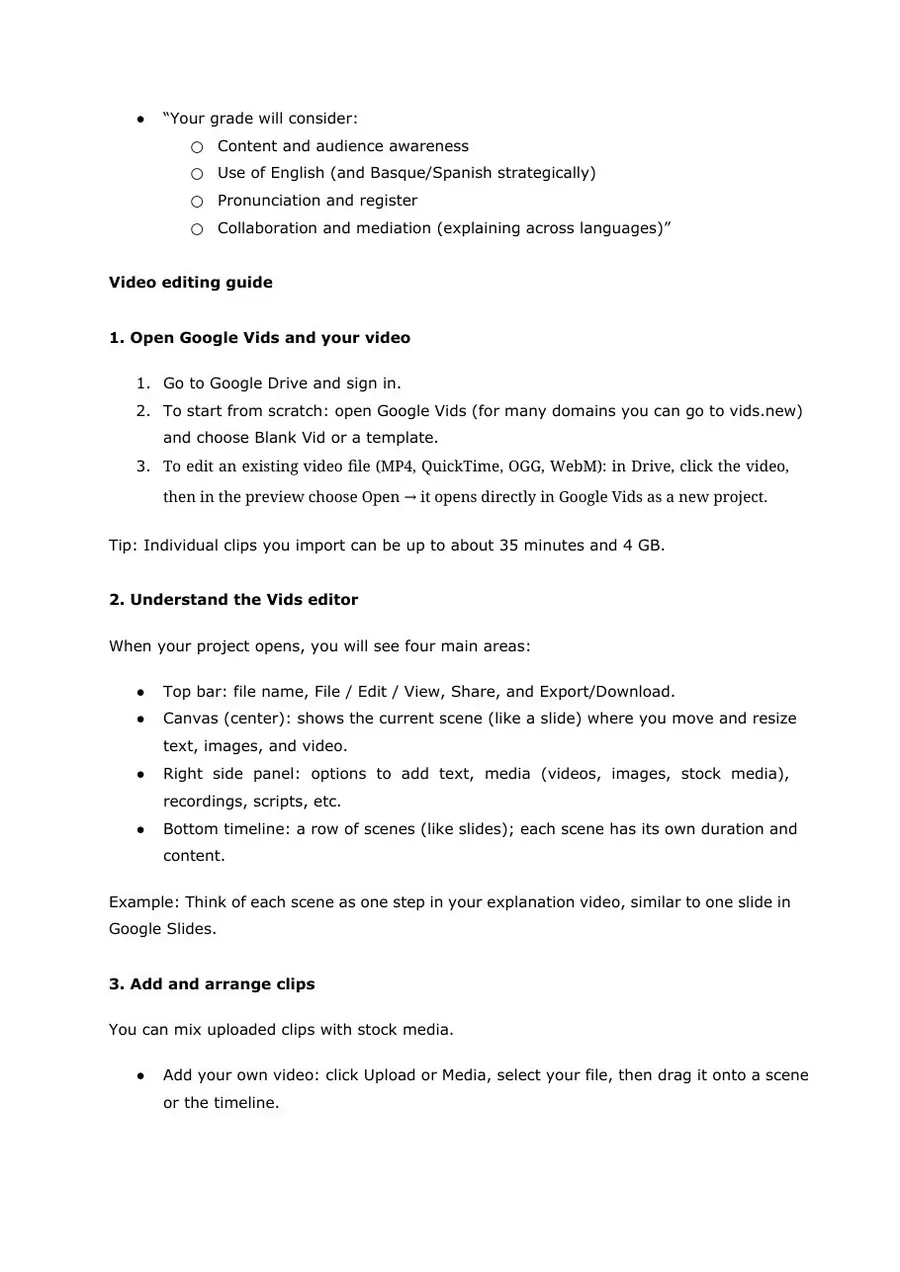
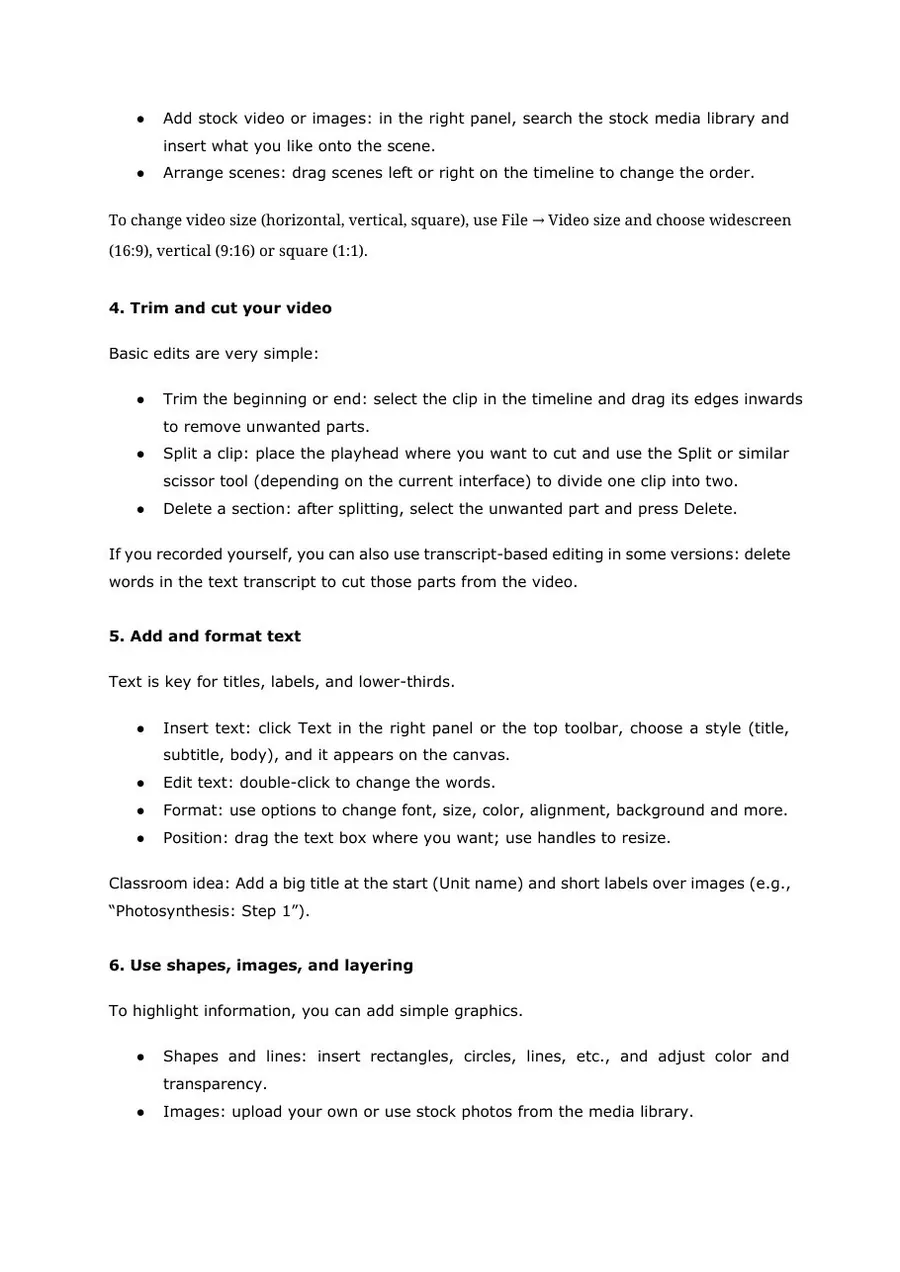
In the final phase, students use a digital editing tool to assemble their clips, add a title screen, and, where possible, captions or subtitles. This stage foregrounds collaborative revision of pronunciation, register, and audience-appropriate tone. A plurilingual mediation focus is explicitly integrated, as groups discuss how content is expressed differently across languages and reflect on lexical choices, formality, and cultural references, turning the video itself into a resource for plurilingual learning.
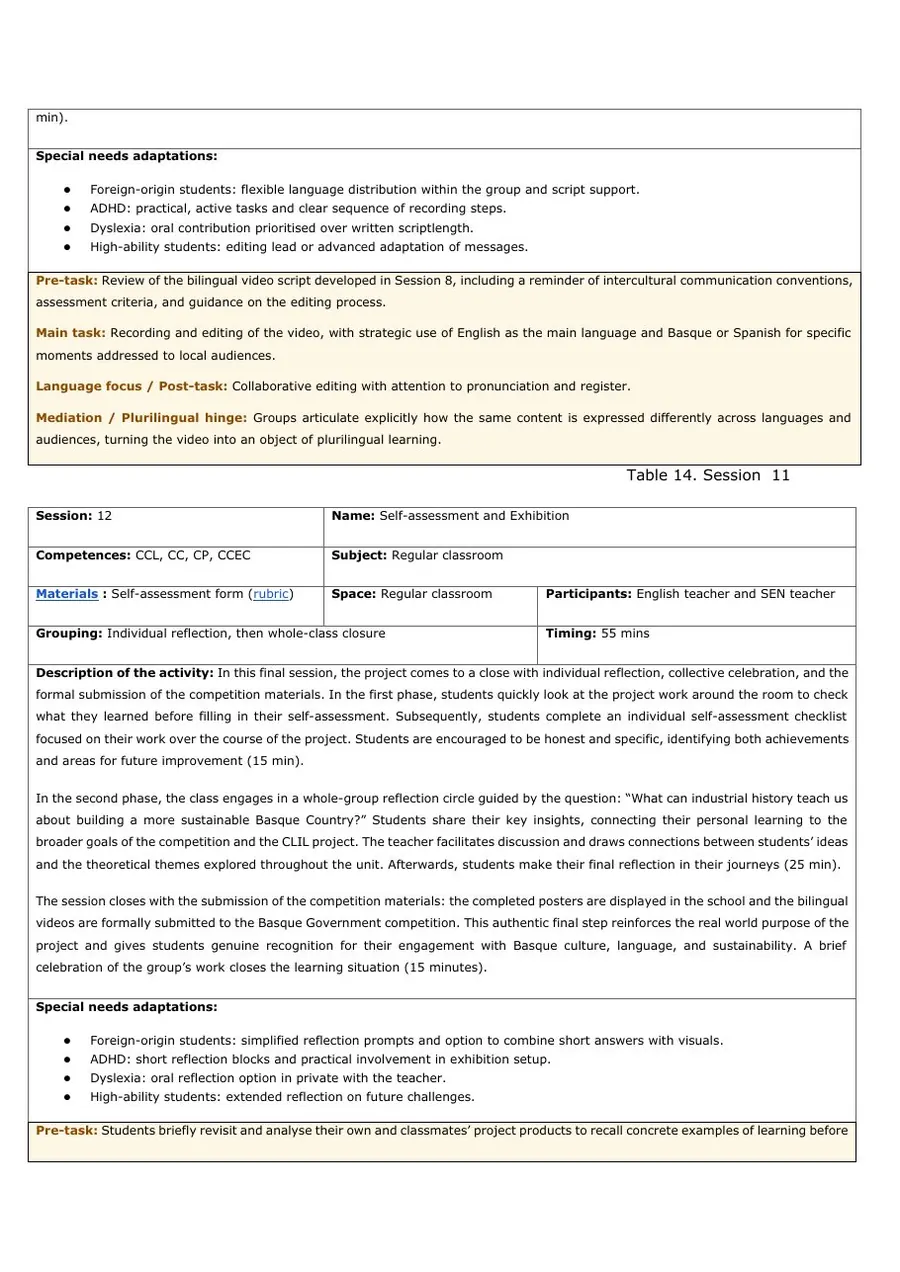
Session 12: Self-Assessment and Reflection (Geography and
History)
This final session brings the project to a close through
individual reflection, collective evaluation and the formal submission
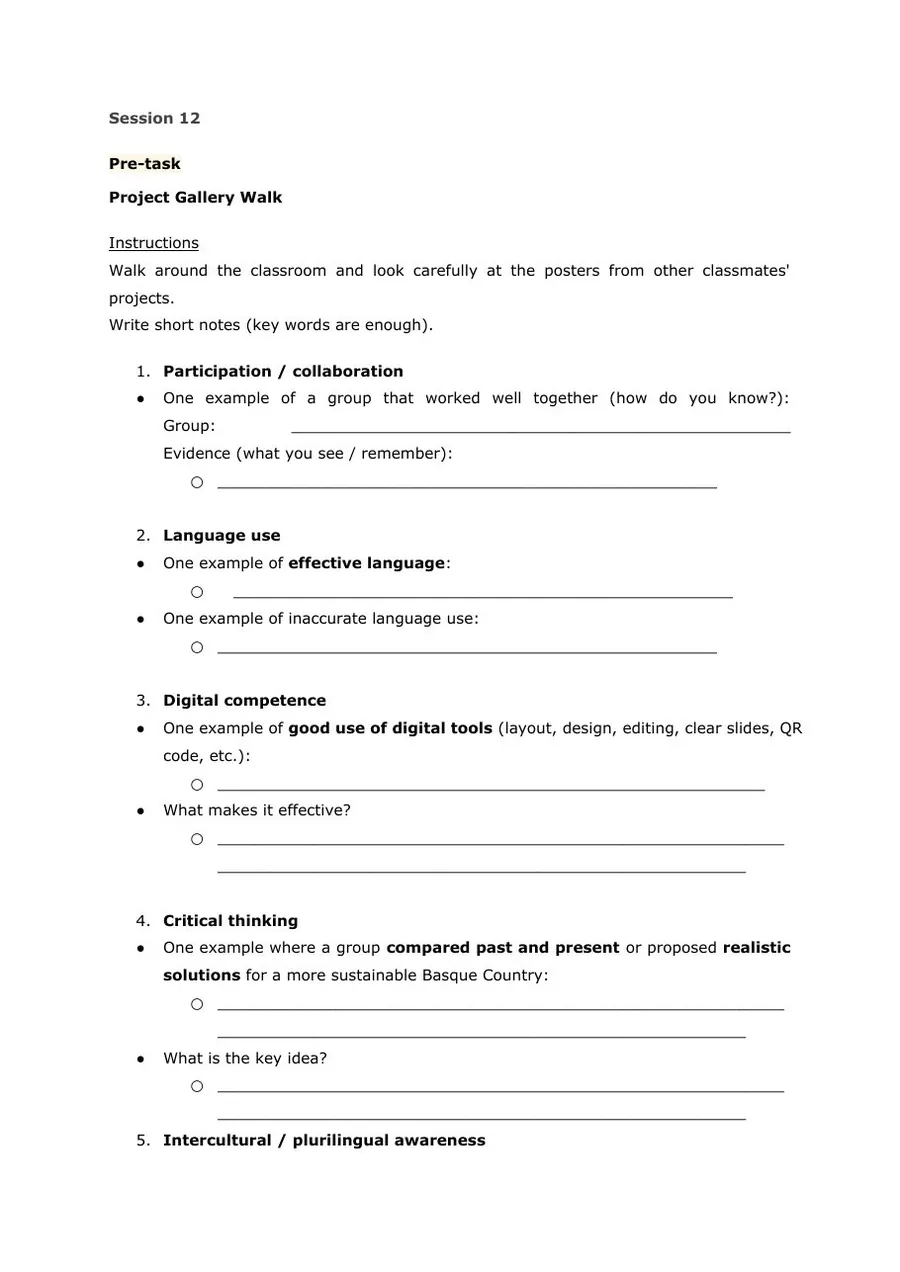
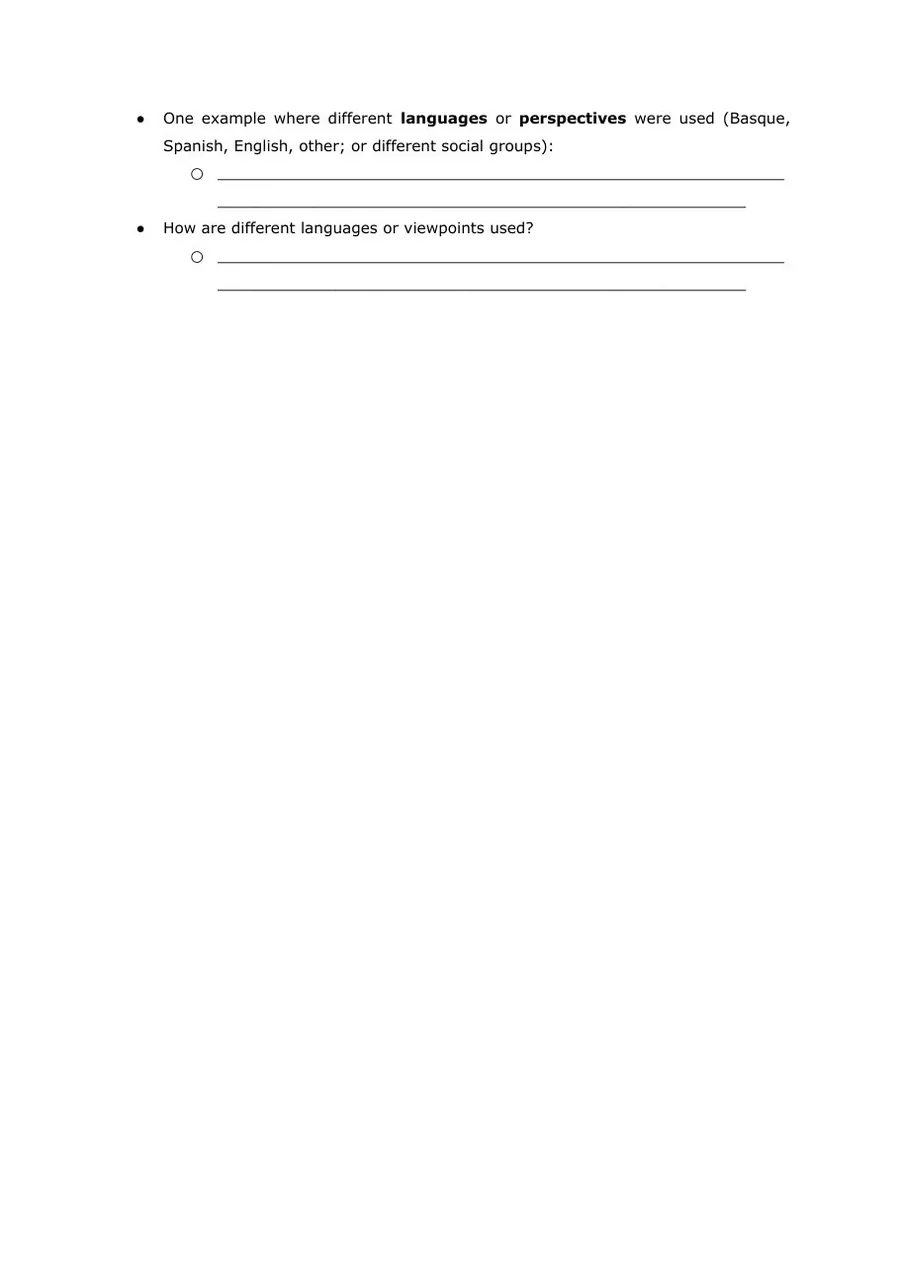
of competition outputs. It begins with a brief gallery walk in which
students revisit the posters and project artefacts displayed in the
classroom, activating recall of what they have learned before completing
an individual self-assessment checklist. This instrument invites
learners to evaluate their work across the project, encouraging honest
and specific identification of both strengths and areas for further
development.
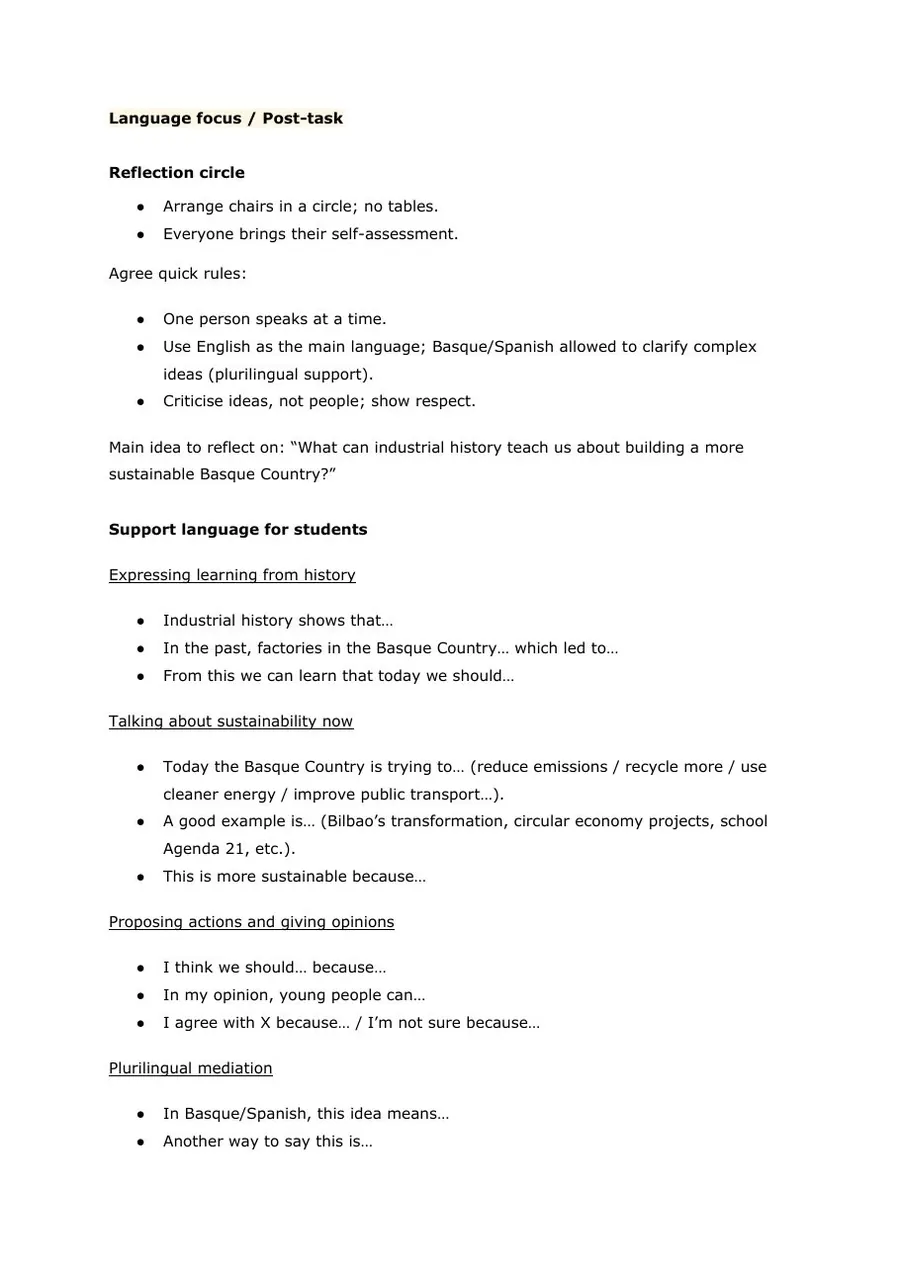
In the second phase, the class participates in a whole-group reflection circle structured around the guiding question: “What can industrial history teach us about building a more sustainable Basque Country?” Students share key insights and connect their personal learning trajectories with the broader aims of the competition and the CLIL project, while the teacher facilitates, synthesises contributions and explicitly links them to the theoretical and curricular themes explored in previous sessions. Learners then record a final written reflection in their learning journals, consolidating metacognitive awareness.
The session concludes with the formal submission of the competition materials: posters are displayed in the school and bilingual videos are submitted to the Basque Government competition. This authentic culminating step reinforces the real-world purpose of the project, provides public recognition of students’ efforts, and symbolically closes the learning situation with a brief collective celebration.
| Session: 1 | Name: Introduction to Industrial Change | |
|---|---|---|
| Competences: CCL, CC, CCEC | Subject: Geography and History | |
| Materials: Video on Bilbao regeneration, projector, vocabulary cards (glossary), worksheet | Space: Regular classroom with projector | Participants: Geography and History teacher and a Special Education teacher (SEN) |
| Grouping: Whole class → Groups of 4 (heterogeneous by language level done beforehand) | Timing: 55 mins | |
Description of the activity: The session begins with a brainstorming activity on industrialisation, aimed at eliciting students’ prior knowledge and introducing the thematic focus of the unit. Subsequently, the teacher presents the project that students will be expected to develop. Following this, learners watch a short video depicting the urban regeneration of Bilbao, with particular emphasis on the transformation of its industrial landscape into a sustainable and culturally dynamic environment. This audiovisual input functions as a contextualised introduction to the topic and facilitates the activation of prior knowledge (10 minutes). After viewing the video, students complete a worksheet designed to reinforce relevant vocabulary through a speaking-based activity. This includes comparing two images, matching definitions, and responding to topic-related questions. Teacher guidance and visual scaffolding are provided to support comprehension, particularly for learners experiencing linguistic difficulties (20 minutes). Subsequently, students analyse images of Bilbao and Vitoria-Gasteiz from different historical periods and respond to guided questions aimed at fostering critical thinking skills, such as identifying differences, inferring changes, and evaluating environmental impact (15 minutes). The session concludes with a whole-class brainstorming activity centred on the question: “How has industry changed our city?” Prior to sharing their ideas, students are required to identify four key points in the worksheet that connect historical transformation with local identity and everyday life. Following this discussion, students are organised into heterogeneous groups of four, which will function as stable working teams throughout the project. Group roles may be informally assigned to encourage participation and collaboration. Finally, students complete the first entry in their reflection journal (10 minutes). |
||
Special needs adaptations:
|
||
Pre-task: The teacher presents the simulated scenario and driving question. Short brainstorm in English on prior knowledge of Bilbao and industrial change. Vocabulary activation using key visuals. Main task: Viewing of a short video on Bilbao’s regeneration; students complete a worksheet identifying environmental changes, architectural developments and social impact. Image-comparison activity using photos of Bilbao and Vitoria-Gasteiz from different periods. Language focus / Post-task: Whole-class brainstorming on the question “How has industry changed our city?”, with four key points written on the worksheet. Formation of stable heterogeneous groups of four. Mediation / Plurilingual hinge: First entry in the plurilingual reflection journal: one term or idea that was easier to express in Basque or Spanish than in English, and why. |
||
Table 4. Session 1
| Session: 2 | Name: Vocabulary and visual mapping | |
|---|---|---|
| Competences: CCL, CD | Subject: English | |
| Materials: Thematic glossary worksheets, mind map example, projector | Space: Regular classroom | Participants: English teacher and a Special Education teacher (SEN) |
| Grouping: Groups of 4 | Timing: 55 mins | |
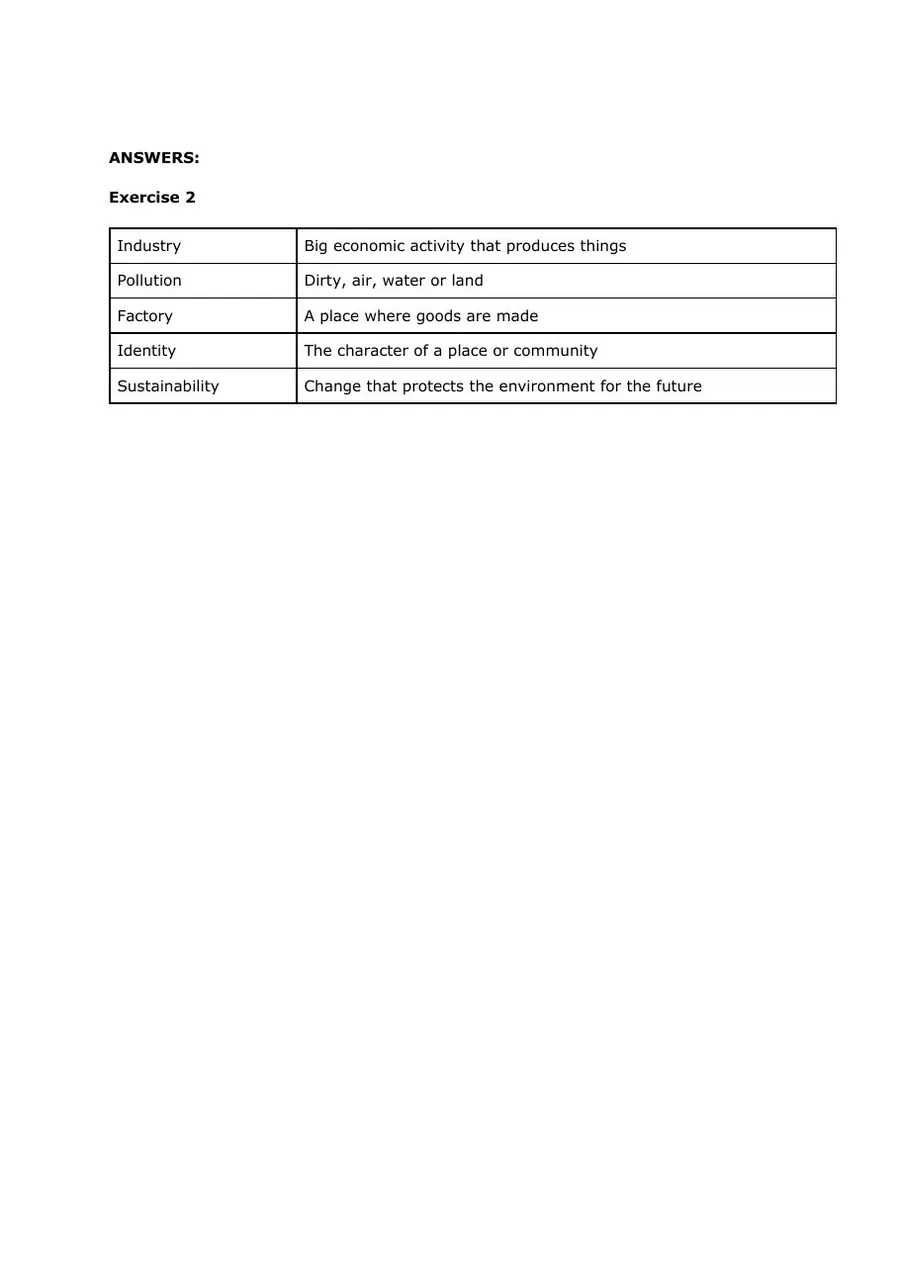
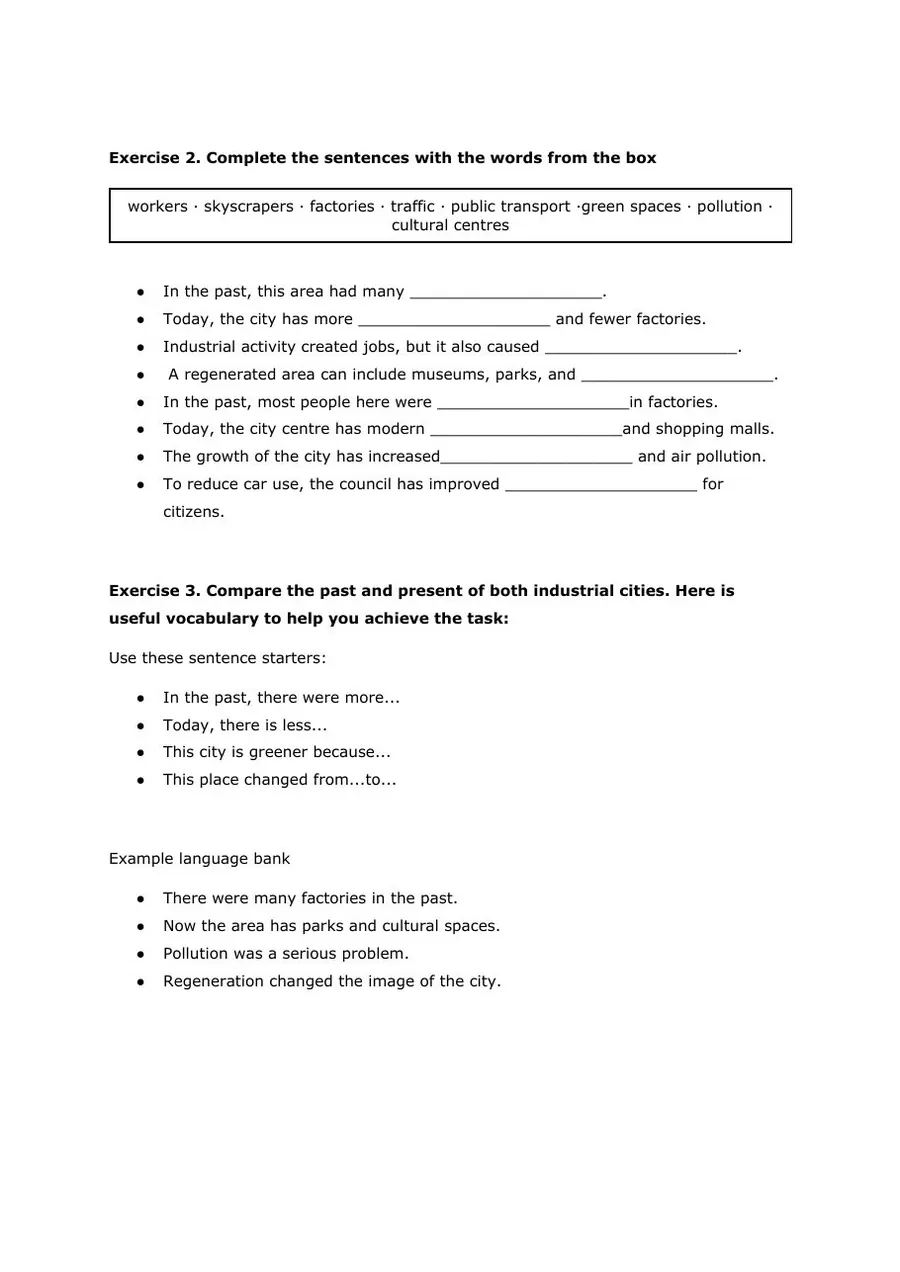
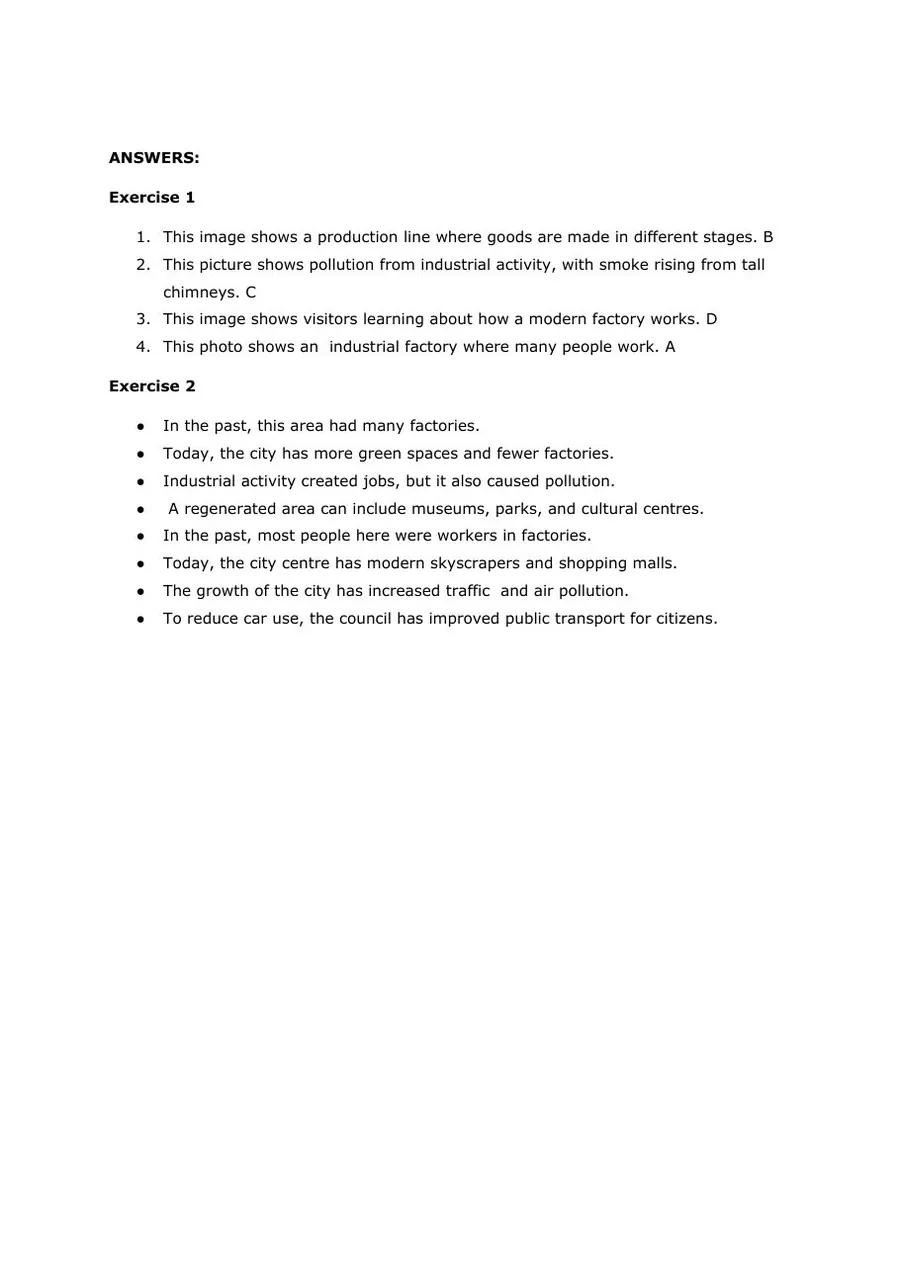
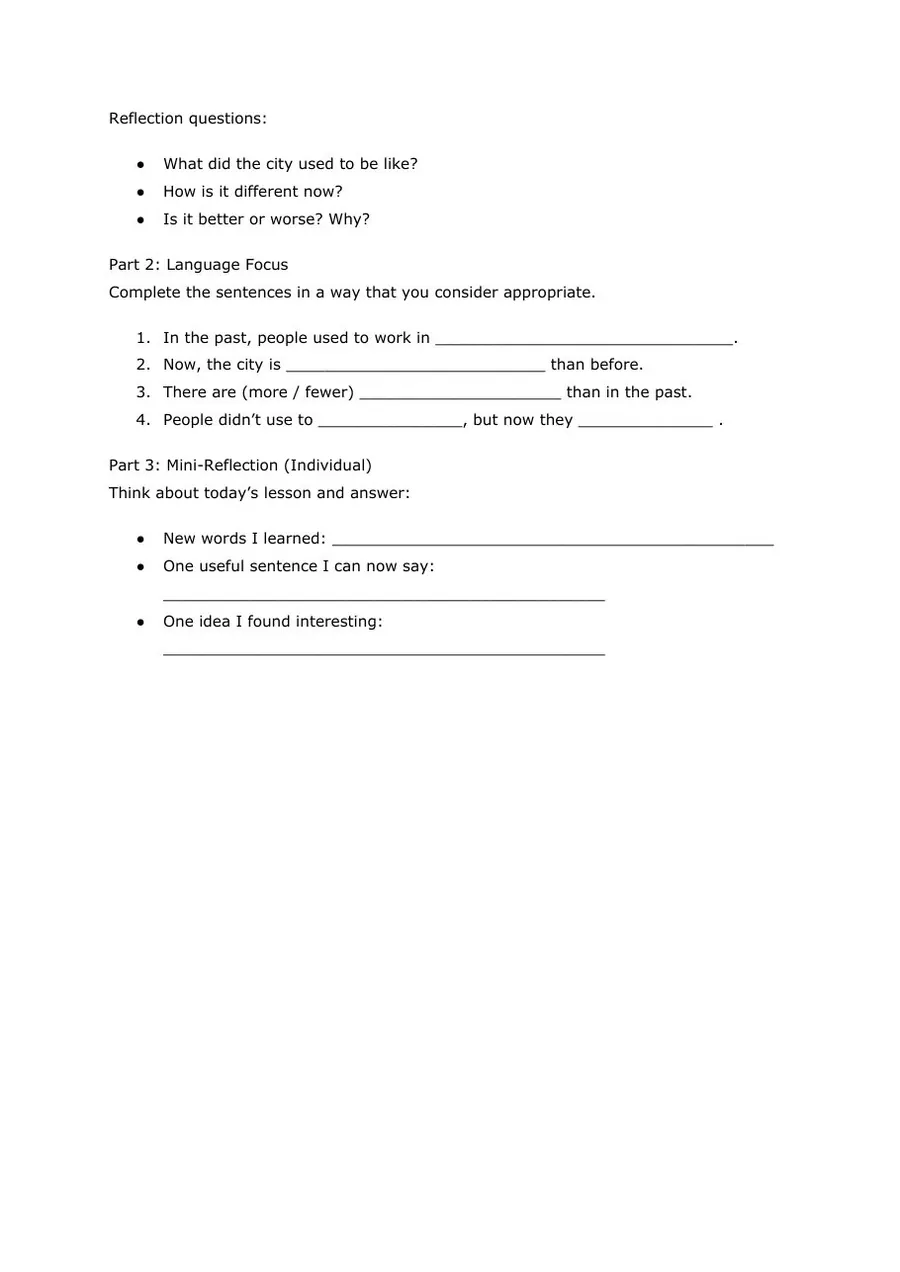
Description of the activity: The session begins with a brief warm-up activity in which the teacher presents a set of word cards. Students are provided with definitions and are required to identify the corresponding lexical items. This initial stage is designed to activate prior knowledge and engage learners in a low-stakes, interactive task (10 minutes). The first main activity consists of a vocabulary matching task supported by visual input. Students initially work individually to match images with their corresponding descriptions. This is followed by a pair-check phase lasting approximately five minutes, during which learners compare their responses and justify their choices using simple linguistic structures (e.g., “I think this is number 2 because…”). The activity concludes with whole-class feedback, where the teacher confirms the correct answers and clarifies key vocabulary items such as “production line,” “pollution,” and “industrial factory,” using the images as visual scaffolding (10 minutes). Subsequently, students engage in a sentence completion task. In the first stage, learners complete Exercise 2 individually by filling in sentences using vocabulary from a provided word bank. This is followed by a pair-check stage that allows for peer correction and collaborative discussion. In the final part of this sequence, students complete Exercise 3 by producing two to three sentences comparing the past and the present, using guided sentence starters such as “In the past…” and “Today…”. More proficient learners are encouraged to extend their responses by incorporating connectors such as “but” or “because” (15 minutes). In the final activity, students work collaboratively in small groups to construct a mind map that links the concepts of industry, environment, and identity. After a brief explanation of the task and the provision of a model example, groups design their mind maps, ensuring the inclusion of relevant vocabulary, references to past and present changes, and clear conceptual connections. The teacher monitors the activity and supports language production by posing guiding questions. The session concludes with a short sharing phase, during which each group presents one or two ideas using the target language structures practiced throughout the lesson. As a consolidation activity, students continue developing their plurilingual reflection journal at home by constructing a trilingual glossary (English / Basque / Spanish) of the key terms introduced during the session. (20 minutes). |
||
Special needs adaptations:
|
||
Pre-task: Warm-up definition-recognition task on industrial vocabulary. Retrieval of Session 1 terms. Main task: Image-matching task (individual), then peer comparison; guided sentence completion moving from a word bank to open production; creation of a collaborative mind-map linking industry, environment and identity. Language focus / Post-task: Whole-class feedback and explicit attention to key structures (used to + infinitive; comparatives) for describing past and present. Mini-reflection: which words were new? Mediation / Plurilingual hinge: Collaborative construction of a trilingual glossary in the journal (English / Basque / Spanish) of the key terms of the unit, with noticing of the suffix pattern ‑ation / ‑azioa / ‑ación and identification of false friends. |
||
Table 5. Session 2
| Session: 3 | Name: Industrial Heritage Exploration | |
|---|---|---|
| Competences: CD, CCL | Subject: Technology and Digitalization | |
| Materials: Google Earth, tablets/computers, guided maps, research templates and presentation template | Space: Computer lab | Participants: Technology and Digitalization teacher and Special Education teacher (SEN) |
| Grouping: Groups of 4 | Timing: 55 mins | |
Description of the activity: The session is structured as an inquiry-based, CLIL-oriented exploration of industrialization and urban transformation in the Basque context, using Google Earth as the main digital tool to support visualisation, research and oral communication in English. In the first phase, learners participate in a guided Google Earth tour of selected industrial sites. The teacher leads the class through a curated sequence of locations related to historical and contemporary industry, focusing on areas such as the shipyards of Bilbao and key industrial zones in and around Vitoria-Gasteiz. The aim of this phase is to activate background knowledge, introduce key visual and geographical references, and provide initial input on concepts such as industrial development, urban change and environmental impact, while learners observe, take brief notes and respond to guiding questions in English. Google Earth’s Voyager and project tools can be used here to present a pre-structured tour with embedded prompts and visuals that highlight relevant industrial landmarks and their surroundings (15 min). In the second phase, students work in small groups to conduct more focused research on specific locations introduced in the initial tour, for example, historic and contemporary sites linked to Bilbao’s shipbuilding sector and industrial zones in Vitoria-Gasteiz. Each group chooses one or two key sites and uses Google Earth’s navigation, 3D views and additional information layers to investigate how these spaces have changed over time in terms of land use, infrastructure, environmental conditions and urban growth.They will be provided a worksheet to note the transformations they find and then a presentation in which they have to write the information they found to present it later (25 min). The final phase focuses on oral communication and the sharing of knowledge. Each group prepares a brief, structured presentation in English to report on the assigned locations, with an emphasis on describing past and present characteristics, identifying changes over time, and reflecting on their potential impact on the environment and local identity. During the presentations, peers engage in a feedback process using an evaluation checklist, which is provided to each group at the end of the session. This approach fosters both linguistic accuracy and communicative effectiveness. Additionally, a mediation-oriented plurilingual component is incorporated, whereby edach group includes 4 glossary entries (one from each student in the group) in a shared classroom document (15 min). |
||
Special needs adaptations:
|
||
Pre-task: Quick demonstration of Google Earth and of the comparative map interface. Main task: In groups, students research specific locations (Miribilla, Altos Hornos de Vizcaya, Armentia), analyse past-present changes with visual and textual support and complete an inquiry worksheet. Each group delivers a short presentation in English. Language focus / Post-task: Peer feedback using a checklist focused on clarity and use of past/present contrasts. Mediation / Plurilingual hinge: Groups publish their trilingual glossary entries in a shared classroom document. |
||
Table 6. Session 3
| Session: 4 | Name: Past and Present Debate | |
|---|---|---|
| Competences: CCL, CC | Subject: English | |
| Materials: Debate language sheet, grammar sheet, debate topic cards, projector, debate student preparation worksheet | Space: Regular classroom (horseshoe arrangement) | Participants: English teacher and a Special Education teacher (SEN) |
| Grouping: Groups of 4 → 2 teams of 8 (ideally) | Timing: 55 mins | |
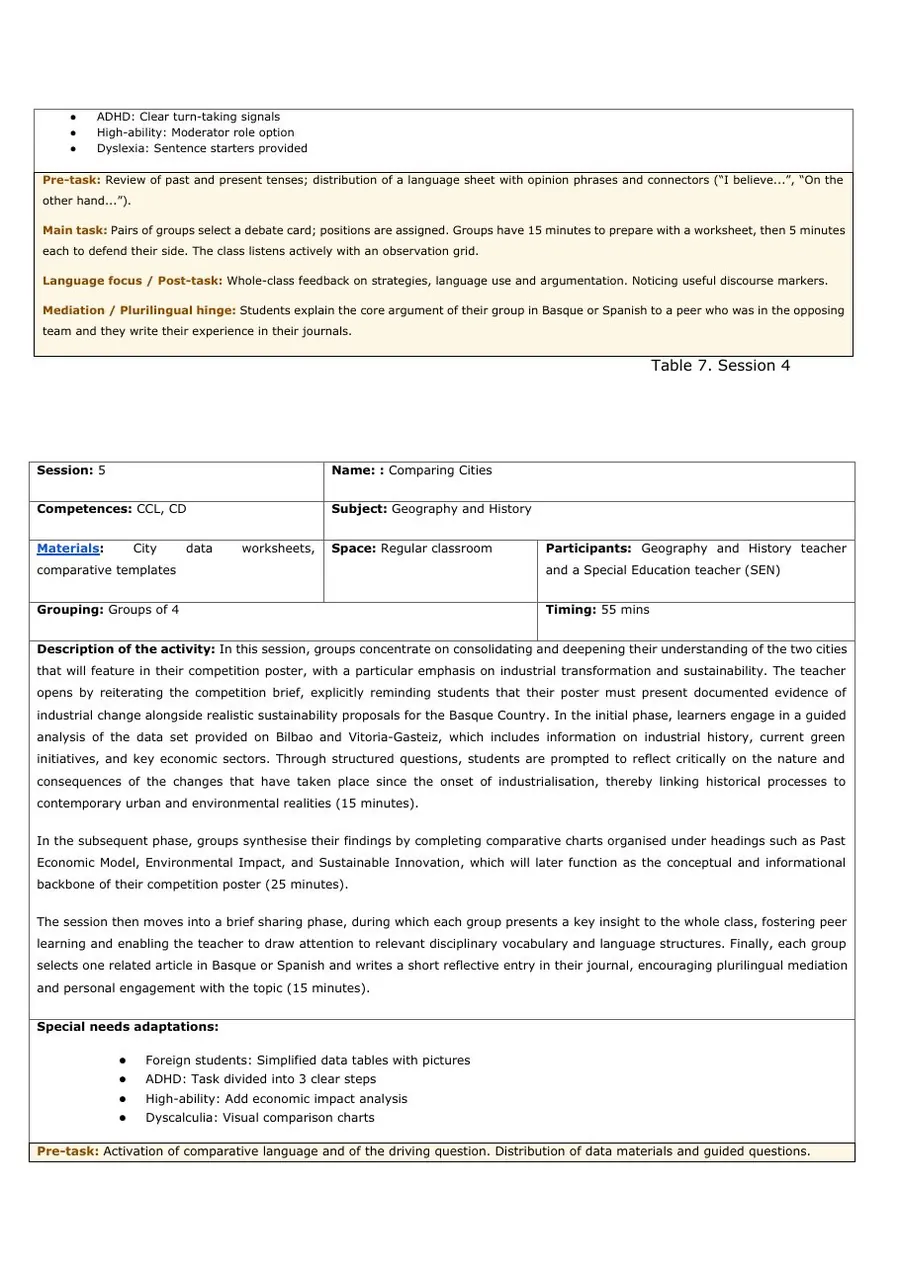
Description of the activity: Before the debate students review the present and past tenses in English using a review photocopy. Afterwards, each student receives a language support sheet containing opinion phrases and connectors (e.g., “I believe…”, “On the other hand…”, “From my point of view…”, “In contrast…”) that can be useful in the debate. This resource is intended to help learners express agreement, disagreement and nuanced viewpoints more accurately and coherently in English (10 minutes). The debate procedure is highly structured to ensure fairness and active involvement. Two groups at a time are invited to the front of the class and select a card from a set of debate topics related to industry, the environment and local identity. For each topic, one group is randomly assigned to argue in favour and the other to argue against, regardless of their personal opinions, thus encouraging critical thinking and the ability to consider multiple perspectives. Once positions are assigned, both groups are given fifteen minutes to complete a planning worksheet where they can note down their main arguments, supporting examples (for instance, from Bilbao or Vitoria), and useful language drawn from the language sheet (15 minutes). After the preparation phase, the debate begins. Each group has approximately five minutes to present and defend its side of the argument, using the target functional language and connectors as far as possible, and responding briefly to the opposing group’s key points. The rest of the class can be encouraged to listen actively and later comment on which arguments they found most convincing and why. At the end of the session, the teacher provides feedback to all students, commenting on both content (quality and relevance of arguments, use of historical and local examples) and language (clarity, use of opinion phrases and connectors, interactional strategies). This feedback aims to reinforce effective communicative behaviours and support learners’ ongoing development of academic discussion skills. Lastly, students individually summarise their group’s main argument in Basque or Spanish to a classmate from the opposing team, and then briefly reflect on this mediation experience in their journals, focusing on what they understood and how they felt during the exchange (30 minutes). |
||
Special needs adaptations:
|
||
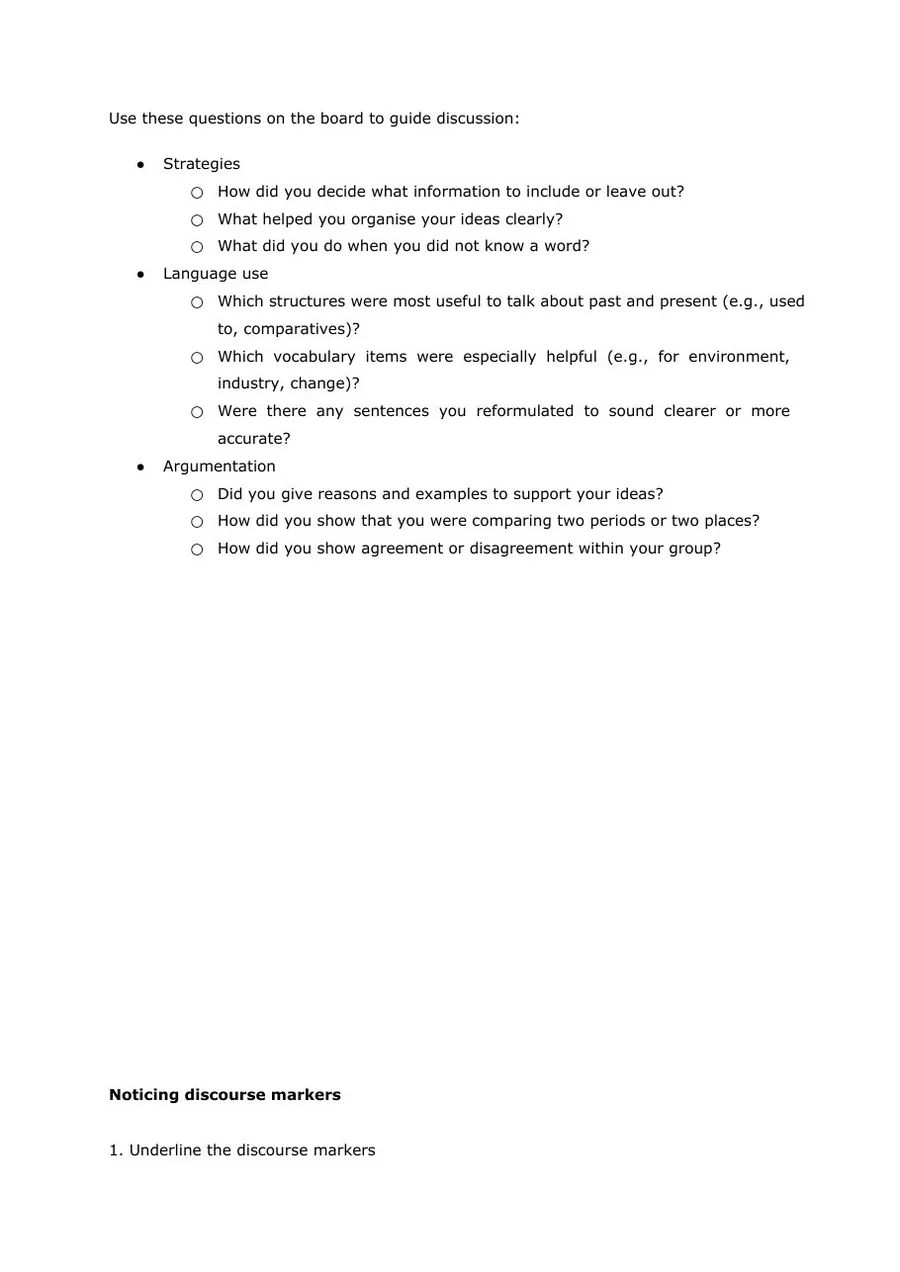
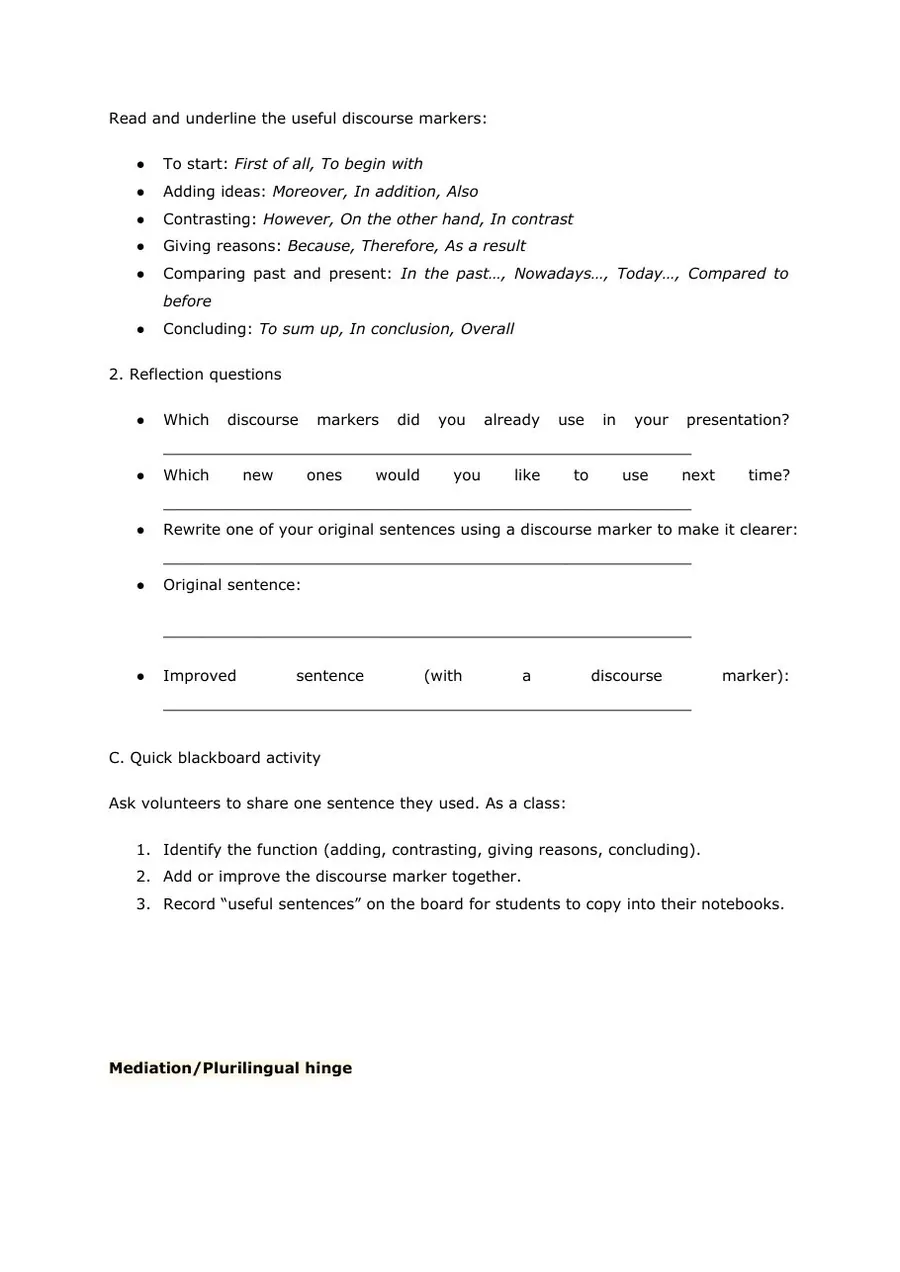
Pre-task: Review of past and present tenses; distribution of a language sheet with opinion phrases and connectors (“I believe...”, “On the other hand...”). Main task: Pairs of groups select a debate card; positions are assigned. Groups have 15 minutes to prepare with a worksheet, then 5 minutes each to defend their side. The class listens actively with an observation grid. Language focus / Post-task: Whole-class feedback on strategies, language use and argumentation. Noticing useful discourse markers. Mediation / Plurilingual hinge: Students explain the core argument of their group in Basque or Spanish to a peer who was in the opposing team and they write their experience in their journals. |
||
Table 7. Session 4
| Session: 5 | Name: : Comparing Cities | |
|---|---|---|
| Competences: CCL, CD | Subject: Geography and History | |
| Materials: City data worksheets, comparative templates | Space: Regular classroom | Participants: Geography and History teacher and a Special Education teacher (SEN) |
| Grouping: Groups of 4 | Timing: 55 mins | |
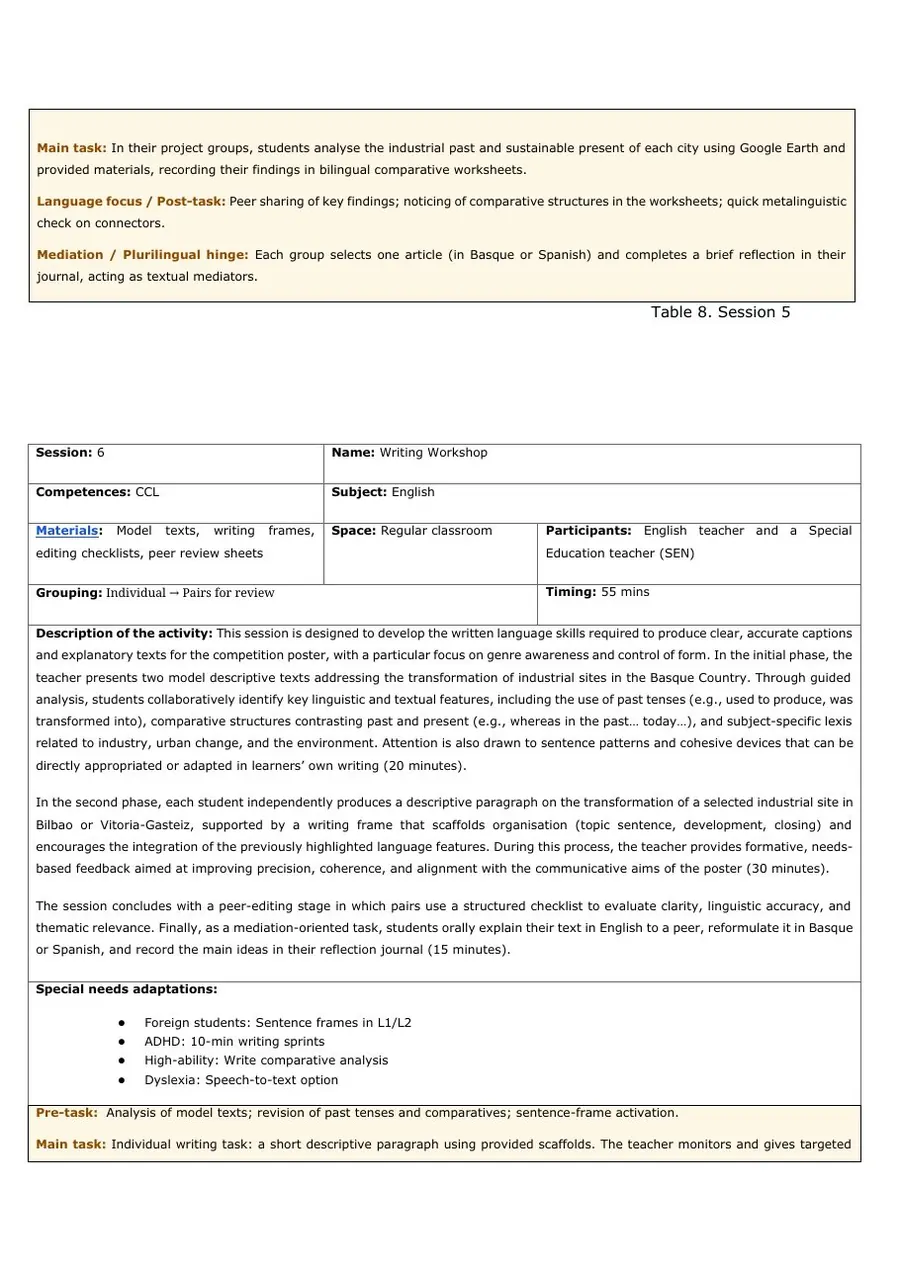
Description of the activity: In this session, groups concentrate on consolidating and deepening their understanding of the two cities that will feature in their competition poster, with a particular emphasis on industrial transformation and sustainability. The teacher opens by reiterating the competition brief, explicitly reminding students that their poster must present documented evidence of industrial change alongside realistic sustainability proposals for the Basque Country. In the initial phase, learners engage in a guided analysis of the data set provided on Bilbao and Vitoria-Gasteiz, which includes information on industrial history, current green initiatives, and key economic sectors. Through structured questions, students are prompted to reflect critically on the nature and consequences of the changes that have taken place since the onset of industrialisation, thereby linking historical processes to contemporary urban and environmental realities (15 minutes). In the subsequent phase, groups synthesise their findings by completing comparative charts organised under headings such as Past Economic Model, Environmental Impact, and Sustainable Innovation, which will later function as the conceptual and informational backbone of their competition poster (25 minutes). The session then moves into a brief sharing phase, during which each group presents a key insight to the whole class, fostering peer learning and enabling the teacher to draw attention to relevant disciplinary vocabulary and language structures. Finally, each group selects one related article in Basque or Spanish and writes a short reflective entry in their journal, encouraging plurilingual mediation and personal engagement with the topic (15 minutes). |
||
Special needs adaptations:
|
||
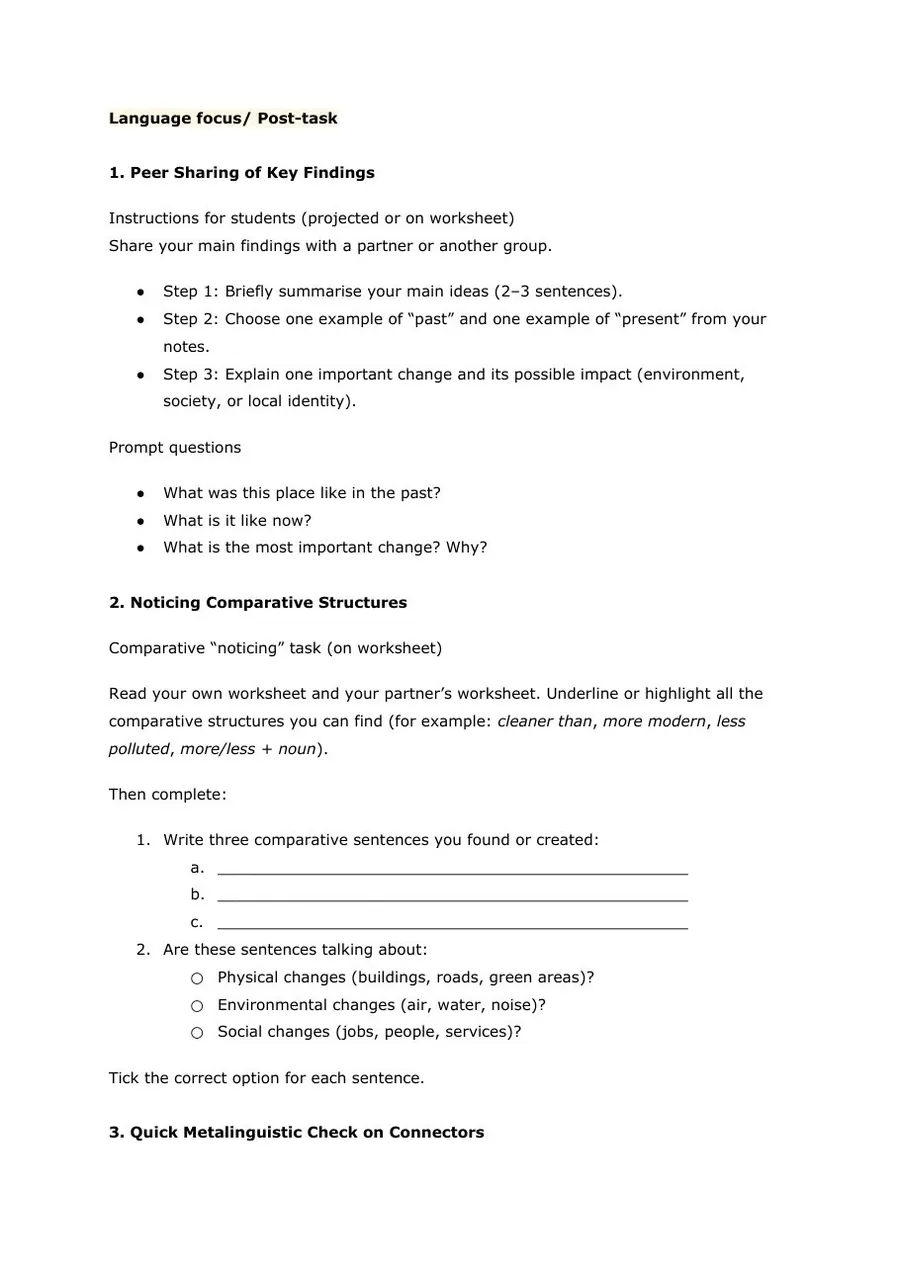
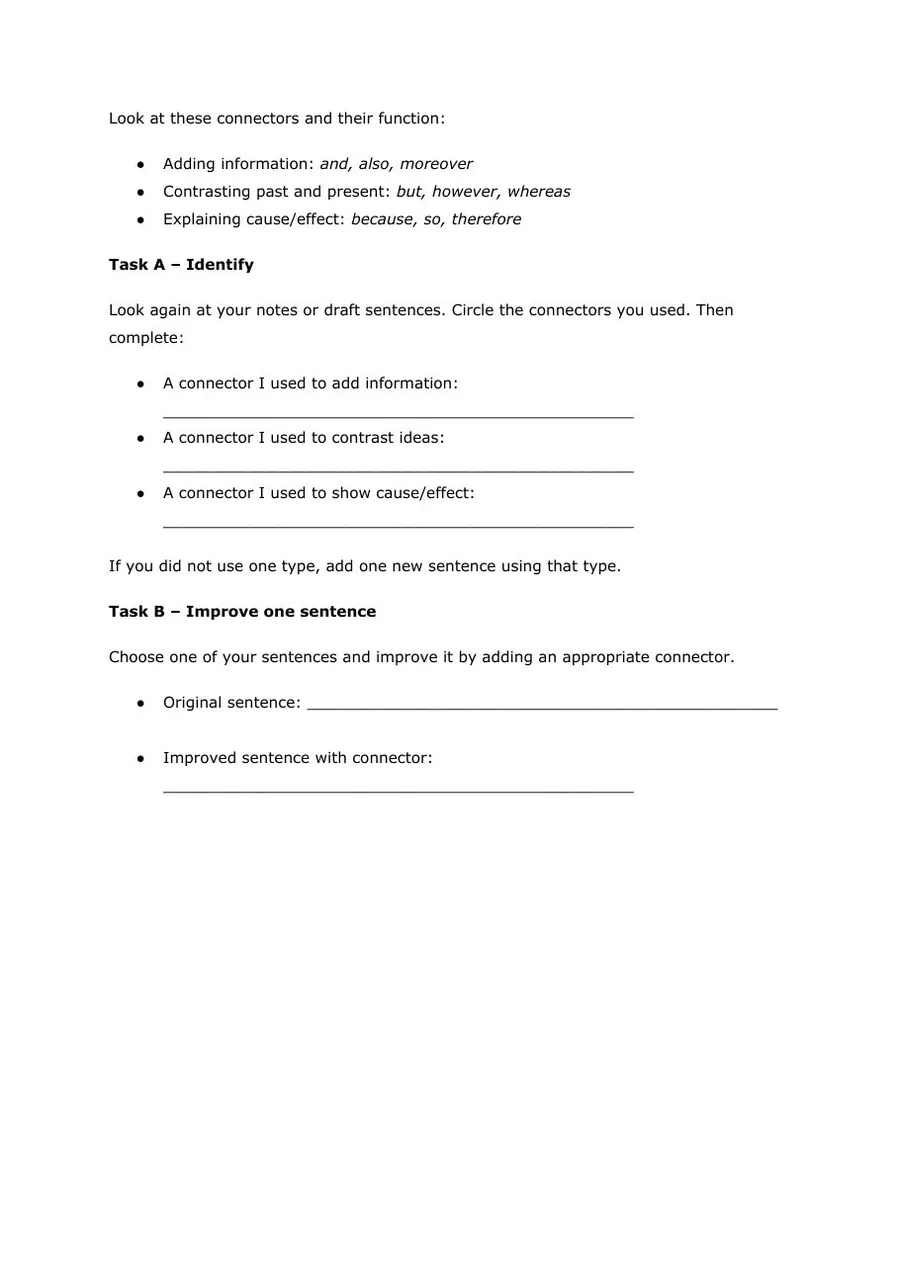
Pre-task: Activation of comparative language and of the driving question. Distribution of data materials and guided questions. Main task: In their project groups, students analyse the industrial past and sustainable present of each city using Google Earth and provided materials, recording their findings in bilingual comparative worksheets. Language focus / Post-task: Peer sharing of key findings; noticing of comparative structures in the worksheets; quick metalinguistic check on connectors. Mediation / Plurilingual hinge: Each group selects one article (in Basque or Spanish) and completes a brief reflection in their journal, acting as textual mediators. |
||
Table 8. Session 5
| Session: 6 | Name: Writing Workshop | |
|---|---|---|
| Competences: CCL | Subject: English | |
| Materials: Model texts, writing frames, editing checklists, peer review sheets | Space: Regular classroom | Participants: English teacher and a Special Education teacher (SEN) |
| Grouping: Individual → Pairs for review | Timing: 55 mins | |
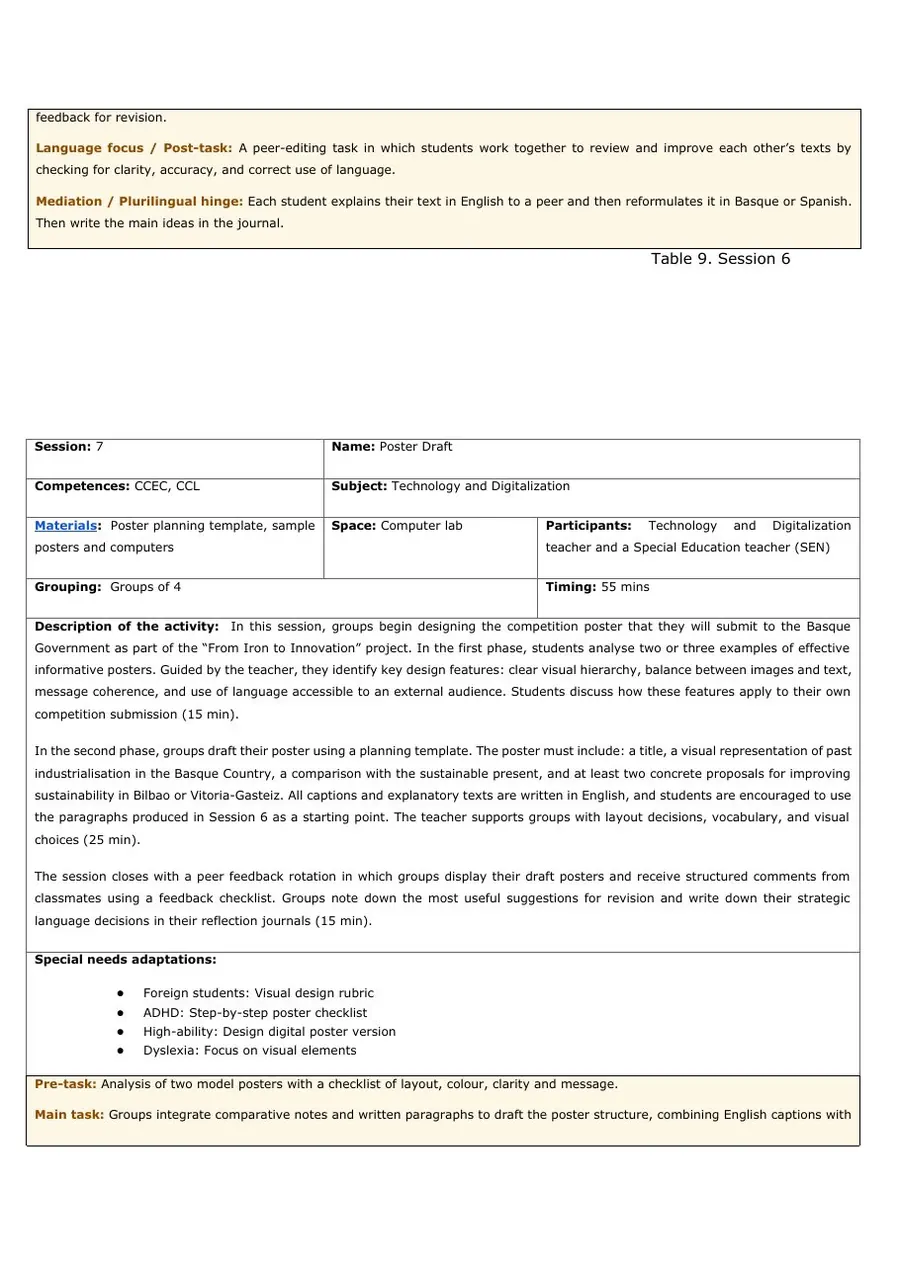
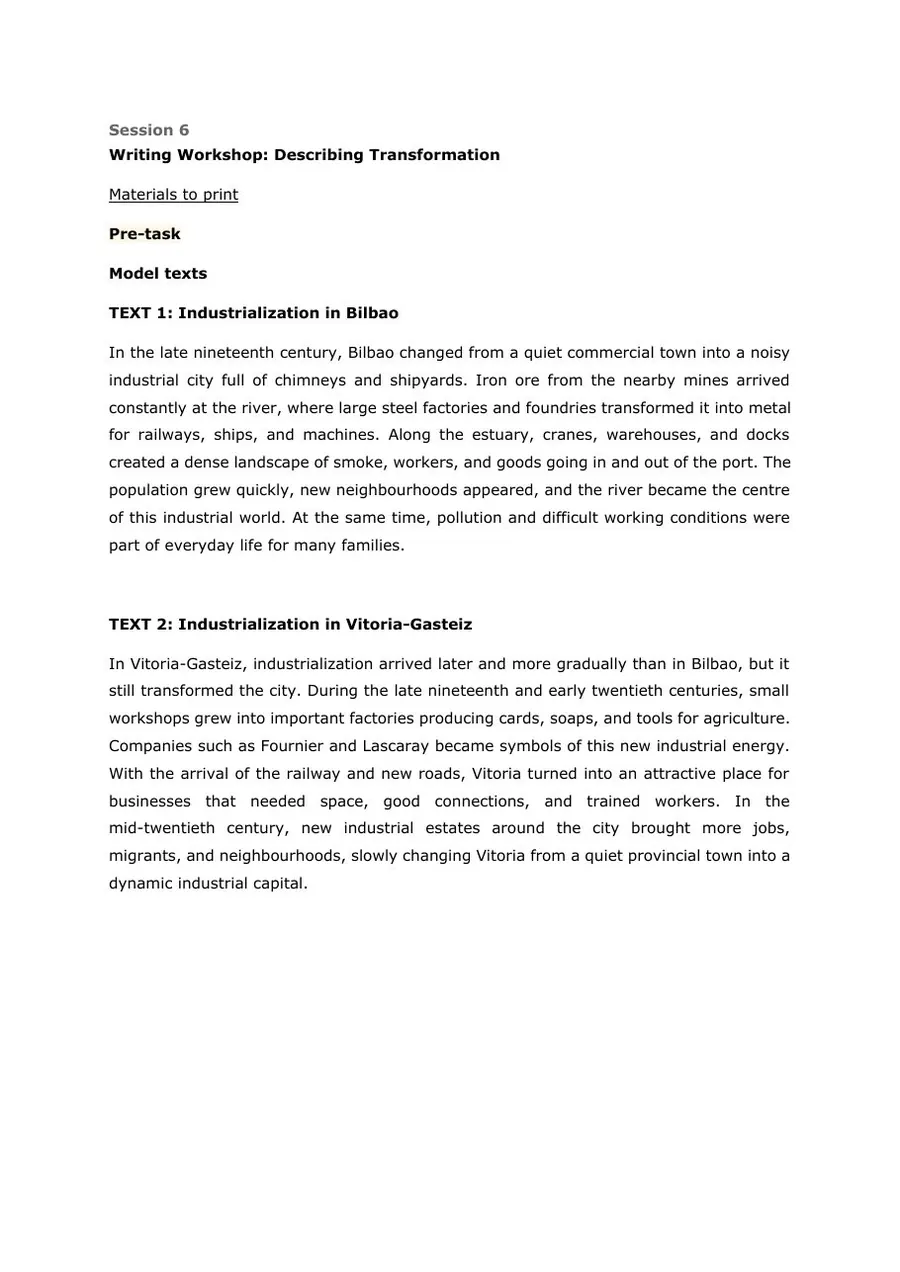
Description of the activity: This session is designed to develop the written language skills required to produce clear, accurate captions and explanatory texts for the competition poster, with a particular focus on genre awareness and control of form. In the initial phase, the teacher presents two model descriptive texts addressing the transformation of industrial sites in the Basque Country. Through guided analysis, students collaboratively identify key linguistic and textual features, including the use of past tenses (e.g., used to produce, was transformed into), comparative structures contrasting past and present (e.g., whereas in the past… today…), and subject-specific lexis related to industry, urban change, and the environment. Attention is also drawn to sentence patterns and cohesive devices that can be directly appropriated or adapted in learners’ own writing (20 minutes). In the second phase, each student independently produces a descriptive paragraph on the transformation of a selected industrial site in Bilbao or Vitoria-Gasteiz, supported by a writing frame that scaffolds organisation (topic sentence, development, closing) and encourages the integration of the previously highlighted language features. During this process, the teacher provides formative, needs-based feedback aimed at improving precision, coherence, and alignment with the communicative aims of the poster (30 minutes). The session concludes with a peer-editing stage in which pairs use a structured checklist to evaluate clarity, linguistic accuracy, and thematic relevance. Finally, as a mediation-oriented task, students orally explain their text in English to a peer, reformulate it in Basque or Spanish, and record the main ideas in their reflection journal (15 minutes). |
||
Special needs adaptations:
|
||
Pre-task: Analysis of model texts; revision of past tenses and comparatives; sentence-frame activation. Main task: Individual writing task: a short descriptive paragraph using provided scaffolds. The teacher monitors and gives targeted feedback for revision. Language focus / Post-task: A peer-editing task in which students work together to review and improve each other’s texts by checking for clarity, accuracy, and correct use of language. Mediation / Plurilingual hinge: Each student explains their text in English to a peer and then reformulates it in Basque or Spanish. Then write the main ideas in the journal. |
||
Table 9. Session 6
| Session: 7 | Name: Poster Draft | |
|---|---|---|
| Competences: CCEC, CCL | Subject: Technology and Digitalization | |
| Materials: Poster planning template, sample posters and computers | Space: Computer lab | Participants: Technology and Digitalization teacher and a Special Education teacher (SEN) |
| Grouping: Groups of 4 | Timing: 55 mins | |
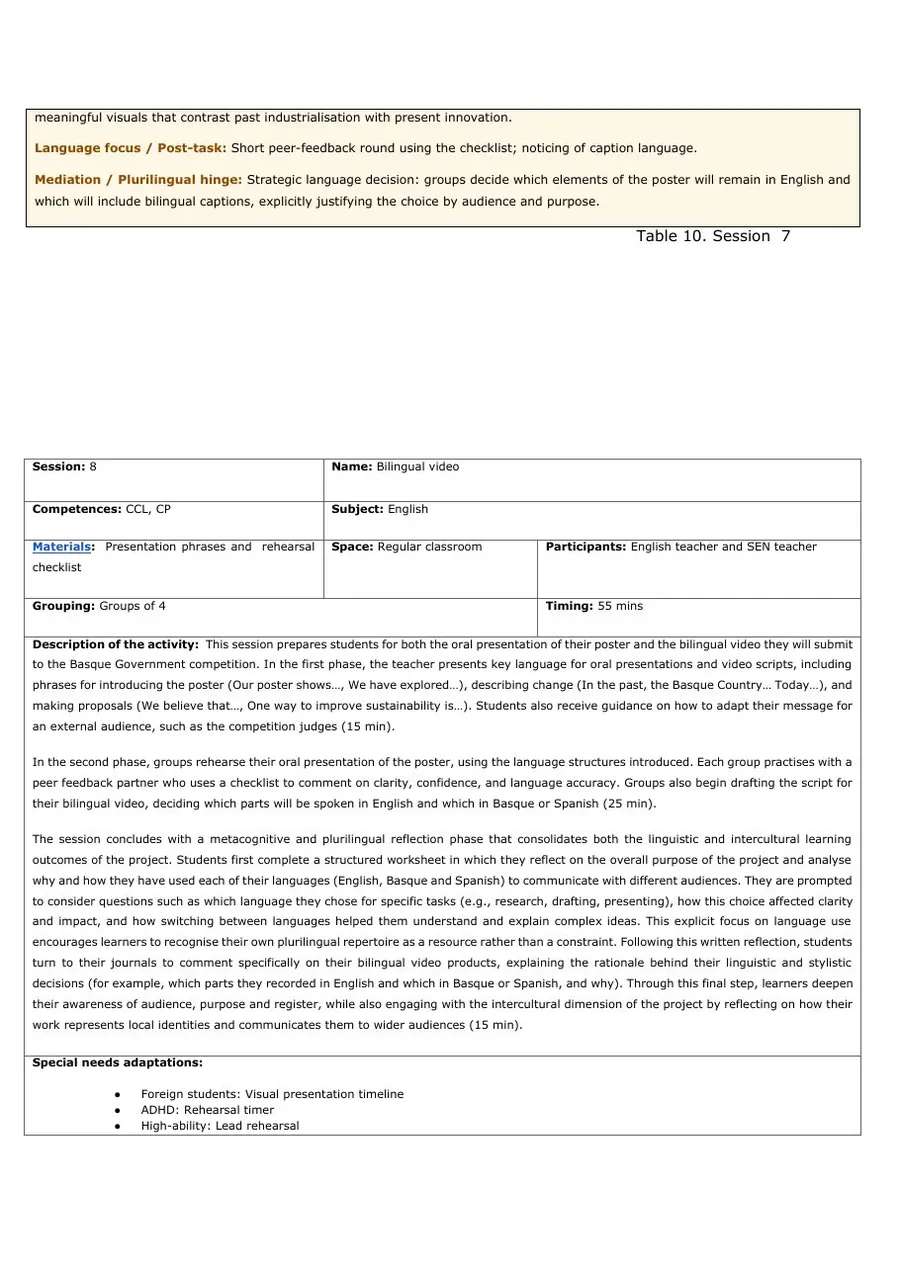
Description of the activity: In this session, groups begin designing the competition poster that they will submit to the Basque Government as part of the “From Iron to Innovation” project. In the first phase, students analyse two or three examples of effective informative posters. Guided by the teacher, they identify key design features: clear visual hierarchy, balance between images and text, message coherence, and use of language accessible to an external audience. Students discuss how these features apply to their own competition submission (15 min). In the second phase, groups draft their poster using a planning template. The poster must include: a title, a visual representation of past industrialisation in the Basque Country, a comparison with the sustainable present, and at least two concrete proposals for improving sustainability in Bilbao or Vitoria-Gasteiz. All captions and explanatory texts are written in English, and students are encouraged to use the paragraphs produced in Session 6 as a starting point. The teacher supports groups with layout decisions, vocabulary, and visual choices (25 min). The session closes with a peer feedback rotation in which groups display their draft posters and receive structured comments from classmates using a feedback checklist. Groups note down the most useful suggestions for revision and write down their strategic language decisions in their reflection journals (15 min). |
||
Special needs adaptations:
|
||
Pre-task: Analysis of two model posters with a checklist of layout, colour, clarity and message. Main task: Groups integrate comparative notes and written paragraphs to draft the poster structure, combining English captions with meaningful visuals that contrast past industrialisation with present innovation. Language focus / Post-task: Short peer-feedback round using the checklist; noticing of caption language. Mediation / Plurilingual hinge: Strategic language decision: groups decide which elements of the poster will remain in English and which will include bilingual captions, explicitly justifying the choice by audience and purpose. |
||
Table 10. Session 7
| Session: 8 | Name: Bilingual video | |
|---|---|---|
| Competences: CCL, CP | Subject: English | |
| Materials: Presentation phrases and rehearsal checklist | Space: Regular classroom | Participants: English teacher and SEN teacher |
| Grouping: Groups of 4 | Timing: 55 mins | |
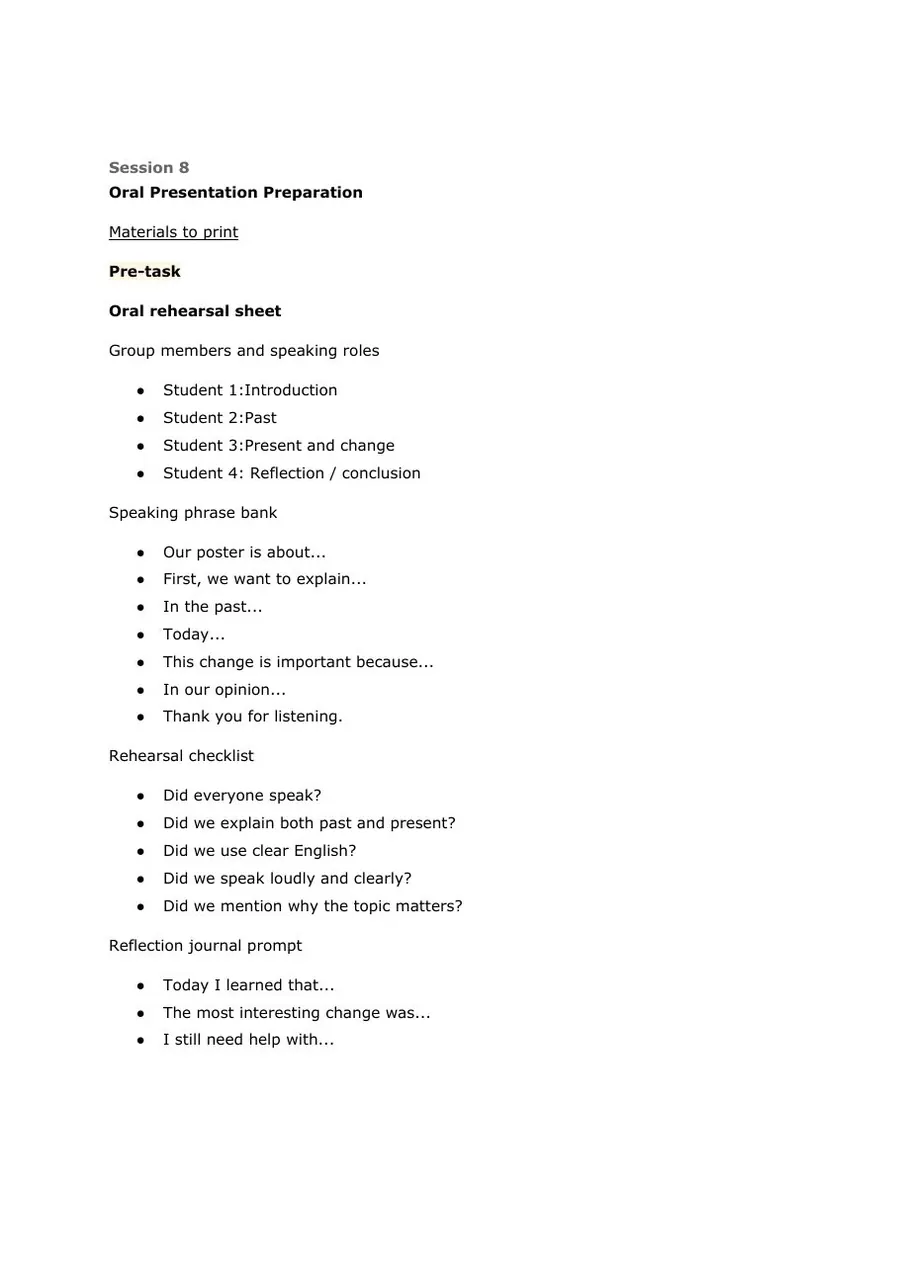
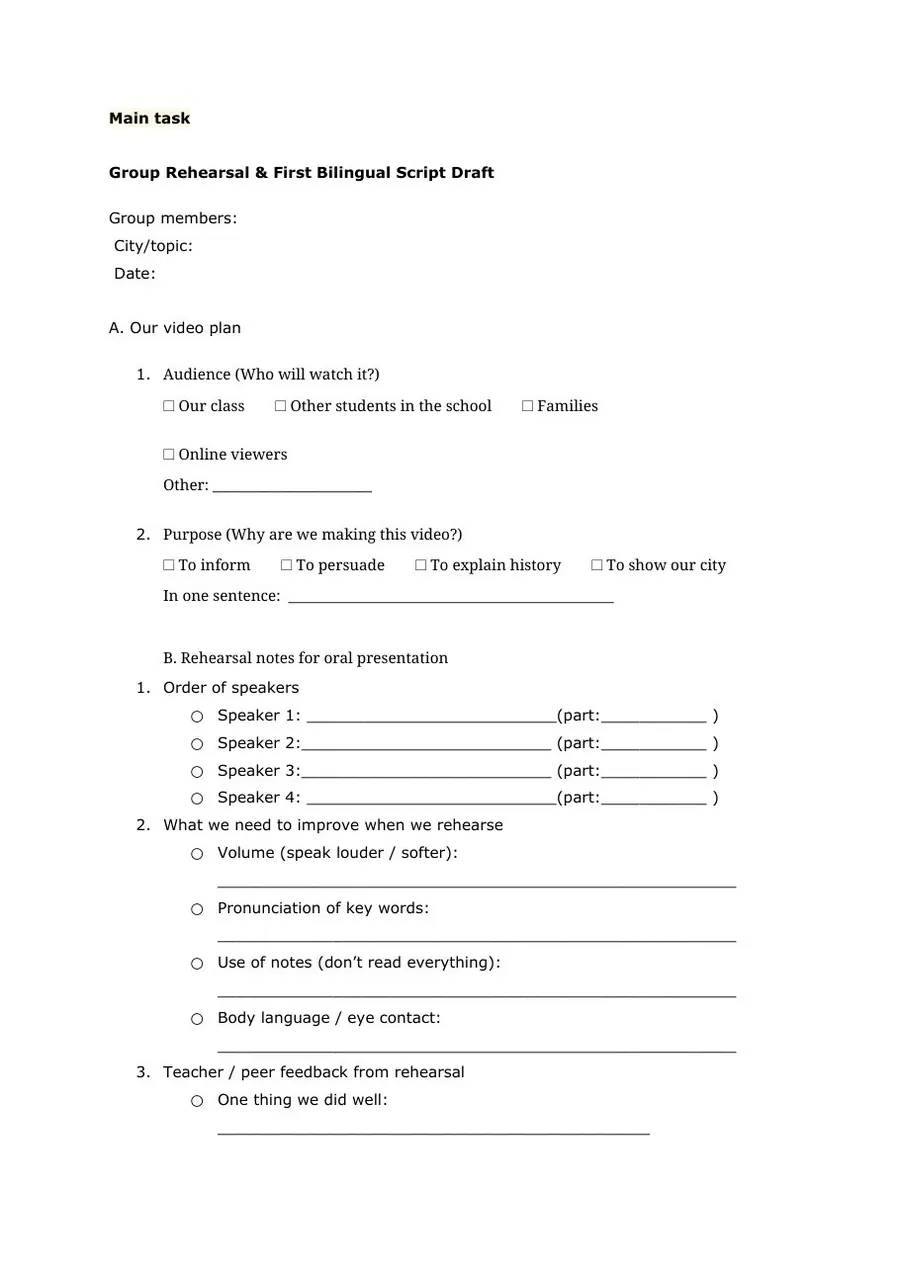
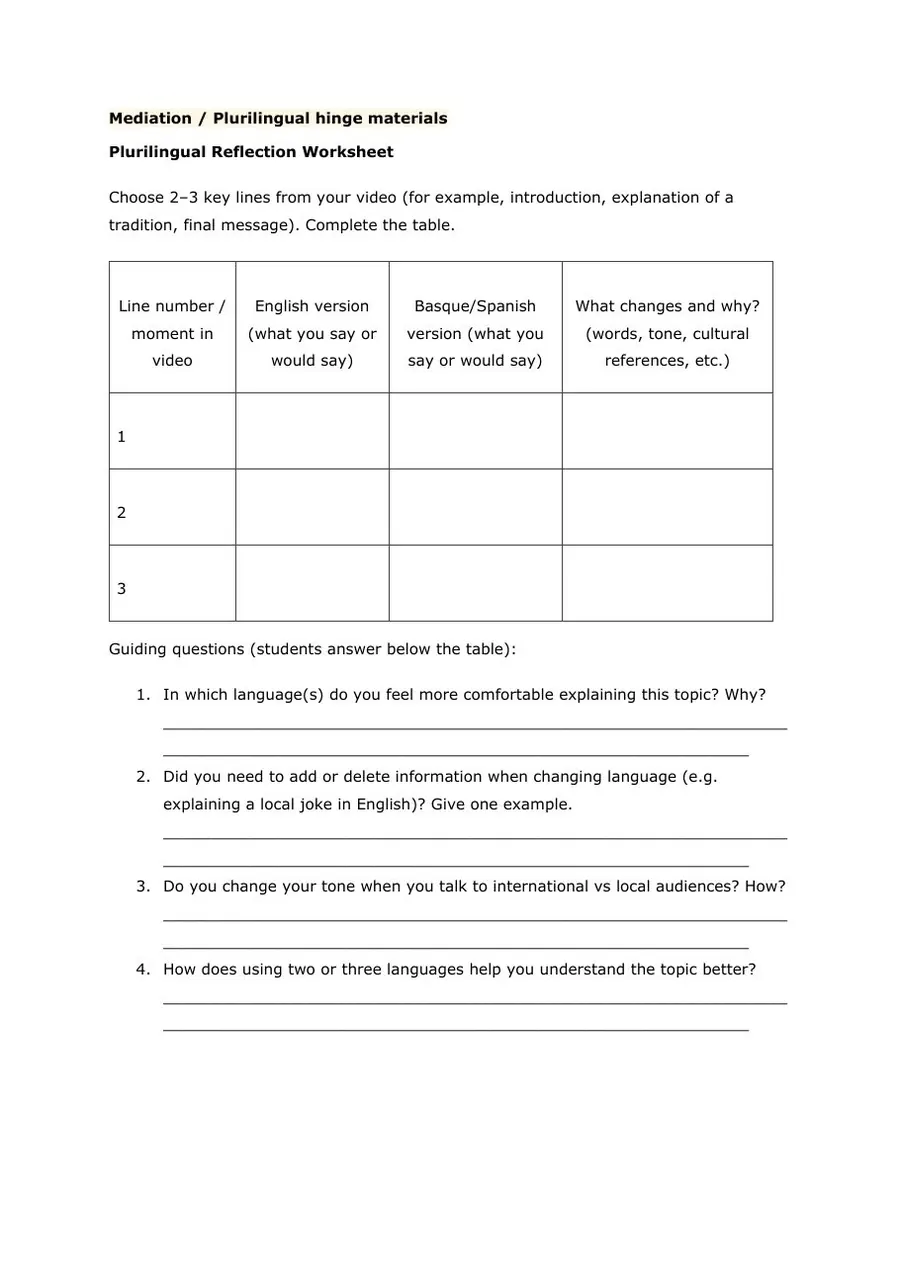
Description of the activity: This session prepares students for both the oral presentation of their poster and the bilingual video they will submit to the Basque Government competition. In the first phase, the teacher presents key language for oral presentations and video scripts, including phrases for introducing the poster (Our poster shows…, We have explored…), describing change (In the past, the Basque Country… Today…), and making proposals (We believe that…, One way to improve sustainability is…). Students also receive guidance on how to adapt their message for an external audience, such as the competition judges (15 min). In the second phase, groups rehearse their oral presentation of the poster, using the language structures introduced. Each group practises with a peer feedback partner who uses a checklist to comment on clarity, confidence, and language accuracy. Groups also begin drafting the script for their bilingual video, deciding which parts will be spoken in English and which in Basque or Spanish (25 min). The session concludes with a metacognitive and plurilingual reflection phase that consolidates both the linguistic and intercultural learning outcomes of the project. Students first complete a structured worksheet in which they reflect on the overall purpose of the project and analyse why and how they have used each of their languages (English, Basque and Spanish) to communicate with different audiences. They are prompted to consider questions such as which language they chose for specific tasks (e.g., research, drafting, presenting), how this choice affected clarity and impact, and how switching between languages helped them understand and explain complex ideas. This explicit focus on language use encourages learners to recognise their own plurilingual repertoire as a resource rather than a constraint. Following this written reflection, students turn to their journals to comment specifically on their bilingual video products, explaining the rationale behind their linguistic and stylistic decisions (for example, which parts they recorded in English and which in Basque or Spanish, and why). Through this final step, learners deepen their awareness of audience, purpose and register, while also engaging with the intercultural dimension of the project by reflecting on how their work represents local identities and communicates them to wider audiences (15 min). |
||
Special needs adaptations:
|
||
Pre-task: Modelling of presentation phrasing (“Our poster shows...”, “We believe the Basque Country can...”). Clarification of assessment criteria. Main task: Group rehearsal of oral presentation; drafting of a first version of the bilingual video script, with explicit decisions about when to use English and when to use Basque or Spanish. Language focus / Post-task: In a separate worksheet students need to reflect on why and how they use each language to reach their audience. Mediation / Plurilingual hinge: Bilingual video script reflection in the journal. |
||
Table 11. Session 8
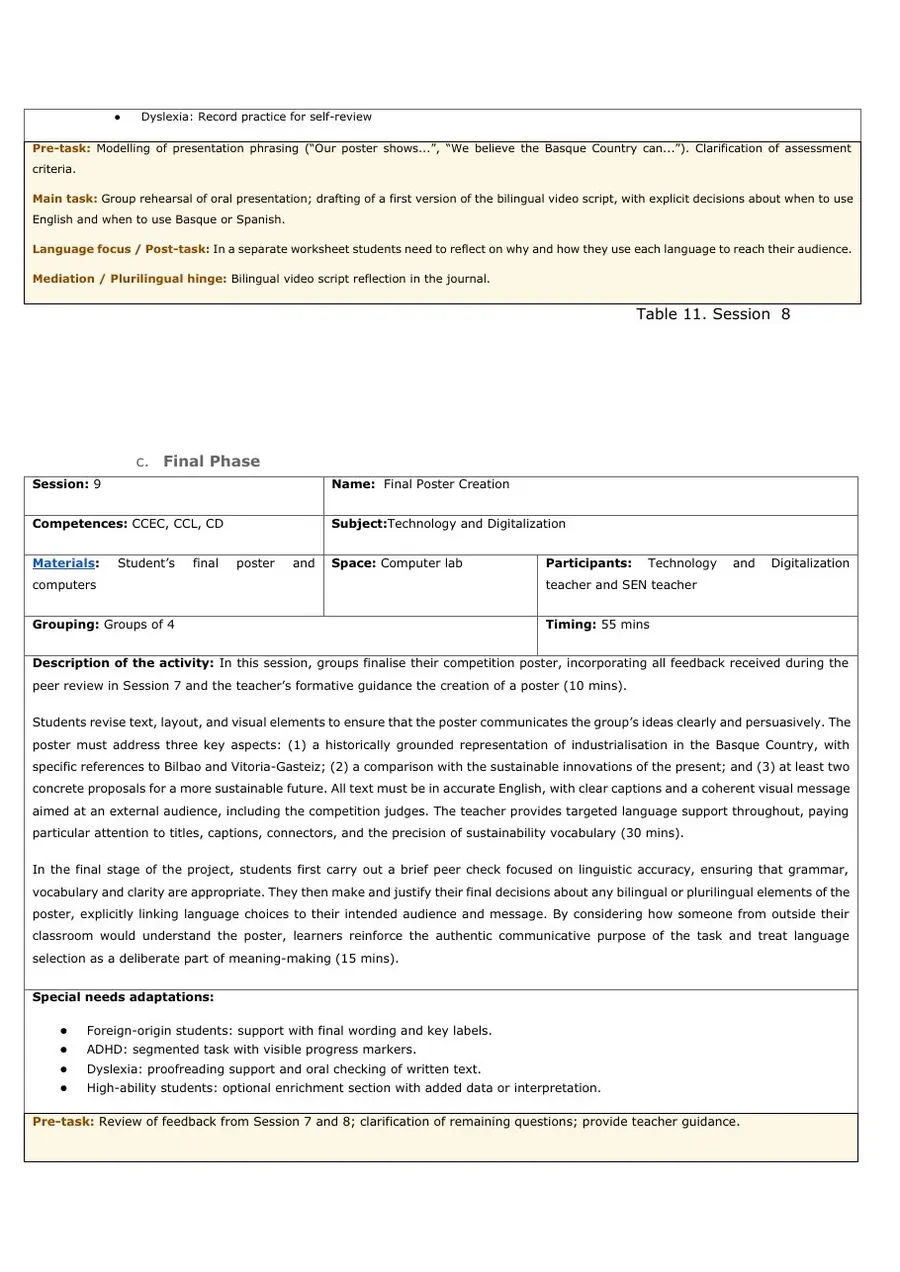
| Session: 9 | Name: Final Poster Creation | |
|---|---|---|
| Competences: CCEC, CCL, CD | Subject:Technology and Digitalization | |
| Materials: Student’s final poster and computers | Space: Computer lab | Participants: Technology and Digitalization teacher and SEN teacher |
| Grouping: Groups of 4 | Timing: 55 mins | |
Description of the activity: In this session, groups finalise their competition poster, incorporating all feedback received during the peer review in Session 7 and the teacher’s formative guidance the creation of a poster (10 mins). Students revise text, layout, and visual elements to ensure that the poster communicates the group’s ideas clearly and persuasively. The poster must address three key aspects: (1) a historically grounded representation of industrialisation in the Basque Country, with specific references to Bilbao and Vitoria-Gasteiz; (2) a comparison with the sustainable innovations of the present; and (3) at least two concrete proposals for a more sustainable future. All text must be in accurate English, with clear captions and a coherent visual message aimed at an external audience, including the competition judges. The teacher provides targeted language support throughout, paying particular attention to titles, captions, connectors, and the precision of sustainability vocabulary (30 mins). In the final stage of the project, students first carry out a brief peer check focused on linguistic accuracy, ensuring that grammar, vocabulary and clarity are appropriate. They then make and justify their final decisions about any bilingual or plurilingual elements of the poster, explicitly linking language choices to their intended audience and message. By considering how someone from outside their classroom would understand the poster, learners reinforce the authentic communicative purpose of the task and treat language selection as a deliberate part of meaning-making (15 mins). |
||
Special needs adaptations:
|
||
Pre-task: Review of feedback from Session 7 and 8; clarification of remaining questions; provide teacher guidance. Main task: Finalisation of the digital poster, ensuring a clear balance between visual and textual content in English. Language focus / Post-task: Brief peer-check on linguistic accuracy. Mediation / Plurilingual hinge: Final decisions on any bilingual elements, justified in terms of audience and message. |
||
Table 12. Session 9
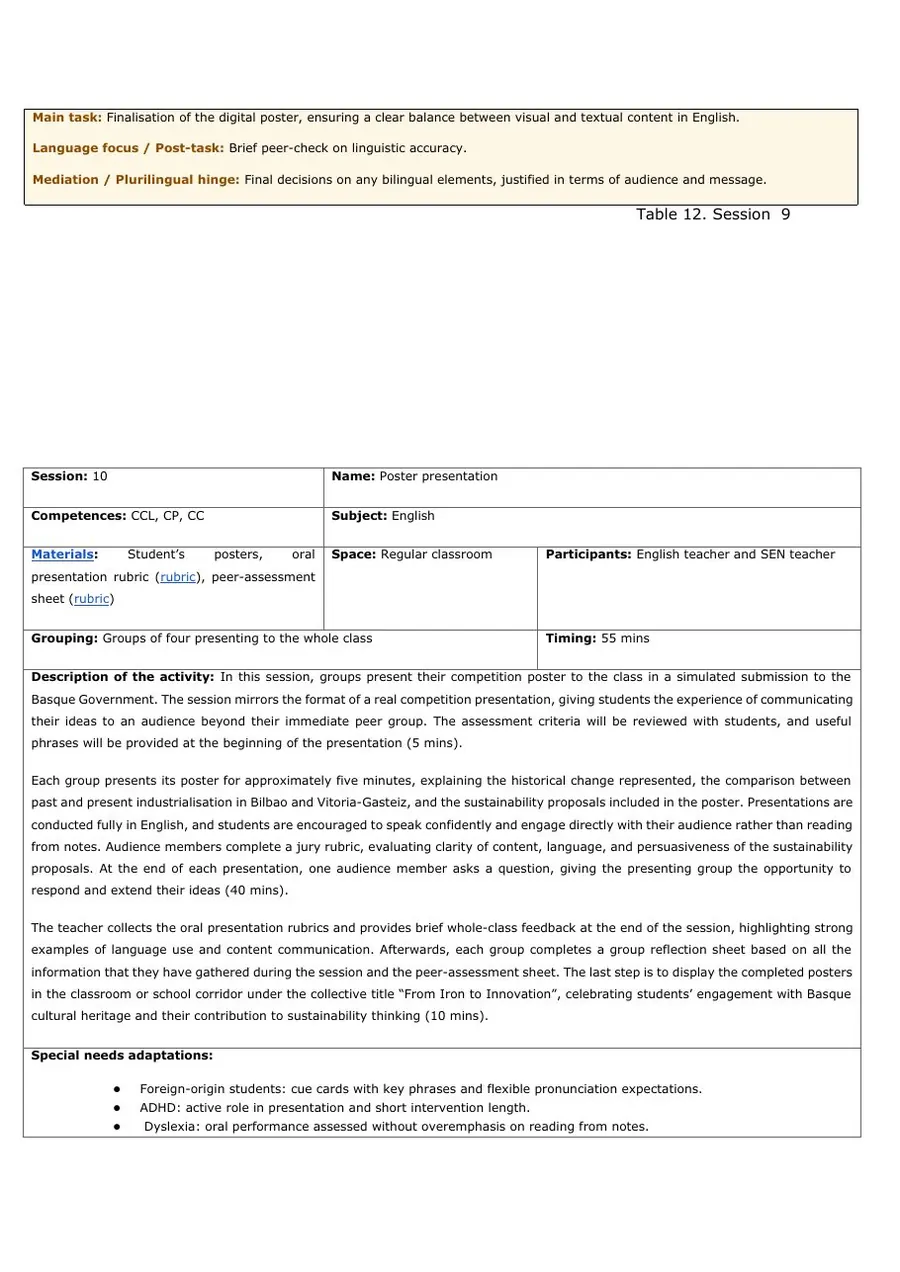
| Session: 10 | Name: Poster presentation | |
|---|---|---|
| Competences: CCL, CP, CC | Subject: English | |
| Materials: Student’s posters, oral presentation rubric (rubric), peer-assessment sheet (rubric) | Space: Regular classroom | Participants: English teacher and SEN teacher |
| Grouping: Groups of four presenting to the whole class | Timing: 55 mins | |
Description of the activity: In this session, groups present their competition poster to the class in a simulated submission to the Basque Government. The session mirrors the format of a real competition presentation, giving students the experience of communicating their ideas to an audience beyond their immediate peer group. The assessment criteria will be reviewed with students, and useful phrases will be provided at the beginning of the presentation (5 mins). Each group presents its poster for approximately five minutes, explaining the historical change represented, the comparison between past and present industrialisation in Bilbao and Vitoria-Gasteiz, and the sustainability proposals included in the poster. Presentations are conducted fully in English, and students are encouraged to speak confidently and engage directly with their audience rather than reading from notes. Audience members complete a jury rubric, evaluating clarity of content, language, and persuasiveness of the sustainability proposals. At the end of each presentation, one audience member asks a question, giving the presenting group the opportunity to respond and extend their ideas (40 mins). The teacher collects the oral presentation rubrics and provides brief whole-class feedback at the end of the session, highlighting strong examples of language use and content communication. Afterwards, each group completes a group reflection sheet based on all the information that they have gathered during the session and the peer-assessment sheet. The last step is to display the completed posters in the classroom or school corridor under the collective title “From Iron to Innovation”, celebrating students’ engagement with Basque cultural heritage and their contribution to sustainability thinking (10 mins). |
||
Special needs adaptations:
|
||
Pre-task: Activation of presentation phrases; reminder of assessment criteria; arrangement of the “Basque Government jury” space. Main task: Group presentations (3–4 minutes each); the rest of the class acts as jury using a rubric. Language focus / Post-task: Whole-class feedback and reflection on communicative effectiveness, clarity, pronunciation and accuracy. Mediation / Plurilingual hinge: Peer-assessment sheets are filled in and each group note one strength and one improvement linked to their use of English and, where relevant, their use of Basque or Spanish. |
||
Table 13. Session 10
| Session: 11 | Name: Digital Video Production | |
|---|---|---|
| Competences: CD, CCL, CP, CCEC | Subject: Technology and Digitalization | |
| Materials: Video editor (Vids app from Google), the audios and videos. | Space: Computer lab | Participants: Technology and Digitalization teacher and SEN teacher |
| Grouping: Groups of four | Timing: 55 mins | |
Description of the activity: In this session, each group produces the bilingual video (in basque and English) that will be submitted alongside the poster to the Basque Government competition. The video is the group’s final public-facing product and should present their ideas about sustainable development in the Basque Country to an external audience. In the first phase, groups review the script drafted in Session 8 and make final decisions about the distribution of speaking turns and language choices. The video must include both English and at least one other language (Basque or Spanish), used in a purposeful and coherent way: students should not simply translate, but should choose which language best conveys each part of the message. The teacher provides final guidance on script clarity and bilingual communication strategies (15 min). In the second phase, groups record their video. Each member contributes a speaking part, presenting their section of the poster and explaining the industrial history, sustainability comparison, or proposals it contains. Videos should be approximately two to three minutes long and can incorporate images from the poster or other relevant visuals. All the group has to actively participate in the creation of the video (25 min). In the final phase, groups use a digital video editing tool (such as the Vids app from Google) to assemble their recordings, add a title screen, and, if time permits, incorporate captions or subtitles. This stage includes a brief collaborative editing focus, during which students pay particular attention to pronunciation and register, revisiting segments where clarity, formality, or audience-appropriate tone can be improved. The teacher supports both technical and linguistic decisions, ensuring that all groups complete a polished, submittable version of their video. A mediation-oriented plurilingual hinge is explicitly integrated: groups are asked to discuss how the same content is expressed differently across languages and for different audiences, using specific examples from their scripts and recordings. In doing so, the video itself becomes an object of plurilingual learning, as students compare lexical choices, levels of formality, and cultural references in English, Basque, and Spanish, and reflect on how these choices shape meaning and reception (15 min). |
||
Special needs adaptations:
|
||
Pre-task: Review of the bilingual video script developed in Session 8, including a reminder of intercultural communication conventions, assessment criteria, and guidance on the editing process. Main task: Recording and editing of the video, with strategic use of English as the main language and Basque or Spanish for specific moments addressed to local audiences. Language focus / Post-task: Collaborative editing with attention to pronunciation and register. Mediation / Plurilingual hinge: Groups articulate explicitly how the same content is expressed differently across languages and audiences, turning the video into an object of plurilingual learning. |
||
Table 14. Session 11
| Session: 12 | Name: Self-assessment and Exhibition | |
|---|---|---|
| Competences: CCL, CC, CP, CCEC | Subject: Regular classroom | |
| Materials : Self-assessment form (rubric) | Space: Regular classroom | Participants: English teacher and SEN teacher |
| Grouping: Individual reflection, then whole-class closure | Timing: 55 mins | |
Description of the activity: In this final session, the project comes to a close with individual reflection, collective celebration, and the formal submission of the competition materials. In the first phase, students quickly look at the project work around the room to check what they learned before filling in their self-assessment. Subsequently, students complete an individual self-assessment checklist focused on their work over the course of the project. Students are encouraged to be honest and specific, identifying both achievements and areas for future improvement (15 min). In the second phase, the class engages in a whole-group reflection circle guided by the question: “What can industrial history teach us about building a more sustainable Basque Country?” Students share their key insights, connecting their personal learning to the broader goals of the competition and the CLIL project. The teacher facilitates discussion and draws connections between students’ ideas and the theoretical themes explored throughout the unit. Afterwards, students make their final reflection in their journeys (25 min). The session closes with the submission of the competition materials: the completed posters are displayed in the school and the bilingual videos are formally submitted to the Basque Government competition. This authentic final step reinforces the real world purpose of the project and gives students genuine recognition for their engagement with Basque culture, language, and sustainability. A brief celebration of the group’s work closes the learning situation (15 minutes). |
||
Special needs adaptations:
|
||
Pre-task: Students briefly revisit and analyse their own and classmates’ project products to recall concrete examples of learning before completing their self‑assessment. Main task: Individual completion of self-assessment forms. Language focus / Post-task: Reflection circle: “What can industrial history teach us about building a more sustainable Basque Country?”. Final metalinguistic reflection journal entry on the whole project. Mediation / Plurilingual hinge: Submission of posters and videos to the simulated Basque Government Youth Sustainability Challenge and exhibition in the school, giving learners authentic recognition for their plurilingual and civic work. |
||
Table 15. Session 12
The selection of materials and resources in this learning situation responds to the methodological principles of CLIL, according to which input must be accessible, cognitively stimulating, and supportive of both content learning and language development. In this sense, materials are not limited to transmitting information, but also function as scaffolds that help students interact with subject knowledge, develop literacy, and participate actively in classroom tasks through English.
Regarding materials, the proposal includes audiovisual, visual, printed, and digital support adapted to the linguistic and cognitive needs of 3rd year ESO students. These materials include a short introductory video on Bilbao’s urban and industrial transformation, maps of the Basque Country, teacher-prepared worksheets, glossaries with key terminology related to industry and geography, sentence starters, visual organizers, and templates for posters or timelines, all of which facilitate comprehension and production in the foreign language while maintaining academic challenge.
Digital resources also play an important role in the learning situation, since they allow students to explore the geographical and socio-economic dimension of the topic in an interactive way. Tools such as Google Earth, digital maps, classroom presentations, and selected online sources help students identify industrial areas, compare territorial changes, and organize information collaboratively, while at the same time contributing to the development of digital competence in a meaningful educational context.
From an organizational point of view, the resources are chosen not only for their informational value but also for their ability to promote inclusion and participation. In CLIL settings, scaffolding materials such as glossaries, models of expected outcomes, visual aids, and guided language structures are especially relevant because they make it possible for learners with different levels of linguistic competence to access the same content and engage in cognitively demanding tasks without simplification of curricular goals (Coyle et al., 2010).
The teacher also constitutes a key pedagogical resource within this learning situation. Rather than acting exclusively as a transmitter of content, the teacher guides interaction, provides strategic language support, monitors cooperative work, and facilitates reflection on social and cultural meanings, which is particularly important when the aim is to foster intercultural critical awareness and not only factual knowledge acquisition.
Introduction to Industrial Change
Materials to print
Pre-task
The learning sequence begins with the presentation of the simulated scenario and the driving question that will guide students' work throughout the unit. This introductory phase is supported by a PowerPoint presentation designed to contextualise the challenge, clarify the final deliverables, and establish the authentic communicative purpose that underpins all subsequent tasks.
The presentation serves multiple functions: it positions students as young civic advisors participating in a fictional Basque Government Youth Sustainability Challenge. Moreover, it introduces the two required outputs (digital poster and bilingual video) and it makes explicit the connection between the unit's thematic focus and students' role as active participants in a civic conversation. By framing the work in this way, the scenario provides both motivation and a clear horizon of expectation, ensuring that every micro-task, vocabulary activity, and mediation moment is perceived as contributing to a meaningful and authentic communicative goal
Main-task
Student worksheet 1: First ideas about change
Name: ____________________ Date: ____________________
Exercise 1. Look at the pictures and answer the questions
below in pairs.
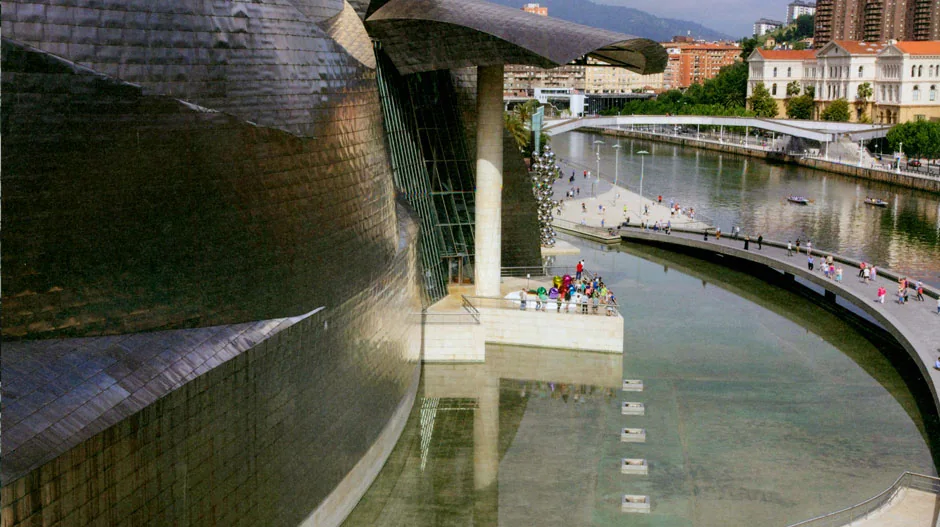
Bilbao, 2017 Vitoria,2009
1.What can you see in the images?
2.Which images look older? Why?
3.Which images look cleaner or greener?
4.What do you think changed?
Exercise 2. Match the words to their correct meanings.
| Word | Meaning |
|---|---|
| Industry |
|
| Pollution |
|
| Factory |
|
| Identity |
|
| Sustainability |
|
Exercise 3. Answer the following questions with your own ideas.
What did our city look like? What kind of industries were important?
______________________________________________________________________________________________________________________________
What jobs did people have before? What jobs do people have now?
______________________________________________________________________________________________________________________________
How did industry affect the river, air and landscape then and now?
______________________________________________________________________________________________________________________________
How have neighbourhoods, transport and buildings changed?
______________________________________________________________________________________________________________________________
What new industries or services are important today? What changes might we see in the future?
______________________________________________________________________________________________________________________________
ANSWERS:
Exercise 2
| Industry | Big economic activity that produces things |
|---|---|
| Pollution | Dirty, air, water or land |
| Factory | A place where goods are made |
| Identity | The character of a place or community |
| Sustainability | Change that protects the environment for the future |
Group image sheet 1
Title:Then and now
Look at the image and answer the questions below.
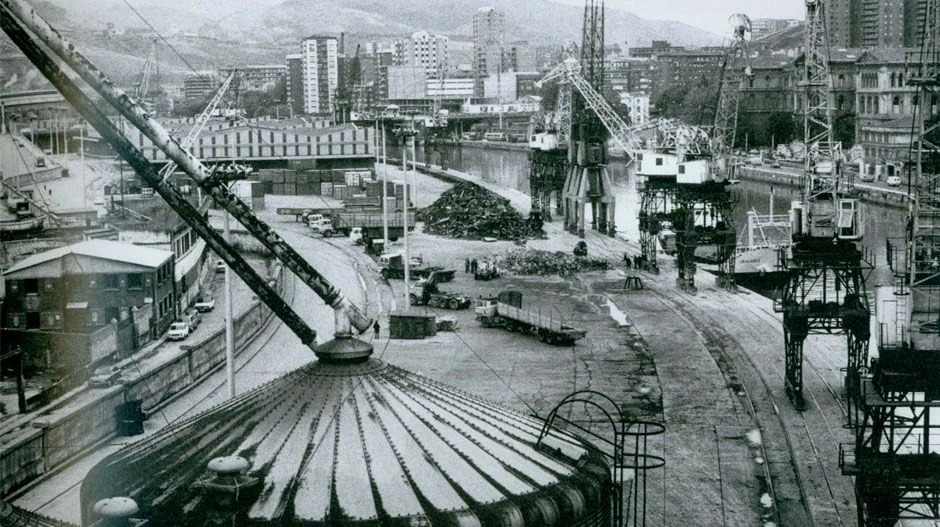
Bilbao, 1980
What can you see in this old picture of Bilbao?
How is this area different from Bilbao today?
What do you think the workers are doing in this place?
Do you think life here was easy or difficult in 1980? Why?
Would you like to visit this part of Bilbao in the past? Why or why not?
Group image sheet 2
Title:Then and now
Look at the image and answer the questions below.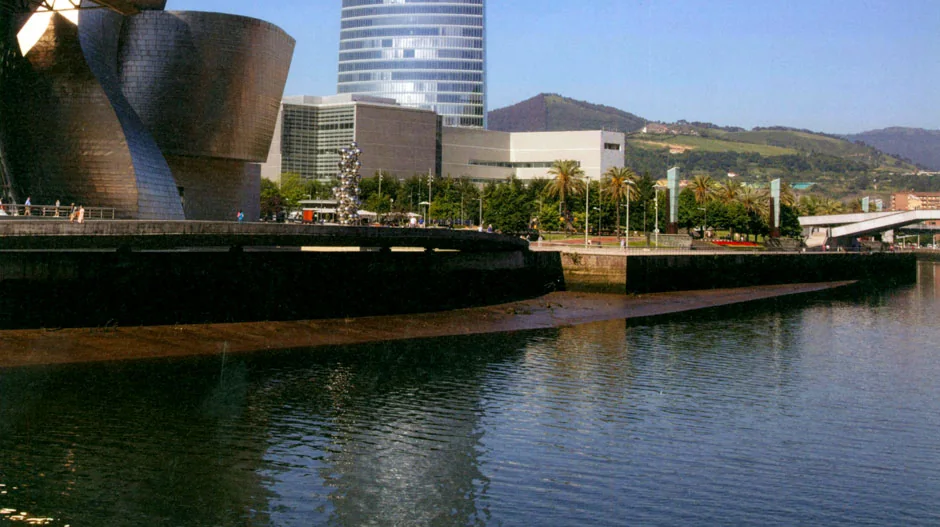
Museo Guggenheim Bilbao, 2017
What buildings can you see next to the river?
How is this area different from Bilbao in 1980?
Why do you think this place is popular with tourists?
Would you like to walk along this river? Why or why not?
Do you prefer this modern Bilbao or the old industrial Bilbao? Why?
Group image sheet 3
Title:Then and now
Look at the image and answer the questions below.
Santiago Arina (1967)/Archivo Municipal de Vitoria-Gasteiz
What animals can you see in this picture?
How does this place look different from the city today?
Do you think this area is in the countryside or in the town? Why?
Would you like to live near a place like this? Why or why not?
What do you think daily life was like here in 1967?
Group image sheet 4
Title:Then and now
Look at the image and answer the questions below.
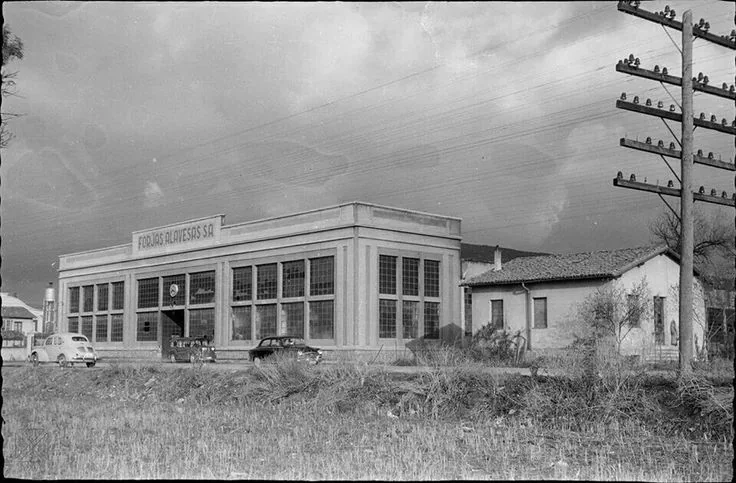
Forjas Alavesas (1969)/Archivo Municipal de Vitoria-Gasteiz
What buildings can you see in this picture?
How is the street in this photo different from the streets in Vitoria-Gasteiz today?
What means of transport can you see, and how old do they look?
Would you like to work in this factory? Why or why not?
Do you think this area was important for the city’s industry? Why?
Language focus/ Post-task
Exercise 4. Write 4 ideas you have gathered from all the activities to answer the following question: “How has industry changed our city?”
______________________________________________________________________________________________________________________________
______________________________________________________________________________________________________________________________
______________________________________________________________________________________________________________________________
______________________________________________________________________________________________________________________________
Mediation/Plurilingual hinge
Plurilingual reflection journal
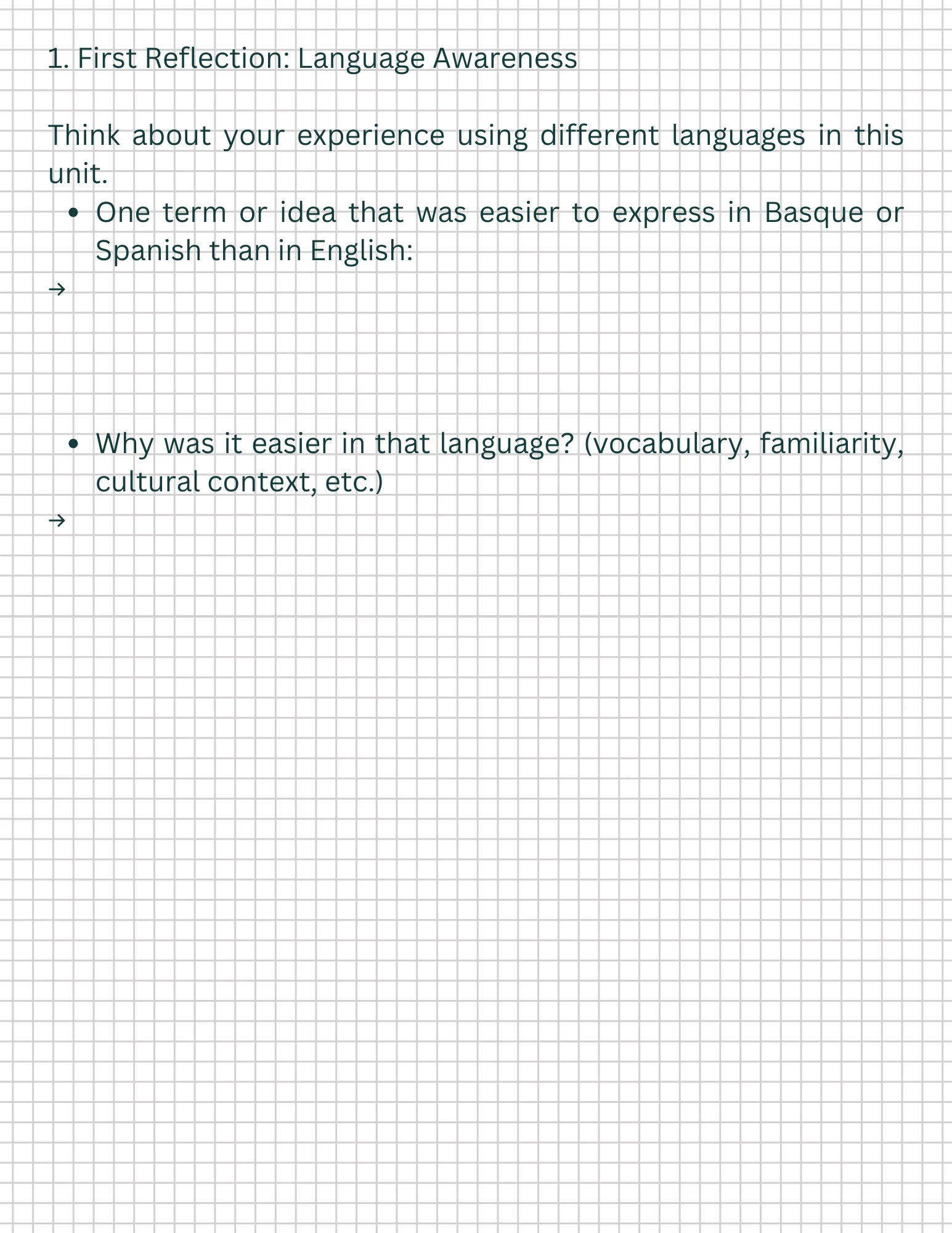
Resources
The video:
OptimiCities. (2023, April 13). How Bilbao transformed itself | Urban renewal case study. YouTube. https://www.youtube.com/watch?v=cH6cE0eKjBA
The images have been taken from:
El Correo. (2017). Ribera de la ría de Bilbao.https://especial.elcorreo.com/2017/fotos-ria-bilbao/ribera-ria-bilbao.html
Wordpress. (s.f.). Recordando Vitoria-Gasteiz. https://recordandovitoria.wordpress.com/
Access to whole journal: My reflection journal
Pre-task
Vocabulary card set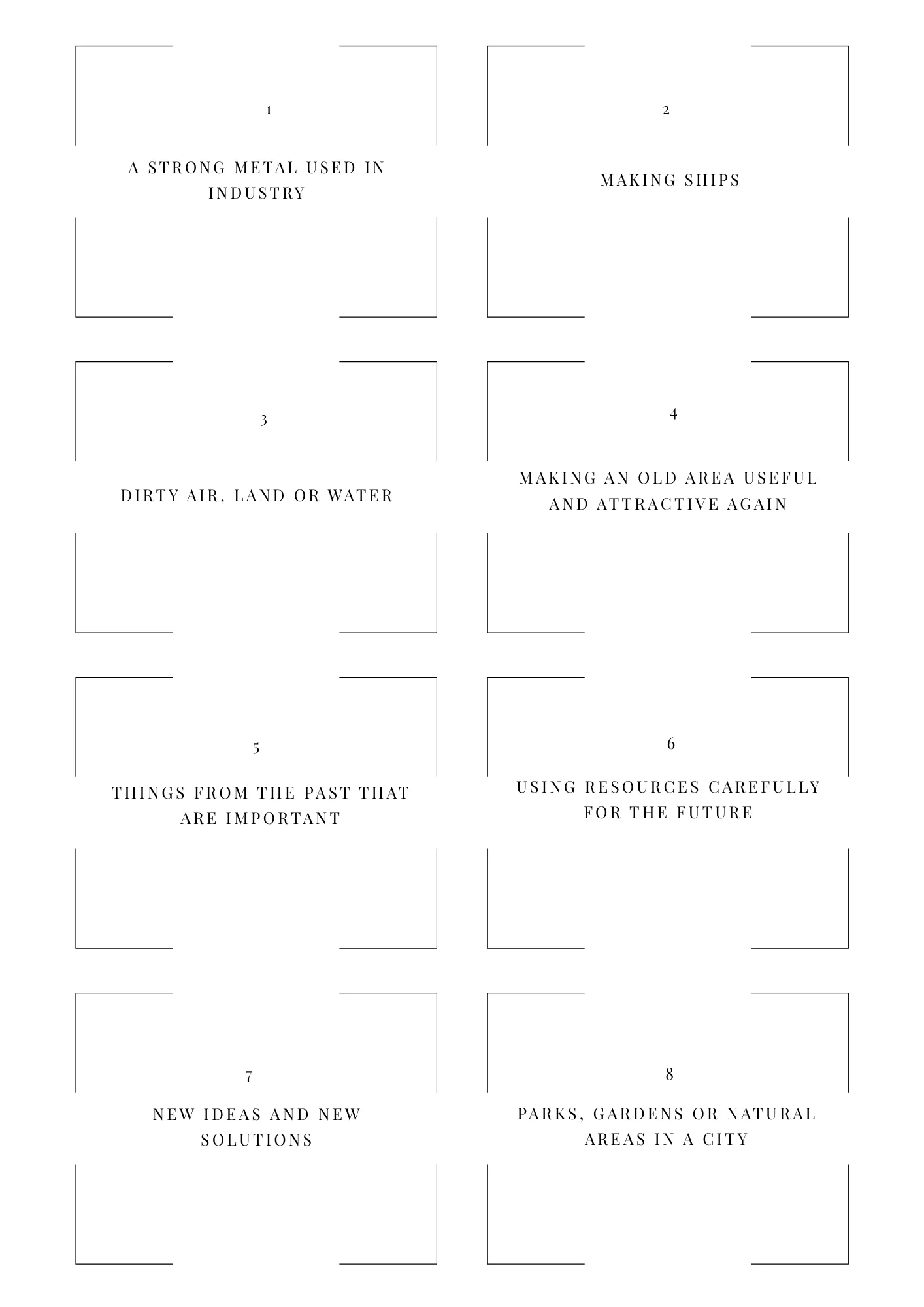
Main-task
Student worksheet 2: Vocabulary in context
Exercise 1. Match each picture with the correct description.
Write the correct number next to each letter.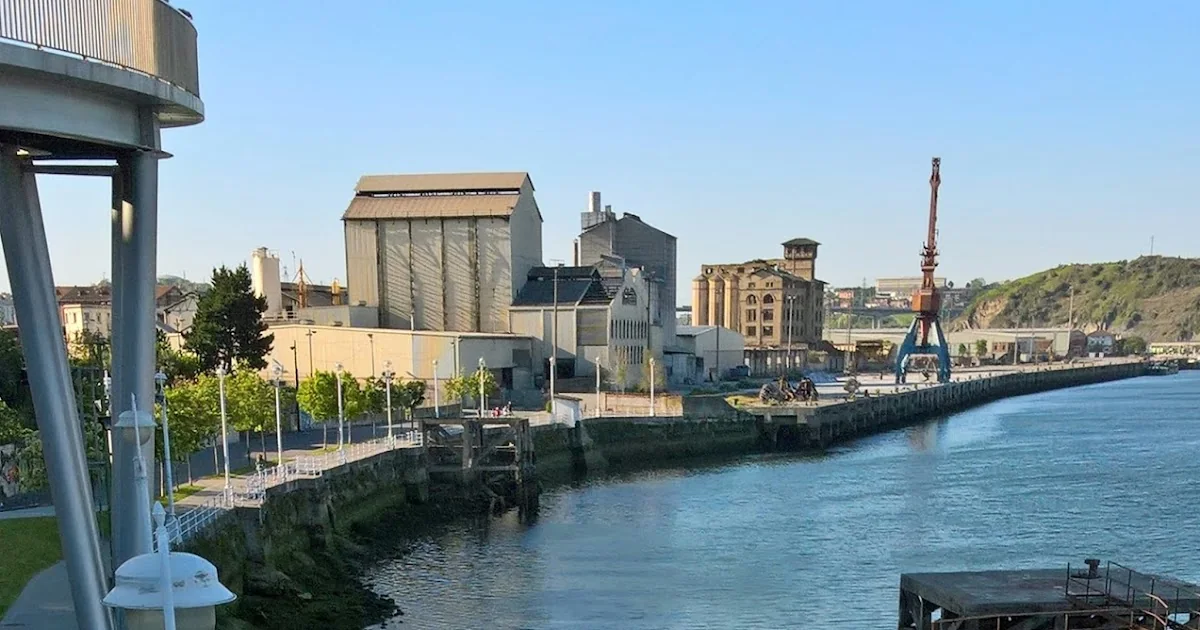
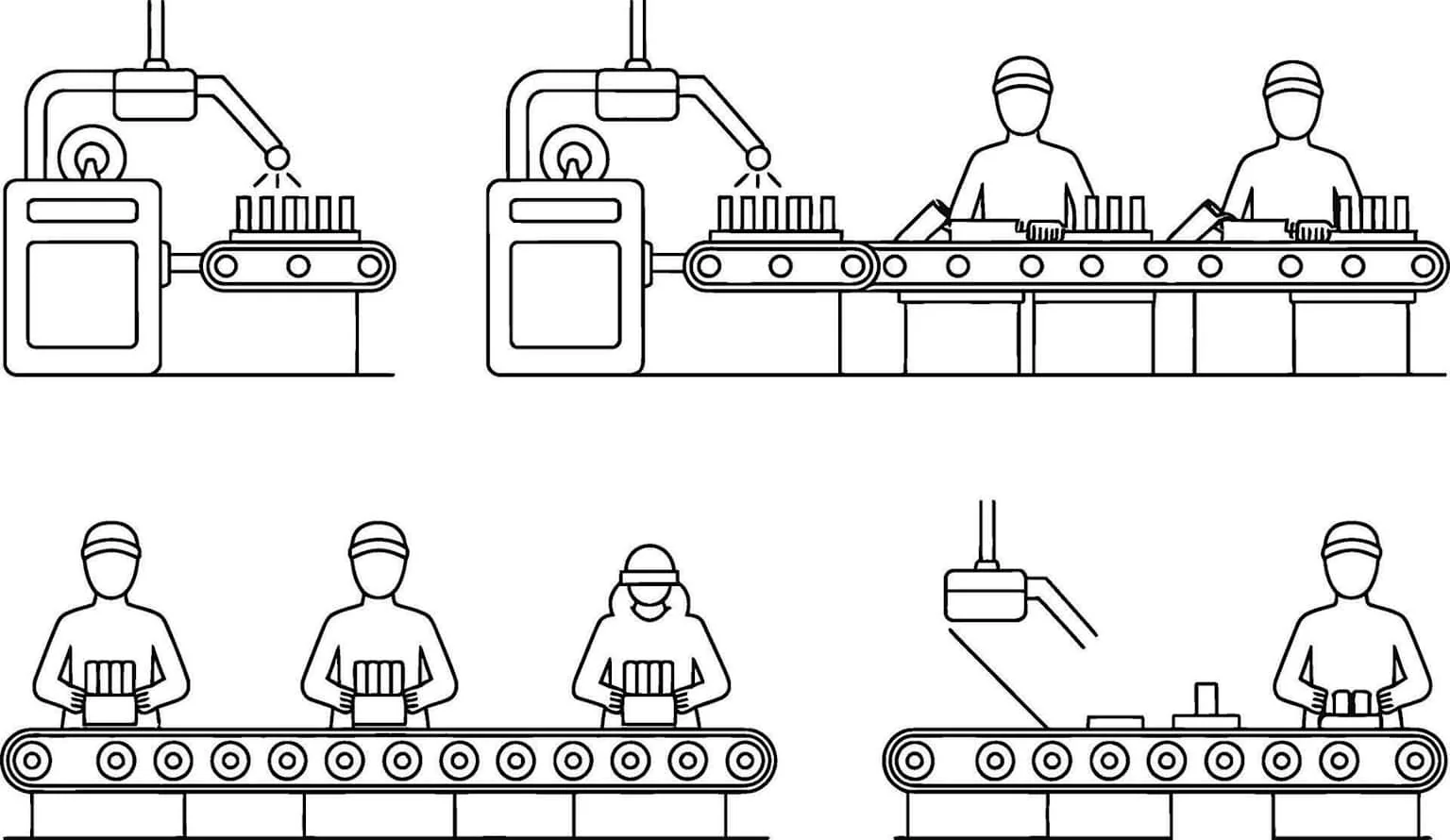
A B
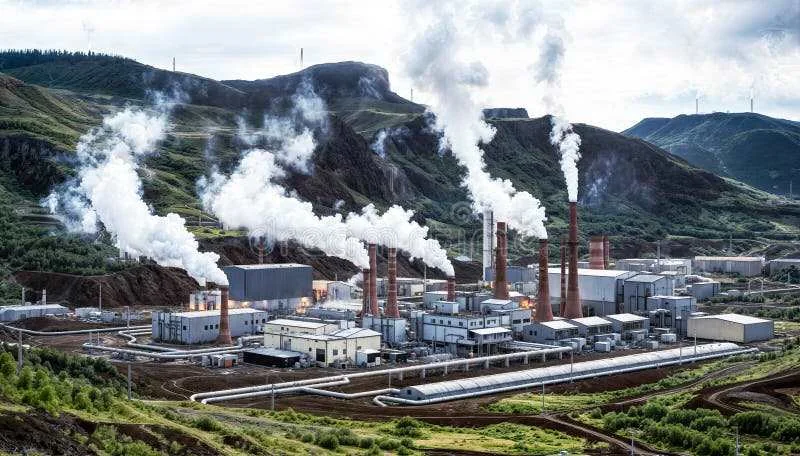
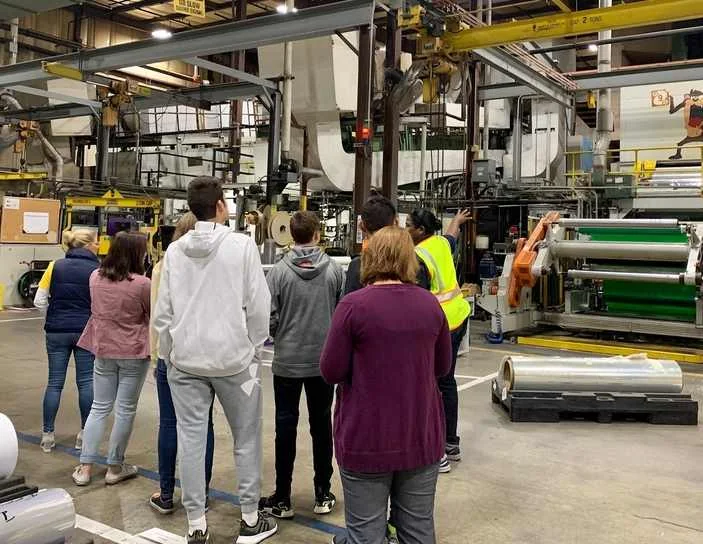
C D
This image shows a production line where goods are made in different stages.
This picture shows pollution from industrial activity, with smoke rising from tall chimneys.
This image shows visitors learning about how a modern factory works.
This photo shows an industrial factory where many people work.
Exercise 2. Complete the sentences with the words from the box
| workers · skyscrapers · factories · traffic · public transport ·green spaces · pollution · cultural centres |
|---|
In the past, this area had many ____________________.
Today, the city has more ____________________ and fewer factories.
Industrial activity created jobs, but it also caused ____________________.
A regenerated area can include museums, parks, and ____________________.
In the past, most people here were ____________________in factories.
Today, the city centre has modern ____________________and shopping malls.
The growth of the city has increased____________________ and air pollution.
To reduce car use, the council has improved ____________________ for citizens.
Exercise 3. Compare the past and present of both industrial cities. Here is useful vocabulary to help you achieve the task:
Use these sentence starters:
In the past, there were more...
Today, there is less...
This city is greener because...
This place changed from...to...
Example language bank
There were many factories in the past.
Now the area has parks and cultural spaces.
Pollution was a serious problem.
Regeneration changed the image of the city.
ANSWERS:
Exercise 1
This image shows a production line where goods are made in different stages. B
This picture shows pollution from industrial activity, with smoke rising from tall chimneys. C
This image shows visitors learning about how a modern factory works. D
This photo shows an industrial factory where many people work. A
Exercise 2
In the past, this area had many factories.
Today, the city has more green spaces and fewer factories.
Industrial activity created jobs, but it also caused pollution.
A regenerated area can include museums, parks, and cultural centres.
In the past, most people here were workers in factories.
Today, the city centre has modern skyscrapers and shopping malls.
The growth of the city has increased traffic and air pollution.
To reduce car use, the council has improved public transport for citizens.
Example of a mind map
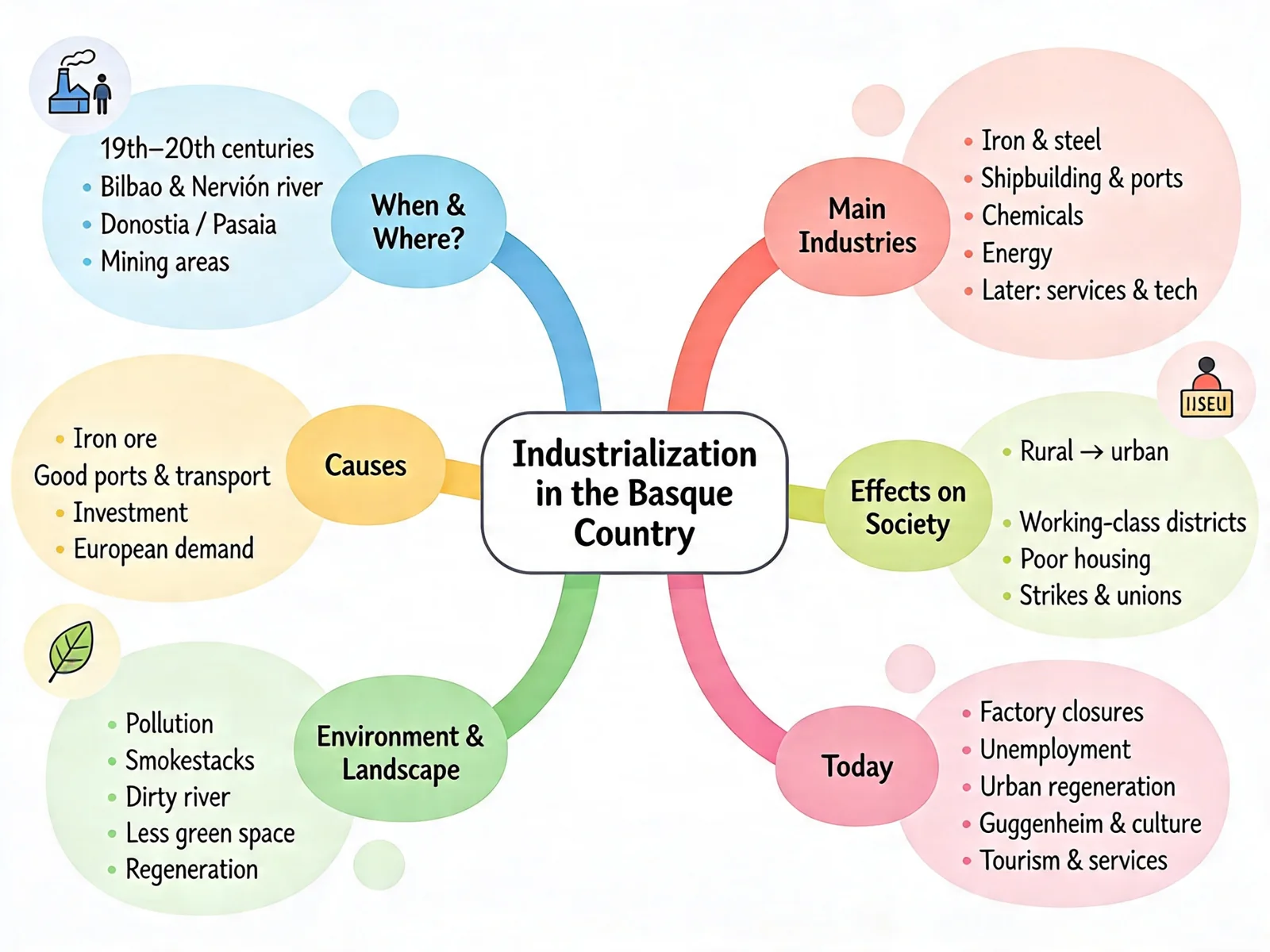
Language focus/ Post-task
Whole-Class Feedback and Language Focus: Past vs
Present
Part 1: Oral Feedback (Whole Class)
Discuss your ideas with the class. Use the following model
structures:
“In the past, people used to + infinitive…”
Example: “People used to work in factories.”
“Now, there is/are more…” / “Nowadays, people…”
Example: “Nowadays, people work in offices.”
Comparatives:
“The city is more/less + adjective than before.”
Example: “The city is cleaner than before.”
“There are more/fewer + noun…”
Example: “There are fewer factories.”
Reflection questions:
What did the city used to be like?
How is it different now?
Is it better or worse? Why?
Part 2: Language Focus
Complete the sentences in a way that you consider appropriate.
In the past, people used to work in _______________________________.
Now, the city is ___________________________ than before.
There are (more / fewer) _____________________ than in the past.
People didn’t use to _______________, but now they ______________ .
Part 3: Mini-Reflection (Individual)
Think about today’s lesson and answer:
New words I learned: ______________________________________________
One useful sentence I can now say: ______________________________________________
One idea I found interesting: ______________________________________________
Mediation/ Plurilingual hinge
Plurilingual reflection journal
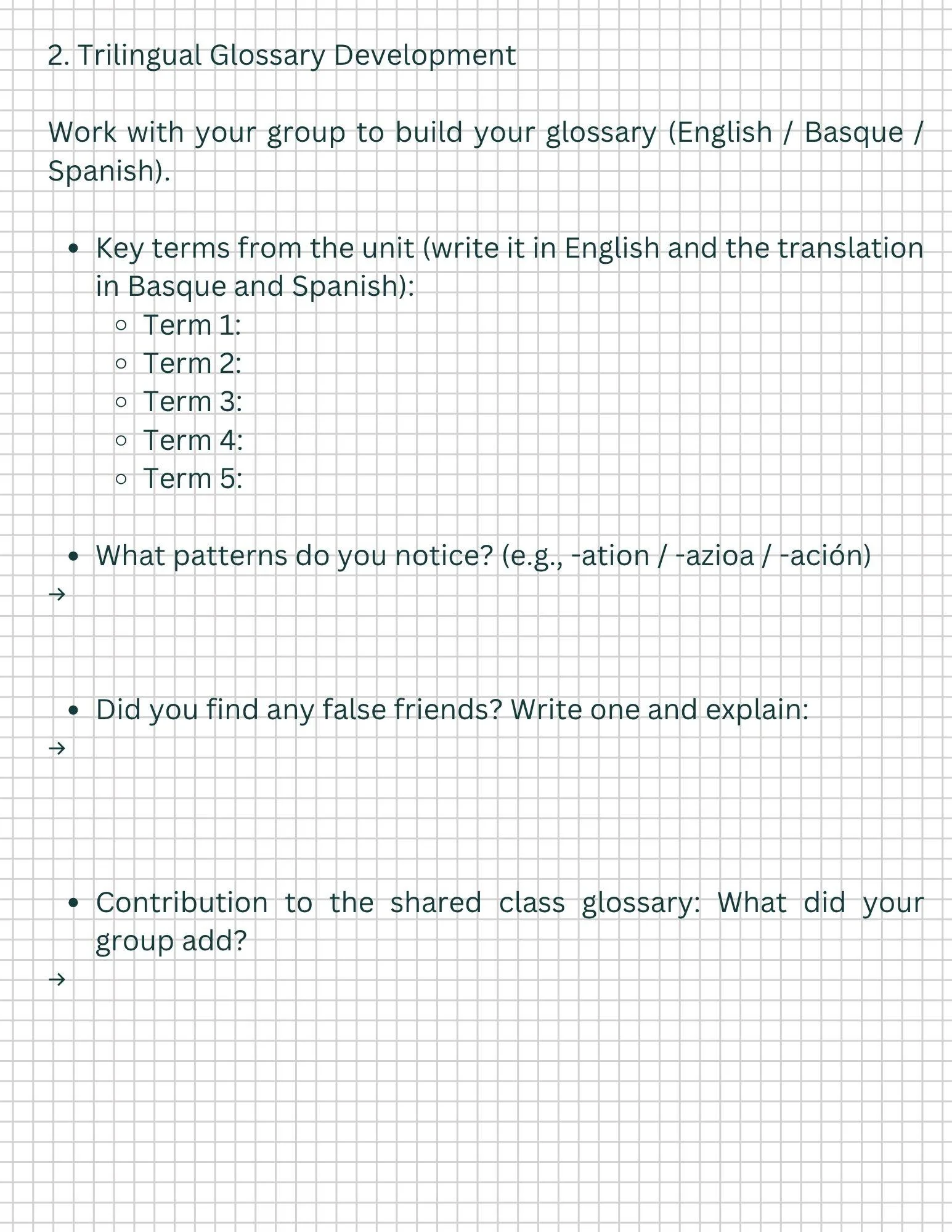
Industrial Heritage Exploration
Materials to print
Pre-task
Digital Exploration of Industrial Heritage
The session is structured as an inquiry-based, CLIL-oriented exploration of industrialisation and urban transformation in the Basque context, using Google Earth (https://earth.google.com/web/) as the main digital tool to support visualisation, research, and oral communication in English. In the pre-task phase, students are introduced to the Google Earth platform and familiarised with its key functionalities, including satellite imagery navigation, historical timeline features, and 3D visualisation of urban landscapes. This digital literacy component ensures all learners can effectively access and manipulate geospatial data during the main task. Students are guided to locate Bilbao and Vitoria-Gasteiz, identify industrial zones, and compare aerial views across different time periods.
Main-task
Group research template
Group members: ____________________
Place 1
Name of place:
___________________________________________
City:
____________________________________________
What can you see now?
___________________________________________
What do you think was there before?
____________________________________________
Is it more industrial, cultural, residential, or green now?
____________________________________________
Place 2
Name of place:
____________________________________________
City:
____________________________________________
What can you see now?
____________________________________________
What do you think was there before?
____________________________________________
Is it more industrial, cultural, residential, or green now?
____________________________________________
Final conclusions
Write two sentences to sum up your ideas:
1. ____________________________________________
2. ____________________________________________
Presentation of Key Findings
Students are required to synthesise the main ideas previously recorded in the worksheet and present their findings through a PowerPoint presentation. This format facilitates the clear and structured communication of their analysis. A presentation template is provided to guide students in organising and developing their content effectively.
Language focus/ Post-task
Peer Feedback Checklist: Oral Presentation
Listen to your classmates and complete the checklist:
Content and Clarity
The presentation is clear and easy to follow.
The main ideas are well explained.
Examples or details are used to support ideas.
Language Use (Past vs Present)
The group correctly uses “used to + infinitive” to describe the past.
The group uses present forms appropriately to describe current situations.
Comparatives are used correctly (e.g., more/less, -er, than).
Communication
The speakers are understandable (pronunciation, volume).
The group works collaboratively (all members participate).
Feedback Comment
One thing they did well: _______________________________________________________________
One suggestion for improvement _______________________________________________________________
Mediation/ Plurilingual hinge
Each group publishes its glosary in the shared classroom document.
Instructions:
Add your group section with the title: Group X – Industrialisation Glossary.
Include at least 4 key terms from the unit. To do so, each group member should include one of the words they have chosen for their individual glossary.
For each term, provide:
English term
Basque translation
Spanish translation
Short definition in English (your own words)
Example Entry:
Pollution
Basque: Poluzioa
Spanish: Contaminación
Definition: Pollution is the introduction of harmful substances or forms of energy into the environment that cause damage or adverse change to air, water, soil, living organisms, or ecosystems.
Check spelling and accuracy in all three languages.
Resources
Below are example links to the digital resources students will need to use during the session:
Google Earth (web version – main access):
https://earth.google.com/web/
Google Earth Education – Explore Earth (for guided
tours/Voyager):
https://www.google.com/intl/en_uk/earth/education/explore-earth/
Google Earth Gallery – Guided tours and stories (optional enrichment): https://www.google.com/earth/about/gallery/
Itsasmuseum Bilbao – Industrial and shipbuilding background (support text for Bilbao shipyards): https://itsasmuseum.eus/en/audioguide-itsasmuseum/room/construccion-naval-en-acero/
Introductory overview of industrialisation in Vitoria-Gasteiz (background reading for students, accessible language): https://wiki.kidzsearch.com/wiki/Vitoria-Gasteiz
Past and Present Debate
Materials to print
Pre-task
Debate language sheet
Giving opinions
I think that...
In my opinion...
I believe that...
From my point of view...
Agreeing
I agree because...
That’s true.
I think so too.
Disagreeing politely
I’m not sure about that.
I see your point, but...
I disagree because...
Adding ideas
Also...
Another important point is...
For example...
Grammar Review: Past and Present Tenses
Exercise 1. Underline the correct verb form in each sentence.
I usually go / am going to school on foot.
Listen! The children play / are playing in the garden now.
She didn’t go / hasn’t gone to the cinema last night.
We have known / knew each other since 2018.
I am living / live with my parents at the moment.
When I was a child, we always spent / were spending summers in the countryside.
He has been studying / studied English for three years.
They were watching / watched TV when the phone rang.
My brother has never been / was never to London.
I am not understanding / don’t understand this exercise.
Exercise 2. Put the verb in brackets into the correct tense
I can’t talk now. I ____________(have) breakfast.
She usually ____________(finish) work at 5, but yesterday she____________ (finish) at 7.
While we ____________(walk) home, it____________ (start) to rain.
I ____________(never / see) such a beautiful film before.
They ____________(live) in this town since they ____________(get) married.
When I arrived, they____________ (already / eat) dinner.
He is tired because he ____________(work) all day.
My grandparents ____________ (not / use) the internet when they were young.
What ____________ (you / do) right now?
Last weekend we ____________(go) to the mountains and____________ (have) a picnic.
Exercise 3. Complete each sentence with a suitable time expression.
yesterday – usually – at the moment – since 2010 – for two hours – last week – every day – just – when I was a child – so far
I have lived in this city _______________________ .
She cleaned her room _______________________ .
He has worked here _______________________ .
I have finished my homework _______________________ .
We haven’t had any problems _______________________ .
We are studying English _______________________ .
My parents took me to the beach _______________________ .
I get up at 7 o’clock_______________________ .
I brush my teeth _______________________ .
We visited our grandparents_______________________ .
ANSWERS:
Exercise 1
I usually go to school on foot.
Listen! The children are playing in the garden now.
She didn’t go to the cinema last night.
We have known each other since 2018.
I am living with my parents at the moment.
When I was a child, we always spent summers in the countryside.
He has been studying English for three years.
They were watching TV when the phone rang.
My brother has never been to London.
I don’t understand this exercise.
Exercise 2
I can’t talk now. I am having breakfast.
She usually finishes work at 5, but yesterday she finished at 7.
While we were walking home, it started to rain.
I have never seen such a beautiful film before.
They have lived in this town since they got married.
When I arrived, they had already eaten dinner.
He is tired because he has been working all day.
My grandparents didn’t use the internet when they were young.
What are you doing right now?
Last weekend we went to the mountains and had a picnic.
Exercise 3
I have lived in this city since 2010.
She cleaned her room yesterday.
He has worked here for two hours.
I have just finished my homework.
We haven’t had any problems so far.
We are studying English at the moment.
My parents took me to the beach when I was a child.
I usually get up at 7 o’clock.
I brush my teeth every day.
We visited our grandparents last week.
Main-task
Cards for the debate
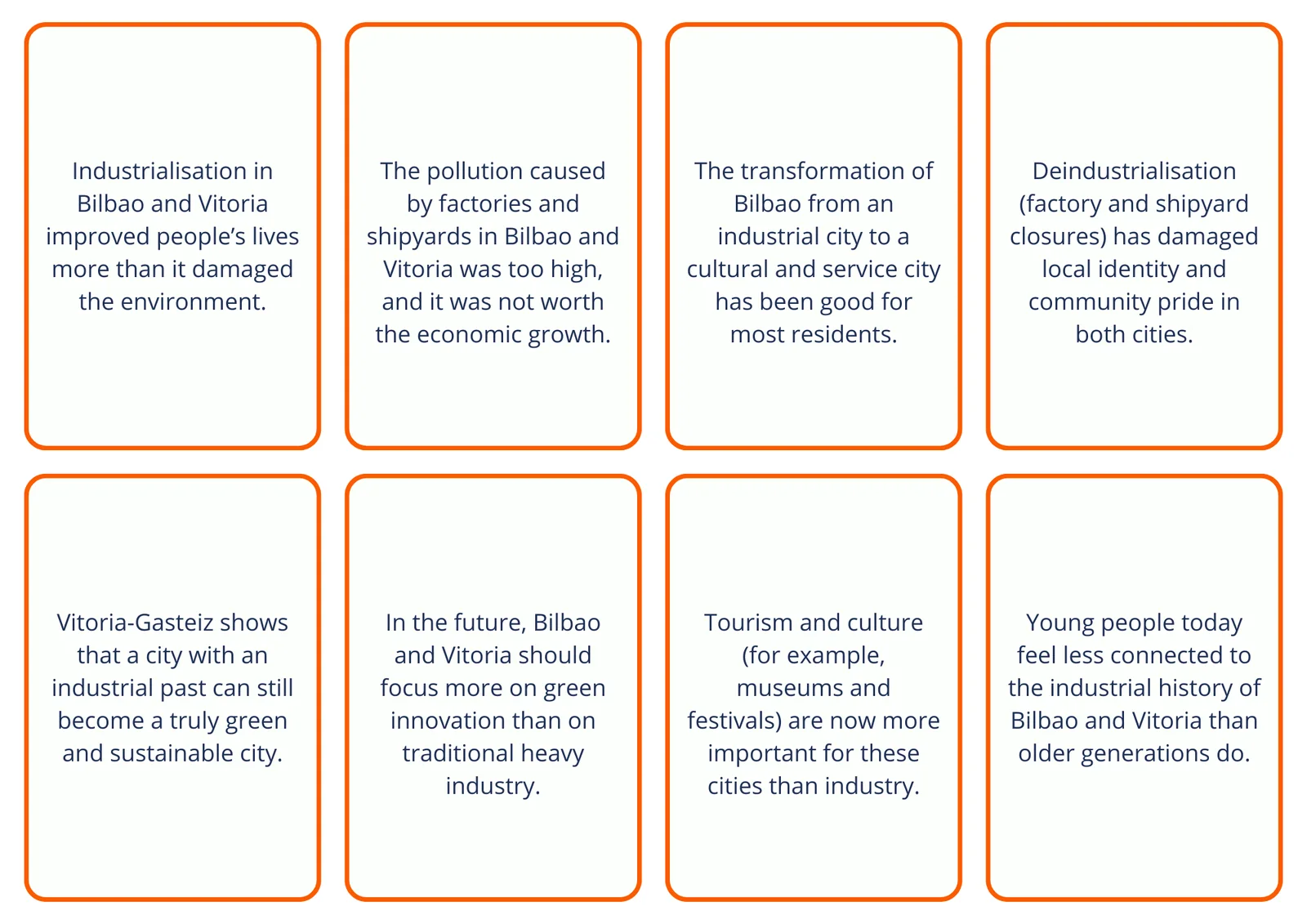
Student preparation for the debate
Names: __________________________________________ Date:_________
Topic: ______________________________________________________________
Our position (circle one): We are for / against.
Brief explanation of our position
________________________________________________________________________________________________________________________________________________________________________________________________________________________________________________________________________________
Our arguments
1. __________________________________________________________________
2. __________________________________________________________________
3. __________________________________________________________________
Possible counter-arguments (think what the other side might say to discredit your arguments and find solutions)
1. __________________________________________________________________
2. __________________________________________________________________
3. __________________________________________________________________
Useful examples
1. __________________________________________________________________
2. __________________________________________________________________
Sentence starter for the debate
______________________________________________________________
Language focus/ Post-task
Whole-class feedback prompts
Use these questions on the board to guide discussion:
Strategies
How did you decide what information to include or leave out?
What helped you organise your ideas clearly?
What did you do when you did not know a word?
Language use
Which structures were most useful to talk about past and present (e.g., used to, comparatives)?
Which vocabulary items were especially helpful (e.g., for environment, industry, change)?
Were there any sentences you reformulated to sound clearer or more accurate?
Argumentation
Did you give reasons and examples to support your ideas?
How did you show that you were comparing two periods or two places?
How did you show agreement or disagreement within your group?
Noticing discourse markers
1. Underline the discourse markers
Read and underline the useful discourse markers:
To start: First of all, To begin with
Adding ideas: Moreover, In addition, Also
Contrasting: However, On the other hand, In contrast
Giving reasons: Because, Therefore, As a result
Comparing past and present: In the past…, Nowadays…, Today…, Compared to before
Concluding: To sum up, In conclusion, Overall
2. Reflection questions
Which discourse markers did you already use in your presentation? _______________________________________________________
Which new ones would you like to use next time? _______________________________________________________
Rewrite one of your original sentences using a discourse marker to make it clearer: _______________________________________________________
Original sentence:
_______________________________________________________
Improved sentence (with a discourse marker): _______________________________________________________
C. Quick blackboard activity
Ask volunteers to share one sentence they used. As a class:
Identify the function (adding, contrasting, giving reasons, concluding).
Add or improve the discourse marker together.
Record “useful sentences” on the board for students to copy into their notebooks.
Mediation/Plurilingual hinge
Plurilingual reflection journal
Comparing Bilbao and Vitoria-Gasteiz
Materials to print
Pre-task
Comparison sentence bank
Bilbao was more industrial than Vitoria-Gasteiz. Vitoria-Gasteiz is greener than Bilbao.
Both cities changed a lot over time.
Today, both cities show new models of development.
Bilbao is known for regeneration, while Vitoria-Gasteiz is known for sustainability.
Answer the following questions
What industries dominated each city in the past?
______________________________________________________________
What changes have occurred?
______________________________________________________________
How is each city working towards sustainability today?
______________________________________________________________
Main task
Comparative worksheet
| Category | Bilbao | Vitoria-Gasteiz |
|---|---|---|
| Past economic model | ||
| Presentimage | ||
| Environmental impact | ||
| Public spaces | ||
| Sustainable Innovation | ||
| What surprised us |
Language focus/Post-task
Sharing of key findings
Key ideas we learned from others
_________________________________________________
_________________________________________________
_________________________________________________
What our group wants to share
_________________________________________________
_________________________________________________
_________________________________________________
Main idea:
_________________________________________________
Important details:
Useful vocabulary / expressions
________________________
________________________
________________________
________________________
________________________
________________________
Final reflection (1–2 sentences)
_________________________________________________
_________________________________________________
Language focus/ Post-task
1. Peer Sharing of Key Findings
Instructions for students (projected or on worksheet)
Share your main findings with a partner or another group.
Step 1: Briefly summarise your main ideas (2–3 sentences).
Step 2: Choose one example of “past” and one example of “present” from your notes.
Step 3: Explain one important change and its possible impact (environment, society, or local identity).
Prompt questions
What was this place like in the past?
What is it like now?
What is the most important change? Why?
2. Noticing Comparative Structures
Comparative “noticing” task (on worksheet)
Read your own worksheet and your partner’s worksheet. Underline or highlight all the comparative structures you can find (for example: cleaner than, more modern, less polluted, more/less + noun).
Then complete:
Write three comparative sentences you found or created:
_________________________________________________
_________________________________________________
_________________________________________________
Are these sentences talking about:
Physical changes (buildings, roads, green areas)?
Environmental changes (air, water, noise)?
Social changes (jobs, people, services)?
Tick the correct option for each sentence.
3. Quick Metalinguistic Check on Connectors
Look at these connectors and their function:
Adding information: and, also, moreover
Contrasting past and present: but, however, whereas
Explaining cause/effect: because, so, therefore
Task A – Identify
Look again at your notes or draft sentences. Circle the connectors you used. Then complete:
A connector I used to add information: _________________________________________________
A connector I used to contrast ideas: _________________________________________________
A connector I used to show cause/effect: _________________________________________________
If you did not use one type, add one new sentence using that type.
Task B – Improve one sentence
Choose one of your sentences and improve it by adding an appropriate connector.
Original sentence: _________________________________________________
Improved sentence with connector: _________________________________________________
Mediation/Plurilingual hinge
Plurilingual reflection journal
Writing Workshop: Describing Transformation
Materials to print
Pre-task
Model texts
TEXT 1: Industrialization in Bilbao
In the late nineteenth century, Bilbao changed from a quiet commercial town into a noisy industrial city full of chimneys and shipyards. Iron ore from the nearby mines arrived constantly at the river, where large steel factories and foundries transformed it into metal for railways, ships, and machines. Along the estuary, cranes, warehouses, and docks created a dense landscape of smoke, workers, and goods going in and out of the port. The population grew quickly, new neighbourhoods appeared, and the river became the centre of this industrial world. At the same time, pollution and difficult working conditions were part of everyday life for many families.
TEXT 2: Industrialization in Vitoria-Gasteiz
In Vitoria-Gasteiz, industrialization arrived later and more gradually than in Bilbao, but it still transformed the city. During the late nineteenth and early twentieth centuries, small workshops grew into important factories producing cards, soaps, and tools for agriculture. Companies such as Fournier and Lascaray became symbols of this new industrial energy. With the arrival of the railway and new roads, Vitoria turned into an attractive place for businesses that needed space, good connections, and trained workers. In the mid‑twentieth century, new industrial estates around the city brought more jobs, migrants, and neighbourhoods, slowly changing Vitoria from a quiet provincial town into a dynamic industrial capital.
Comparing the Two Texts: Industrialization in Bilbao and Vitoria-Gasteiz
Name:____________________
Date: ____________________
1. General information
What is the main topic of both texts?
_____________________________________________________________________________________________________________________________________________________________________________________________
Which city industrialized earlier?
☐ Bilbao ☐ Vitoria-Gasteiz Why?
2. Content comparison
A. Causes of industrialization
Bilbao – What started or supported industrialization there?
_____________________________________________________________________________________________________________________________________________________________________________________________
Vitoria-Gasteiz – What started or supported industrialization
there?
_____________________________________________________________________________________________________________________________________________________________________________________________
B. Main industries and activities
Bilbao – Write 3 things that were important (factories, port, materials, etc.):
__________________________________________________________________________________________________________________
__________________________________________________________________________________________________________________
__________________________________________________________________________________________________________________
Vitoria-Gasteiz – Write 3 things that were important (factories, companies, products, etc.):
__________________________________________________________________________________________________________________
__________________________________________________________________________________________________________________
__________________________________________________________________________________________________________________
C. Changes in the city
How did Bilbao change? (population, neighbourhoods, landscape,
problems, etc.)
____________________________________________________________________________________________________________________________________________________________________________________________________________________________________________________________
How did Vitoria-Gasteiz change? (population, new areas, new role,
etc.)
____________________________________________________________________________________________________________________________________________________________________________________________________________________________________________________________
3. Language and structure
Underline in both texts:
Time expressions (for example: in the late nineteenth century, during…).
Adjectives that describe the city (for example: quiet, noisy, industrial).
Write 3 useful expressions you want to use in your own paragraph:
____________________________________________________________________________________________________________________________________________________________________________________________________________________________________________________________
What differences do you see in how the texts are organized?
(order of ideas, type of information, ending, etc.)
____________________________________________________________________________________________________________________________________________________________________________________________________________________________________________________________
4. Ideas for your own text
Which city are you going to write about?
☐ Bilbao ☐ Vitoria-Gasteiz ☐ Another city:
Write 3 ideas from the texts that you want to reuse (adapt to your city):
____________________________________________________________________________________________________________________________________________________________________________________________________________________________________________________________
Write 3 ideas that you want to add from your own knowledge:
____________________________________________________________________________________________________________________________________________________________________________________________________________________________________________________________
Write one possible opening sentence for your paragraph:
____________________________________________________________________________________________________________________________________________________________________________________________________________________________________________________________
Write one possible closing sentence for your paragraph:
____________________________________________________________________________________________________________________________________________________________________________________________________________________________________________________________
Useful information to write your own texts
Writing frame
Title: __________________________________
In the past, ________________________________.
There were _________________________________.
This area was important because ________________.
However, it also had problems such as ____________.
Today, ____________________________________.
Now there are ______________________________.
This change is important because ________________.
In my opinion, ______________________________.
Useful language box
in the past
today / nowadays
over time
changed from ...to ...
more sustainable
cleaner
more modern
important for the city
Checklist
Does the text mention past and present?
Does it use topic vocabulary?
Is the message clear?
Is there a personal opinion at the end?
Main task
Individual Writing Task – Descriptive Text
Name:_____________________________________
Date: _____________________________________
Topic:
1. Brainstorm your ideas
What am I describing?
______________________________________________________________________________________________________________________________
Key features:
______________________________________________________________________________________________________________________________
Adjectives I can use:
______________________________________________________________________________________________________________________________
2. Writing scaffolds (use them to help you)
This place/city is known for…
One important feature is…
It has… / There is/are…
Another interesting aspect is…
This makes it… (adjective)
3. My text (100-120 words)
__________________________________________________________________________________________________________________________________________________________________________________________________________________________________________________________________________________________________________________________________________________________________________________________________________________________________________________________________________________________________________
________________________________________________________________________________________________________________________________________________________________________________________________________________________________________________________________________________________________________________________________________________________________________________________________________________________________________________________________________________________________________________________________________________________________________________________________________________________________________________________________________________________________________________________________________________________________________________________________________________________________________________________________________________________________________________________________________________________________________________________________________________________________________________________________________________________________________________________________________________________________________________________________________________________________________________________________________________________________________________________________________________________________________________________________________________________________________________________
4. Check your writing
Did I use complete sentences? ☐
Did I use descriptive adjectives? ☐
Did I use correct verb forms? ☐
Did I organize my ideas clearly? ☐
Language focus/Post-task
Peer-Editing Rubric: Descriptive Paragraph on Industrialization
Writer’s name:_______________________________
Reviewer’s name:_____________________________
For each criterion, tick the box and add one comment.
1. Content and ideas
Comment about content:
2. Organization
Comment about organization:
3. Language and vocabulary
Comment about language:
4. Accuracy (spelling and grammar)
Comment about accuracy:
5. Overall impression
One thing I liked:
One suggestion to improve:
Mediation/ Plurilingual hinge
Plurilingual reflection journal
Resources
Text 1:
Revolución industrial en Bizkaia: 1876–1900. (n.d.). In Bilbao Museoa. Retrieved April 29, 2026, from https://bilbaomuseoa.eus/explora/historia/revolucion-industrial-en-bizkaia-1876-1900/628e1d8d-35ce-d601-c19e-3e9f5107b1a7 [adapted]
Text 2:
Villar Ibáñez, J. E. (2019, March 4). Vitoria-Gasteiz, de ciudad levítica a capital industrial de Euskadi. Asociación Vasca de Patrimonio Industrial y Obra Pública. Retrieved April 29, 2026, from http://www.patrimonioindustrialvasco.com/patrimonio/vitoria-gasteiz-de-ciudad-levitica-a-capital-industrial-de-euskadi/ [adapted]
Poster Draft
Materials to print
Pre- task
Poster analysis checklis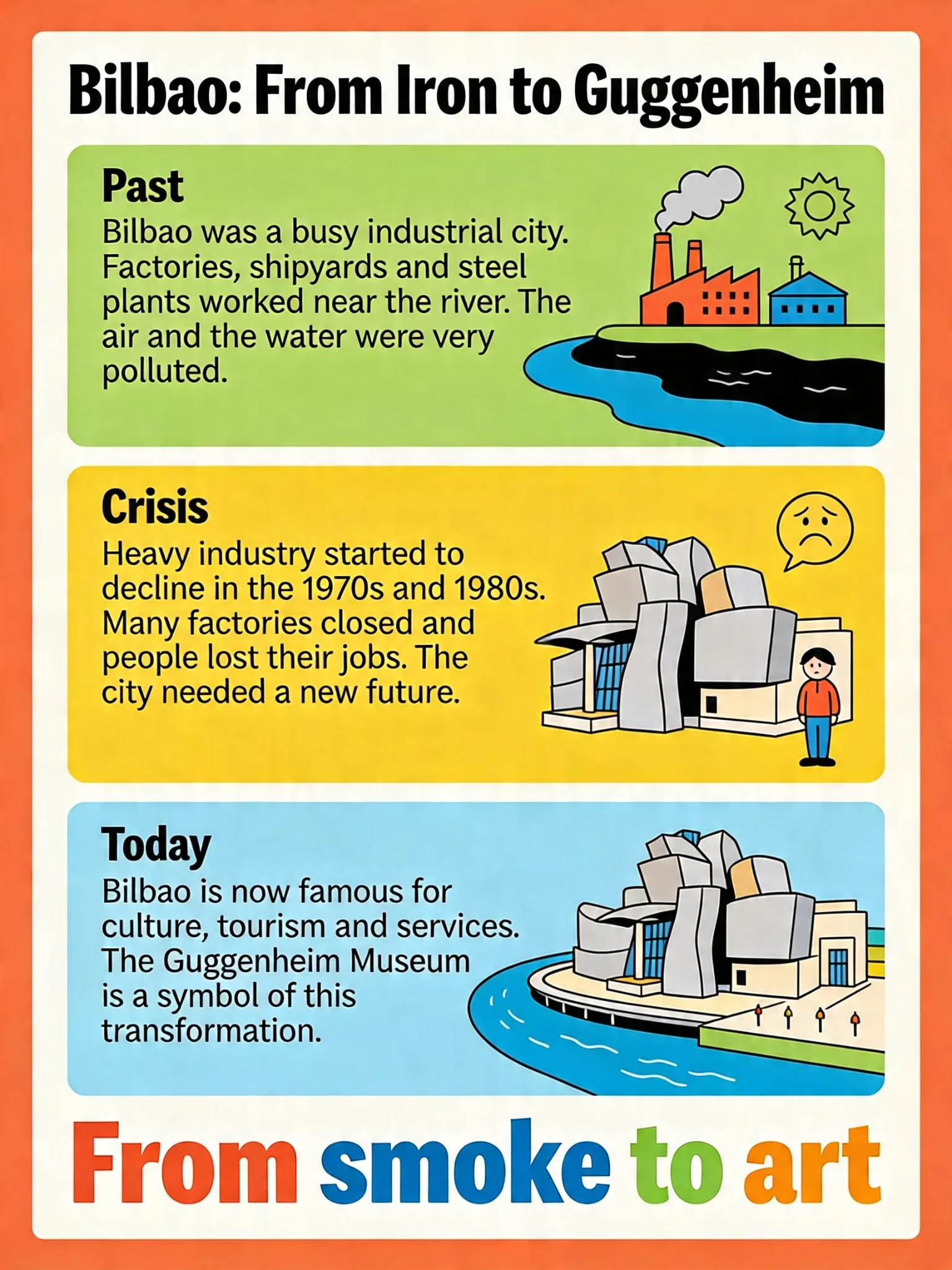
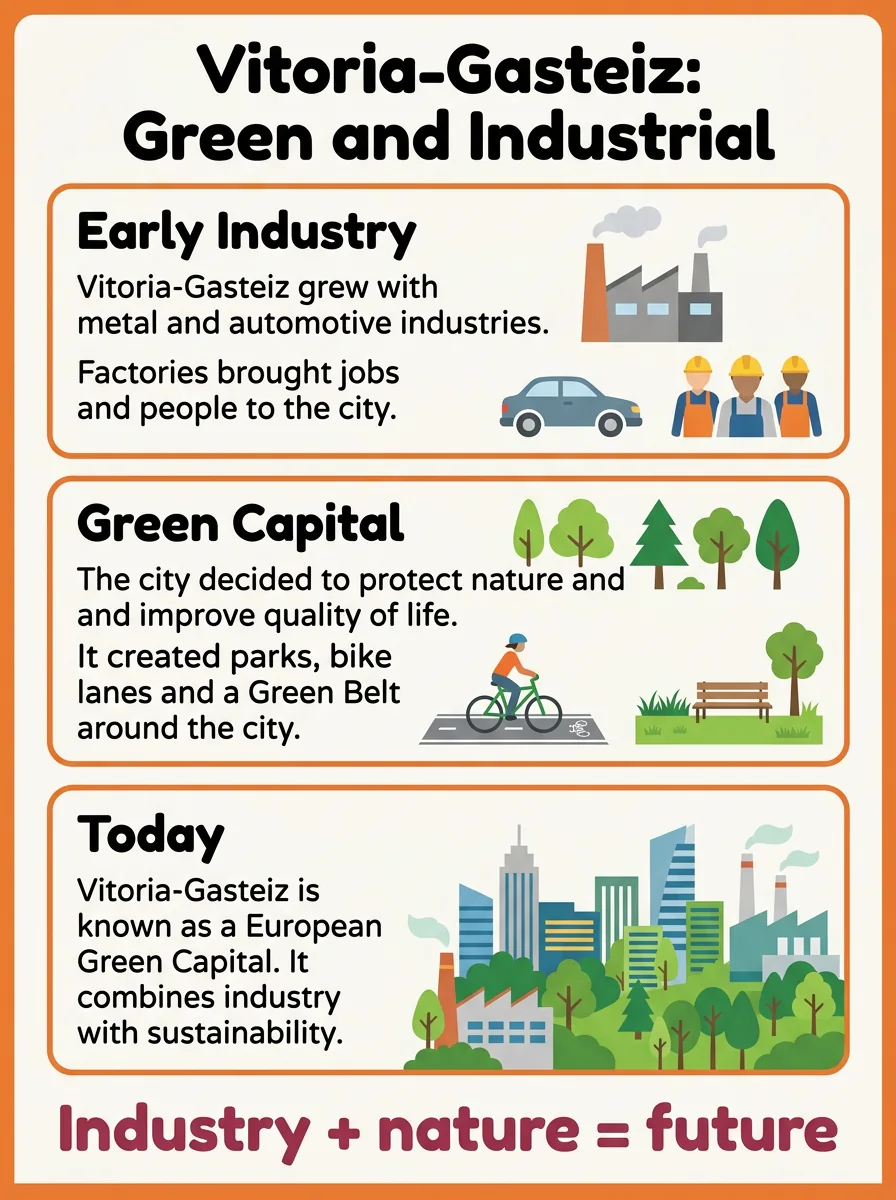
Poster A title: _________________________________________
Poster B title:_________________________________________
1. Layout (organisation on the page)
| Criteria | Poster A | Poster B |
|---|---|---|
| The title is clear and easy to see. | ☐ Yes ☐ No |
☐ Yes ☐ No |
| Information is divided into clear sections/boxes. | ☐ Yes ☐ No |
☐ Yes ☐ No |
| There is enough space (not too full, not too empty). | ☐ Yes ☐ No |
☐ Yes ☐ No |
| Images and text are well balanced. | ☐ Yes ☐ No |
☐ Yes ☐ No |
Comment on layout (What works well? What could be
better?):
Poster A:
__________________________________________________________________________________________________________________________________________________________________________________________________________________
Poster B:
__________________________________________________________________________________________________________________________________________________________________________________________________________________
2. Colour
| Criteria | Poster A | Poster B |
|---|---|---|
| Colours are attractive. | ☐ Yes ☐ No |
☐ Yes ☐ No |
| Colours help to separate sections. | ☐ Yes ☐ No |
☐ Yes ☐ No |
| Colours match the topic and message. | ☐ Yes ☐ No |
☐ Yes ☐ No |
Comment on colour:
Poster A:
__________________________________________________________________________________________________________________________________________________________________________________________________________________
Poster B:
__________________________________________________________________________________________________________________________________________________________________________________________________________________
3. Clarity (how easy it is to understand)
| Criteria | Poster A | Poster B |
|---|---|---|
| Text is easy to read (font size, type). | ☐ Yes ☐ No |
☐ Yes ☐ No |
| Sentences are short and clear. | ☐ Yes ☐ No |
☐ Yes ☐ No |
| Important words or ideas stand out. | ☐ Yes ☐ No |
☐ Yes ☐ No |
| It is easy to understand the timeline/structure. | ☐ Yes ☐ No |
☐ Yes ☐ No |
Comment on clarity:
Poster A:
__________________________________________________________________________________________________________________________________________________________________________________________________________________
Poster B:
__________________________________________________________________________________________________________________________________________________________________________________________________________________
4. Message (content and slogan)
| Criteria | Poster A | Poster B |
|---|---|---|
| The main idea of the poster is clear. | ☐ Yes ☐ No |
☐ Yes ☐ No |
| The slogan or final message is strong and memorable. | ☐ Yes ☐ No |
☐ Yes ☐ No |
| The poster shows change over time or contrast. | ☐ Yes ☐ No |
☐ Yes ☐ No |
| The information matches the images. | ☐ Yes ☐ No |
☐ Yes ☐ No |
What is the main message of each poster?
Poster A:
__________________________________________________________________________________________________________________________________________________________________________________________________________________
Poster B:
__________________________________________________________________________________________________________________________________________________________________________________________________________________
5. Ideas for our own poster
One idea from Poster A that we want to copy/adapt:
___________________________________________________________________________________________________________________________________________________________________________________________________
One idea from Poster B that we want to copy/adapt:
___________________________________________________________________________________________________________________________________________________________________________________________________
Our idea for a possible title:
___________________________________________________________________________________________________________________________________________________________________________________________________
Our idea for a possible slogan:
___________________________________________________________________________________________________________________________________________________________________________________________________
Main task
Poster planning template
Poster title:
___________________________________________________________________
Our main message
___________________________________________________________________
What we want to show
The past: _______________________________________________________________
The present:
_______________________________________________________________
The changes:
_______________________________________________________________
The future:
_______________________________________________________________
Visual elements that need to be included (check when done)
Photos or drawings
Timeline
Keywords
Our English captions
1. _______________________________________________________________
2. _______________________________________________________________
3. _______________________________________________________________
Language focus/Post-task
Poster design checklist
Is the title clear?
Can the reader understand the topic quickly?
Are there enough visuals?
Are the captions short and correct?
Is the poster balanced and readable?
Example poster title ideas
From Iron to Innovation
From Factories to Green Futures
Changing Cities, Changing Identities
Mediation/Plurilingual hinge
Plurilingual reflection journal
Oral Presentation Preparation
Materials to print
Pre-task
Oral rehearsal sheet
Group members and speaking roles
Student 1:Introduction
Student 2:Past
Student 3:Present and change
Student 4: Reflection / conclusion
Speaking phrase bank
Our poster is about...
First, we want to explain...
In the past...
Today...
This change is important because...
In our opinion...
Thank you for listening.
Rehearsal checklist
Did everyone speak?
Did we explain both past and present?
Did we use clear English?
Did we speak loudly and clearly?
Did we mention why the topic matters?
Reflection journal prompt
Today I learned that...
The most interesting change was...
I still need help with...
Main task
Group Rehearsal & First Bilingual Script Draft
Group members:
City/topic:
Date:
A. Our video plan
Audience (Who will watch it?)
☐ Our class ☐ Other students in the school ☐ Families
☐ Online viewers
Other: _______________________
Purpose (Why are we making this video?)
☐ To inform ☐ To persuade ☐ To explain history ☐ To show our
city
In one sentence: _______________________________________________
B. Rehearsal notes for oral presentation
Order of speakers
Speaker 1: __________________________(part:___________ )
Speaker 2:__________________________ (part:___________ )
Speaker 3:__________________________ (part:___________ )
Speaker 4: __________________________(part:___________ )
What we need to improve when we rehearse
Volume (speak louder / softer): ______________________________________________________
Pronunciation of key words:
______________________________________________________
Use of notes (don’t read everything): ______________________________________________________
Body language / eye contact: ______________________________________________________
Teacher / peer feedback from rehearsal
One thing we did well: _____________________________________________
One thing to improve before recording: ____________________________________________
C. First draft of our bilingual video script
Use the table to plan each part of the video and the language(s) you will use.
| Video section | Who speaks? | Main content (key ideas) | Language(s) we will use (English / Basque / Spanish) | Why this language choice? |
|---|---|---|---|---|
| Introduction | ||||
| Past | ||||
| Crisis/change | ||||
| Today/future | ||||
| Closing |
Write your first draft under each heading (bullet points or short sentences are fine at this stage):
Introduction:
______________________________________________________________________________________________________________________________________________________________________________________________________________________________________________________________________________________________________________________________________________________________________________________________________
Past:
______________________________________________________________________________________________________________________________________________________________________________________________________________________________________________________________________________________________________________________________________________________________________________________________________
Crisis / change:
______________________________________________________________________________________________________________________________________________________________________________________________________________________________________________________________________________________________________________________________________________________________________________________________________
Today / future:
______________________________________________________________________________________________________________________________________________________________________________________________________________________________________________________________________________________________________________________________________________________________________________________________________
Closing message / slogan:
______________________________________________________________________________________________________________________________________________________________________________________________________________________________________________________________________________________________________________________________________________________________________________________________________
Language focus/Post-task
Mediation & Plurilingual Design of the Video
Group members:_________________________________________
A. Mapping audience, purpose and language use
Who in our audience understands which languages?
Many people understand English: ☐ Yes ☐ No ☐ Some
Many people understand Basque: ☐ Yes ☐ No ☐ Some
Many people understand Spanish: ☐ Yes ☐ No ☐ Some
When will we use each language and why?
______________________________________________________________________________________________________________________________________________________________________________________________________________________________________________________________________________________________________________________________________________________________________________________________________
Complete the table:
| Video part | Language(s) we will use | Reason (mediation / clarity / identity / emphasis) |
|---|---|---|
| Title & slogan | ||
| Short explanations of history | ||
| More complex explanations | ||
| Emotions / opinions | ||
| Subtitles / on-screen text |
B. Code-switching as a conscious design decision
Discuss and write short answers.
In which moment will we switch from one language to
another?
_______________________________________________________________________________________________________________________________________________________________________________________________________________________________________________________________________________________________________________________________________________________________________________________________________________________________________________________________________
How does this switch help the audience understand better or feel
included?
_______________________________________________________________________________________________________________________________________________________________________________________________________________________________________________________________________________________________________________________________________________________________________________________________________________________________________________________________________
Are there words or expressions that we prefer in Basque or
Spanish because they feel more authentic / local? Which ones?
_______________________________________________________________________________________________________________________________________________________________________________________________________________________________________________________________________________________________________________________________________________________________________________________________________________________________________________________________________
Are there parts where English is useful to summarise, to give key
words, or to sound more international? Explain.
_______________________________________________________________________________________________________________________________________________________________________________________________________________________________________________________________________________________________________________________________________________________________________________________________________________________________________________________________________
C. Final plurilingual script overview
Write one example line for each language that will appear in your video:
Example line in English:
_______________________________________________________________________________________________________________________________________________________________________________________________________________________________________________________________________________________________________________________________________________________________________________________________________________________________________________________________________
Example line in Basque:
_______________________________________________________________________________________________________________________________________________________________________________________________________________________________________________________________________________________________________________________________________________________________________________________________________________________________________________________________________
Example line in Spanish:
_______________________________________________________________________________________________________________________________________________________________________________________________________________________________________________________________________________________________________________________________________________________________________________________________________________________________________________________________________
How do these three lines work together to communicate the same message?
________________________________________________________________________________________________________________________________________________________________________________________________________________________________________________________________________________________
Mediation/ Plurilingual hinge
Plurilingual reflection journal
Pre-task
Guided questions for whole-class discussion
What were the main points of feedback you received in Session 7–8? (content / design / language?)
What have you already changed in your poster?
What is still not clear or still difficult to improve?
Four-step editing for posters
Task & rubric check – Does my poster follow the instructions (topic, audience, format)? Have I met each criterion on the rubric?
Content & structure check – Is my message clear, logical, and complete? Are the sections ordered in a way that helps the reader?
Design & balance check – Is there a good balance between text and images? Is anything too small, too crowded, or hard to read?
Language accuracy check – Are grammar, spelling, punctuation, and vocabulary appropriate for our level and the audience?
Main task
Checklist
Include:
A clear, informative title
2–4 short sections with headings (not long paragraphs)
At least 2–3 visual elements (photos, icons, diagrams, charts, etc.)
Check balance:
No “wall of text” (maximum about 35–40 words per section, use bullet points if possible)
Key words highlighted (colour, bold, size)
Images support and do not distract from the main message
Language focus / Post‑task
Peer-check
1. Grammar check
Tick (✓) if correct; cross (X) if it does not appear.
Verb tenses (past, present, future) are used correctly.
Subject and verb agree (he plays, they play).
Articles (a / an / the) are used correctly.
Word order in sentences is correct (Subject + verb + object, etc.).
Write one example:
Correct sentence you liked: _______________________________________________
Sentence that could improve: _______________________________________________
2. Vocabulary and word choice
Tick (✓) if correct; cross (X) if it does not appear.
The words are appropriate for the topic.
The same word is not repeated too many times.
There are no direct translations that sound strange in English.
Write one suggestion:
“Maybe you could change to
____________________________________________________________________”
3. Spelling and punctuation
Tick (✓) if correct; cross (X) if it does not appear.
Capital letters for names, countries, languages, etc.
Sentences start with capital letters and end with a full stop, question mark, or exclamation mark.
Spelling of key words is correct (check with dictionary / teacher if needed).
Correct one spelling or punctuation mistake (copy and fix it):
“Original:___________________________________________________________
”
“Corrected:
__________________________________________________________”
Self‑reflection prompts
Afterwards students answer briefly to these questions:
Two things I am happy with in my poster are… ______________________________________________________________________________________________________________________________
One thing I improved today is… ______________________________________________________________________________________________________________________________
One thing I still want to improve (if I had more time) is ______________________________________________________________________________________________________________________________
Mediation / Plurilingual hinge materials
Decision guide for students
| Bilingual element (describe it) | Keep / modify / remove? | Why? (Audience & message) |
|---|---|---|
| Bilingual element (describe it) | Keep / modify / remove? | Why? (Audience & message) |
| e.g. Title in Basque + English | Keep (maybe simplify) | Our main audience is classmates who speak Basque and are learning English; both languages show the connection and help comprehension. |
| e.g. Small glossary with 5 words in English + L1 translation | Keep | This helps visitors who have lower English level understand key terms. |
Write a short note (10–12 sentences) explaining your decisions about
bilingual/plurilingual elements in your poster.
Include:
Who your main audience is
Which languages you used (and where)
Why these choices help your audience understand the content better
_________________________________________________________________________________________________________________________________________________________________________________________________________________________________________________________________________________________________________________________________________________________________________________________________________________________________________________________________________________________________________________________________________________________________________________________________________
Pre-task
Useful phrases for your oral presentation
Opening the presentation
Good morning / afternoon. Today we are going to talk about …
Our presentation is about …
First, we will talk about … then we will explain … and finally we will …
Introducing group members / roles
We are group number … My name is … and this is …
I will start by explaining … Then, X will continue with …
Moving from one point to another
Now we are going to look at …
The next point is …
After that, we will explain …
Explaining and clarifying
This means that …
In other words, …
For example, …
To make it clearer, imagine …
Referring to visual support
As you can see in this slide / picture / chart …
Here you can see …
This image shows …
Emphasising important ideas
The most important point is …
It is essential to remember that …
We would like to highlight …
Concluding the presentation
To sum up, …
In conclusion, we have shown that …
Finally, we would like to say that …
Inviting questions / closing
Thank you for listening. Do you have any questions?
Thanks for your attention. We are happy to answer your questions.
Plurilingual mediation hints (Basque/Spanish)
(If you need to clarify a difficult idea:)
In Basque/Spanish we say … which means … in English.
This is similar to the word … in Basque/Spanish.
Remind assessment criteria
Arrange space and roles for “Basque Government jury”
Main task
Group presentations (3–4’ each)
Class acts as jury using rubric
Jury rubric
Group presenting: Date: ____________
Jury member (your name): _____________________
Circle one option in each row.
Communicative effectiveness (How easy was it to understand the message?)
4 = Very clear, easy to follow
3 = Mostly clear, small parts confusing
2 = Sometimes confusing
1 = Very difficult to follow
Organisation (Beginning, middle and end?)
4 = Very clear beginning, middle and end
3 = Clear in general
2 = Some parts missing or not clear
1 = No clear structure
Pronunciation and clarity
4 = Very clear, I understood almost everything
3 = Mostly clear, I missed a few words
2 = Often difficult to understand
1 = Very difficult to understand
Use of English
4 = Good vocabulary and grammar; mistakes did not stop understanding
3 = Some mistakes, but I understood
2 = Many mistakes, sometimes difficult to understand
1 = Very limited English
Engagement with the audience
4 = Looked at us, spoke loudly and confidently
3 = Sometimes looked at us; volume mostly OK
2 = Rarely looked at us; spoke too softly or too fast
1 = Read from paper; hard to hear
Comments for the group
One thing you liked: _________________________________________________________
One thing they could improve: _________________________________________________________
(If relevant in your context, you can add a yes/no or short line:) ____________________________________________________________________
Use of Basque/Spanish to help understanding (if used)
Was it helpful? How? ______________________________________________________________________________________________________________________
Language focus / Post‑task
Questions to prompt whole-class feedback
What did this group do well when communicating?
(Think about clarity, examples, visuals, speaking to the
audience.)
What did this group do well in their use of English?
(Vocabulary, grammar, pronunciation, useful phrases.)
If they used Basque or Spanish, how did it help your understanding?
They used Basque/Spanish to:
explain a difficult word / concept
connect ideas to our reality
compare expressions in English and Basque/Spanish
Give an example if you remember:
One concrete suggestion to improve their communication next
time
(Start with “Next time, you could …”)
One concrete suggestion to improve their use of English
Mediation / Plurilingual hinge materials
Each presenting group completes this at the end, using information from jury sheets and teacher feedback.
Title: Group reflection – Basque Government presentation
Group name/number: _______________________________
Our main strength
In communication (e.g. structure, examples, visuals, body
language):
“We think our main strength was … because …”
___________________________________________________________________________________________________________________________________________________________________________
Our main area to improve
In communication:
“Next time we want to improve … so we will …”
___________________________________________________________________________________________________________________________________________________________________________
Our main strength in English
(vocabulary, grammar, pronunciation, presentation phrases):
___________________________________________________________________________________________________________________________________________________________________________
One specific improvement in English for next time
“Next time, we will try to … (for example: use more linking words
/ check past tense / speak more slowly).”
___________________________________________________________________________________________________________________________________________________________________________
Plurilingual reflection (if relevant)
Did we use Basque or Spanish to help our classmates? How?
___________________________________________________________________________________________________________________________________________________________________________
Next time, we could use Basque/Spanish to … and then explain it in English.
___________________________________________________________________________________________________________________________________________________________________________
Students then complete the corresponding peer-assessment rubric provided for this task: rubric
Pre-task
Re‑activate previous work (Session 8 script)
“Take out the bilingual video script you drafted in Session 8.”
“First, read it silently and check: Does it still match what you want to say? Any changes after last lesson’s feedback?”
Quick peer review of the script
“In your group, read the script aloud once. Student A reads English parts, Student B reads Basque/Spanish parts.”
“While you read, underline any expression that sounds too informal/too formal for your target audience.”
“Put a question mark (?) next to any line you are not sure how to pronounce in English.”
Reminder: intercultural communication conventions
“Remember: your video is for two audiences: an international audience (English) and a local audience (Basque/Spanish).”
“Ask yourselves:
How do we greet, thank, or close in English for an international audience?
How do we do it in Basque/Spanish for a local audience?
Are we being respectful and clear in both cases?”
“Check: Do we avoid stereotypes? Do we explain local references briefly for international viewers?”
Reminder: assessment criteria
“Your grade will consider:
Content and audience awareness
Use of English (and Basque/Spanish strategically)
Pronunciation and register
Collaboration and mediation (explaining across languages)”
Video editing guide
1. Open Google Vids and your video
Go to Google Drive and sign in.
To start from scratch: open Google Vids (for many domains you can go to vids.new) and choose Blank Vid or a template.
To edit an existing video file (MP4, QuickTime, OGG, WebM): in Drive, click the video, then in the preview choose Open → it opens directly in Google Vids as a new project.
Tip: Individual clips you import can be up to about 35 minutes and 4 GB.
2. Understand the Vids editor
When your project opens, you will see four main areas:
Top bar: file name, File / Edit / View, Share, and Export/Download.
Canvas (center): shows the current scene (like a slide) where you move and resize text, images, and video.
Right side panel: options to add text, media (videos, images, stock media), recordings, scripts, etc.
Bottom timeline: a row of scenes (like slides); each scene has its own duration and content.
Example: Think of each scene as one step in your explanation video, similar to one slide in Google Slides.
3. Add and arrange clips
You can mix uploaded clips with stock media.
Add your own video: click Upload or Media, select your file, then drag it onto a scene or the timeline.
Add stock video or images: in the right panel, search the stock media library and insert what you like onto the scene.
Arrange scenes: drag scenes left or right on the timeline to change the order.
To change video size (horizontal, vertical, square), use File → Video size and choose widescreen (16:9), vertical (9:16) or square (1:1).
4. Trim and cut your video
Basic edits are very simple:
Trim the beginning or end: select the clip in the timeline and drag its edges inwards to remove unwanted parts.
Split a clip: place the playhead where you want to cut and use the Split or similar scissor tool (depending on the current interface) to divide one clip into two.
Delete a section: after splitting, select the unwanted part and press Delete.
If you recorded yourself, you can also use transcript‑based editing in some versions: delete words in the text transcript to cut those parts from the video.
5. Add and format text
Text is key for titles, labels, and lower‑thirds.
Insert text: click Text in the right panel or the top toolbar, choose a style (title, subtitle, body), and it appears on the canvas.
Edit text: double‑click to change the words.
Format: use options to change font, size, color, alignment, background and more.
Position: drag the text box where you want; use handles to resize.
Classroom idea: Add a big title at the start (Unit name) and short labels over images (e.g., “Photosynthesis: Step 1”).
6. Use shapes, images, and layering
To highlight information, you can add simple graphics.
Shapes and lines: insert rectangles, circles, lines, etc., and adjust color and transparency.
Images: upload your own or use stock photos from the media library.
Layering: right‑click or use options like Bring to front / Send to back to stack objects correctly (e.g., text on top of a colored box).
7. Control timing and animations
You can control when things appear and disappear.
Scene duration: drag the edge of a scene in the timeline to make it longer or shorter.
Object timing: some versions show tracks for each object; you can drag these to decide when text, images, or clips enter and exit.
Animations: select an object, choose Enter, Exit, or looping animations (like fade‑in, slide‑in), and adjust the timing.
Example: Make the title fade in at the start of the scene, then disappear just before the next scene begins.
8. Add audio, voice, and music
Good sound makes the video feel more professional.
Options you can use:
Background music: click Audio or Music, pick stock tracks or AI‑generated music, and lower the volume so it does not cover your voice.
Voiceover: record directly in Vids using Record and share or similar; you can speak while your slides/scenes are visible.
AI voiceovers and avatars (if available in your Workspace): write a script and let an AI voice or avatar read it for you.
Audio balance: use automatic audio ducking (if present) so background music lowers when someone speaks.
9. Edit recordings and use transcripts
When you record your camera, screen, or both, Vids creates separate layers.
Record: choose Record and share or built-in recording tools, then select screen, camera, or both.
Re‑record: after a recording, preview it and either Insert into the scene or Restart to try again.
Edit layers: you can move, crop, or hide camera boxes, change layout, and trim screen recordings just like normal clips.
Transcript trim: remove filler words (“um”, “uh”) and long pauses automatically using transcript trim or similar features.
10. Add transitions between scenes
Transitions make the video flow smoothly.
Select the gap between two scenes on the timeline.
Choose a transition (fade, slide, etc.) and adjust its duration.
Tip: For educational videos, simple fades are usually clearer than fancy effects.
11. Collaborate with others
Because Vids is part of Google Workspace, you can work like in Docs or Slides.
Share: click Share, add collaborators, and set their permissions (viewer, commenter, editor).
Real‑time editing: multiple people can edit scenes at the same time, add comments, and reply.
Version history: open the history to see previous versions and restore them if needed.
Nice classroom use: Students script, record, and edit a short CLIL video together, each one responsible for different scenes.
12. Export and share your video
When you are happy with your edit:
Preview: use the Preview or Play button to watch the whole video.
Download: go to File → Download as MP4 to get a standard video file.
Save/Share: the project is automatically saved in Google Drive; you can share the Vids file link or upload the exported MP4 to YouTube, Classroom, or your LMS.
Main task
Step‑by‑step guide
Technical set‑up
Decide tools: e.g. phones + simple editor
Define maximum length (e.g. 2–3 minutes) and number of takes allowed. Video‑based language tasks often work best short and focused.
Language strategy reminder
“English is your main language for the video. Basque/Spanish are used strategically for:
A greeting or closing aimed at local viewers
A cultural reference or idiomatic expression
A short on‑screen quote or subtitle.”
Group roles
Suggest groups choose roles:
Speaker(s)
Camera operator
Director (checks script, timing, assessment criteria)
Editor (will lead editing, with help).
Recording phase
“You have X minutes to rehearse and Y minutes to record.”
“Record at least two full takes.”
“Speak clearly, look at the camera, and remember which parts are in which language.”
Quick raw review
Groups watch one full take and answer:
Can we understand all English parts?
Are Basque/Spanish moments clear and purposeful?
Do we need to re‑record any section?
Language focus / Post‑task
While‑Editing Pronunciation & Register Checklist
Listen to your video and pause when necessary.
Pronunciation – English
Can we understand all words, even if the accent is local?
Are subject‑specific terms (e.g. festival names, place names, key concepts) pronounced clearly?
Do we link words or do we read word‑by‑word?
Register – English
Is our language too informal (e.g. “This thing is like super cool”) for this purpose?
Or too formal/unnatural (e.g. “In consequence of this fact, we proceed to…”)?
Do we speak to the viewer directly (“you”) and use a friendly but respectful tone?
Basque/Spanish parts
Do we sound like we really speak to local people (family, classmates, community)?
Do we use expressions local viewers would recognise?
Is there any slang we should avoid for a school project?
Action box
Choose 2–3 lines to re‑record or re‑edit for better pronunciation or register.
Mark them here and correct them now.
Mediation / Plurilingual hinge materials
Plurilingual Reflection Worksheet
Choose 2–3 key lines from your video (for example, introduction, explanation of a tradition, final message). Complete the table.
| Line number / moment in video | English version (what you say or would say) | Basque/Spanish version (what you say or would say) | What changes and why? (words, tone, cultural references, etc.) |
|---|---|---|---|
| 1 | |||
| 2 | |||
| 3 |
Guiding questions (students answer below the table):
In which language(s) do you feel more comfortable explaining this topic? Why? ______________________________________________________________________________________________________________________________
Did you need to add or delete information when changing language (e.g. explaining a local joke in English)? Give one example. ______________________________________________________________________________________________________________________________
Do you change your tone when you talk to international vs local audiences? How? ______________________________________________________________________________________________________________________________
How does using two or three languages help you understand the topic better? ______________________________________________________________________________________________________________________________
Pre-task
Project Gallery Walk
Instructions
Walk around the classroom and look carefully at the posters from
other classmates' projects.
Write short notes (key words are enough).
Participation / collaboration
One example of a group that worked well together (how do you
know?):
Group: ____________________________________________________
Evidence (what you see / remember):
____________________________________________________
Language use
One example of effective language:
____________________________________________________
One example of inaccurate language use:
____________________________________________________
Digital competence
One example of good use of digital tools (layout, design, editing, clear slides, QR code, etc.):
_________________________________________________________
What makes it effective?
__________________________________________________________________________________________________________________
Critical thinking
One example where a group compared past and present or proposed realistic solutions for a more sustainable Basque Country:
__________________________________________________________________________________________________________________
What is the key idea?
__________________________________________________________________________________________________________________
Intercultural / plurilingual awareness
One example where different languages or perspectives were used (Basque, Spanish, English, other; or different social groups):
__________________________________________________________________________________________________________________
How are different languages or viewpoints used?
__________________________________________________________________________________________________________________
Main-task
Student self‑assessment checklist
Students complete the corresponding self-assessment checklist: rubric
Language focus / Post‑task
Reflection circle
Arrange chairs in a circle; no tables.
Everyone brings their self‑assessment.
Agree quick rules:
One person speaks at a time.
Use English as the main language; Basque/Spanish allowed to clarify complex ideas (plurilingual support).
Criticise ideas, not people; show respect.
Main idea to reflect on: “What can industrial history teach us about building a more sustainable Basque Country?”
Support language for students
Expressing learning from history
Industrial history shows that…
In the past, factories in the Basque Country… which led to…
From this we can learn that today we should…
Talking about sustainability now
Today the Basque Country is trying to… (reduce emissions / recycle more / use cleaner energy / improve public transport…).
A good example is… (Bilbao’s transformation, circular economy projects, school Agenda 21, etc.).
This is more sustainable because…
Proposing actions and giving opinions
I think we should… because…
In my opinion, young people can…
I agree with X because… / I’m not sure because…
Plurilingual mediation
In Basque/Spanish, this idea means…
Another way to say this is…
For example, in my town… (give a concrete example).
Plurilingual reflection journal
Mediation / Plurilingual hinge materials
Youth Sustainability Challenge – Project Submission
Group members: __________________________________________________
Project title: __________________________________________________
Main language(s) used in the poster/video: __________________________________________________
Short abstract (5–6 lines) in English:
______________________________________________________________________________________________________________________________________________________________________________________________________________________________________________________________________________________________________________________________________________________
Message to the Basque Government (2–3 lines):
___________________________________________________________________________________________________________________________________________________________________________
Languages and mediation:
“We used these languages for these purposes:
Basque: _________________________________________________________________________________________________________________________________________________________
Spanish: _________________________________________________________________________________________________________________________________________________________
English: _________________________________________________________________________________________________________________________________________________________
The proposal adopts a formative and competence-based perspective consistent with CLIL methodology. This means that assessment is understood as an ongoing process integrated into learning, combining assessment for learning and assessment of learning, so that students receive guidance during the sequence and are also evaluated in relation to the achievement of the proposed objectives.
The assessment criteria are designed to reflect the integrated nature of the learning situation. Therefore, they do not focus only on linguistic accuracy, but also on students’ ability to understand and interpret content related to Basque industrial history and geography, use English appropriately to communicate ideas, collaborate effectively with peers, and critically reflect on the social and environmental implications of industrial transformation.
In practical terms, students are assessed according to several dimensions: comprehension of key historical and geographical concepts, correct and appropriate use of subject-specific vocabulary in English, oral and written clarity, participation in cooperative work, quality of the final visual product, and capacity to express informed opinions during the debate and the reflective journal. This multidimensional assessment is coherent with rubric-based evaluation, which is widely considered especially suitable for CLIL because it makes expectations explicit and helps align learning outcomes, classroom tasks, and performance indicators.
To support this process, different assessment tools are used throughout the sequence. These include teacher observation, analytic rubrics for posters and oral presentations, peer-assessment checklists, and self-reflection journals, which together provide a more complete picture of student learning and promote learner autonomy and responsibility in the assessment process.
Special attention is also paid to assessment as a means of inclusion. Because students may differ in language level, confidence, or learning pace, the use of varied instruments and scaffolded criteria helps ensure that assessment captures progress in both content and communication without penalizing learners unfairly for working through a foreign language. In this way, assessment becomes not only a mechanism for grading performance but also a tool for supporting development and participation in the CLIL classroom.
Finally, the assessment criteria are closely linked to the broader educational aim of fostering intercultural critical awareness. Students are expected not only to recall information about industrial development in the Basque Country, but also to compare past and present realities, identify tensions between economic progress and environmental impact, and articulate personal and socially informed positions about the future of local industry, thus demonstrating reflective engagement with their own cultural and civic context.
| Criterion | 4 – Excellent | 3 – Good | 2 – Basic | 1 – Emerging |
|---|---|---|---|---|
| Content understanding | The poster shows accurate, well-selected information about industrial change, sustainability, and identity, with clear historical and geographical relevance. | The poster includes relevant information and shows a generally accurate understanding of the topic. | The poster includes some relevant information, but parts are incomplete, unclear, or only loosely connected to the topic. | The poster shows very limited understanding or contains major inaccuracies. |
| Use of English | English is used clearly and appropriately; vocabulary is varied and mostly accurate; captions and short explanations are easy to understand. | English is generally appropriate and understandable, with some minor errors that do not block meaning. | English is partly understandable, but errors or limited vocabulary reduce clarity. | English is very limited or often unclear, making communication difficult. |
| Visual organization | The layout is clear, attractive, and well structured; visuals and text support each other effectively. | The layout is clear overall and the visual elements support the message. | The layout is somewhat disorganized or crowded; visual support is uneven. | Layout is unclear and visual design does not help communicate the message. |
| Critical perspective | The poster goes beyond description and includes meaningful reflection on environmental, social, or cultural consequences. | The poster includes some reflection on the significance of industrial change. | Reflection is limited or superficial. | There is little or no evidence of reflection. |
| Teamwork | All group members contribute visibly and the final product reflects good cooperation. | Most group members contribute and collaboration is generally effective. | Participation is uneven and collaboration is limited. | Cooperation is minimal or the product depends mainly on one person. |
Table 16. Poster rubric
| Criterion | 4 – Excellent | 3 – Good | 2 – Basic | 1 – Emerging |
|---|---|---|---|---|
| Clarity of explanation | Ideas are presented clearly, logically, and confidently, with effective examples. | Ideas are mostly clear and logically organized. | Ideas are understandable in part, though organization is uneven. | Explanations are difficult to follow or very limited. |
| Spoken English | Pronunciation, fluency, and vocabulary allow effective communication with only minor difficulties. | Spoken English is understandable overall, with some pauses or errors. | Communication is possible, but frequent pauses or errors reduce clarity. | Spoken production is very limited or hard to understand. |
| Interaction with audience | The group maintains audience attention, responds adequately to questions, and shows confidence. | The group interacts appropriately and answers questions with some support. | Interaction is limited and responses need significant support. | There is little interaction with the audience or no response to questions. |
| Content relevance | The presentation explains the poster’s topic accurately and highlights key historical, social, and environmental aspects. | The presentation includes the main content points and is mostly accurate. | Some relevant content is included, but important points are missing or underdeveloped. | Content is incomplete, unclear, or inaccurate. |
| Group coordination | Speaking turns are balanced and transitions are smooth. | Most speaking turns are balanced and organized. | Balance is uneven or coordination is somewhat weak. | Coordination is poor and roles are unclear. |
Table 17. Oral presentation rubric
Group member name Your name: |
1st member: | 2nd member: | 3rd member: |
|---|---|---|---|
Participation & effort (1–4) 1: Rarely participated or did not complete tasks; 4: Took initiative and worked hard |
|||
Responsibility & timeliness (1–4) 1: Often late or unprepared; 4: Always met deadlines and was well prepared |
|||
| Quality of work (1–4) 1: Work often incomplete or with serious problems; 4: High‑quality work that improved the poster | |||
Collaboration & attitude (1–4) 1: Often negative or uncooperative; 4: Very respectful, helpful, and good at solving problems |
|||
| Presentation communication (1–4) 1: Very hard to hear/understand; 4: Spoke clearly and explained the poster very well | |||
| Comments |
Table 18. Peer-assessment sheet
| Criterion | 4 – Excellent | 3 – Good | 2 – Basic | 1 – Emerging |
|---|---|---|---|---|
| Message adaptation | The video adapts the poster message effectively for an external audience rather than translating literally. | The message is adapted appropriately with only minor limitations. | The adaptation is partial and sometimes resembles direct translation. | The message is poorly adapted or unclear for the intended audience. |
| Bilingual communication | Languages are used strategically and coherently to support understanding. | Both languages are used clearly, though not always strategically. | Both languages appear, but use is uneven or limited. | The bilingual component is very limited or unclear. |
| Digital quality | Video is well organized, audible, and visually clear. | Video is understandable and technically acceptable overall. | Video has some technical issues that reduce quality. | Video quality makes understanding difficult. |
| Content accuracy | Information is accurate and relevant to the project focus. | Information is generally accurate with minor omissions. | Information is partly accurate but incomplete. | Information is very limited or inaccurate. |
| Group contribution | All members contribute in a meaningful way to the final product. | Most members contribute appropriately. | Contribution is uneven. | Contribution is minimal or highly imbalanced. |
Table 19. Bilingual video rubric
| Statement | Yes | Partly | Not yet |
|---|---|---|---|
| I can explain in English how industry changed in the Basque Country. | |||
| I can use key vocabulary related to industry, environment, and sustainability. | |||
| I contributed actively to my group’s poster and presentation. | |||
| I listened to others and respected different viewpoints. | |||
| I can reflect on the relationship between progress, environment, and identity. | |||
| I know what I did well and what I still need to improve. |
Table 20. Self-assessment checklist
This learning situation is fully aligned with the competence-based orientation of LOMLOE and the Basque Decree 77/2023, which emphasise the development of key competences through meaningful, interdisciplinary learning situations rather than isolated content blocks. The proposal From Iron to Innovation contributes in a particularly clear way to linguistic communication competence (CCL), plurilingual competence (CP), digital competence (CD), citizenship competence (CC) and cultural awareness and expression (CCEC), as it uses English as the vehicular language to explore Social Sciences content, digital tools and civic issues related to industrialisation and sustainability in the Basque Country.
From the perspective of CCL, students work with a wide range of oral, written and multimodal input (videos, maps, texts, charts) and produce diverse outputs (debates, written descriptions, posters, presentations and a bilingual video), which allows them to progress towards CEFR B1 consolidation in an integrated way. Plurilingual competence (CP) is developed through the systematic use of Basque and Spanish as supporting resources in mediation tasks, trilingual glossaries and bilingual final products, in line with the holistic view of repertoire promoted in the Council of Europe Companion Volume and Basque linguistic policy. In digital competence (CD), learners use tools such as Google Earth, collaborative digital platforms and multimodal editing software to research, design and communicate their work, moving beyond passive consumption to active creation.
The proposal also responds to citizenship competence (CC) and cultural awareness and expression (CCEC) by asking students to analyse the historical and environmental impact of industrialisation in cities they know (Bilbao, Vitoria-Gasteiz), to compare past and present models, and to design realistic proposals for a more sustainable future in their own region. This approach not only connects curriculum content in Geography and History and Technology and Digitalisation, but also encourages critical reflection on identity, progress and social responsibility in the Basque context. The sequence thus embodies a CLIL approach in which content, communication, cognition and culture are integrated, as recommended by current curricular and theoretical frameworks.
Assessment is competence-based and combines product, process and reflection. The digital poster, oral presentation and bilingual video are evaluated with rubrics that make explicit reference to content understanding, language use, mediation and civic engagement, while peer-assessment and self-assessment via a reflection journal foster metacognition and learner autonomy. In each session, specific competences in English and Social Sciences are operationalised through concrete tasks and linked to observable assessment criteria, ensuring that curricular expectations are made transparent and attainable for students. In this way, the learning situation provides a coherent path from basic knowledge (vocabulary, historical facts, geographical concepts) to higher-order competences (critical comparison, argumentation, proposal of solutions), fully in line with the competence-based curriculum.
| Session | Key competences | Descriptors (examples) | Specific competences (what students should be able to do) | Evaluation criteria (observable) | Basic knowledge developed in this session |
|---|---|---|---|---|---|
| 1. Introduction to Industrial Change | CCL, CC, CCEC | Understand main ideas in audiovisual texts about familiar topics; participate in guided whole-class discussions; interpret images of local contexts. | Identify initial ideas about industrialisation in the Basque Country; describe changes in Bilbao/Vitoria-Gasteiz using simple English; relate local images to historical change. | Learners contribute at least one idea in English during brainstorming; complete the worksheet on video and images; can mention 2–3 ways industry has changed their city. | Basic industrial and urban-change vocabulary; first notions of industrialisation in Bilbao/Vitoria-Gasteiz; strategies for interpreting images and short videos. |
| 2. Vocabulary and Visual Mapping | CCL, CD | Recognise and use topic-specific vocabulary; understand matching tasks and simple definitions; organise concepts visually. | Use industrial and environmental vocabulary accurately in matching/sentence tasks; create a mind map linking industry, environment and identity; start a trilingual glossary. | Correctly complete most vocabulary tasks; mind map includes key concepts and links; glossary entries in EN/EU/ES for key terms. | Lexis: production line, pollution, factory, etc.; sentence frames for past/present comparison; concept of mind mapping; trilingual glossary as mediation tool. |
| 3. Industrial Heritage Exploration | CCL, CD, CC, CCEC | Use digital maps to obtain information; understand teacher-guided questions on geography; present brief oral reports in English. | Navigate Google Earth to explore industrial sites; note changes in land use and environment; present findings to peers with basic historical and geographical references. | Worksheet on industrial sites completed with relevant notes; oral presentation includes at least one past–present contrast and one comment on environmental impact. | Basic geographical concepts (site, land use, infrastructure); examples of Basque industrial zones; vocabulary for describing maps and landscapes. |
| 4. Past and Present Debate | CCL, CC, CP | Express opinions and arguments in simple English; use basic discourse markers; reformulate ideas in another language. | Participate in structured debates on industry, environment and identity; use opinion phrases and connectors; mediate by summarising arguments in Basque/Spanish. | Students contribute at least one argument and one counter-argument using target language; mediation summary is completed in journal; respectful turn-taking observed. | Language for debate (I think, In contrast, From my point of view); consolidation of past vs. present structures; initial civic perspectives on industrial models. |
| 5. Comparing Cities | CCL, CC, CCEC | Interpret simple data sets and short texts; compare two familiar cities in terms of past and present. | Analyse information on Bilbao and Vitoria-Gasteiz (industrial history, green initiatives); complete comparative charts; connect local readings in Basque/Spanish to English project work. | Comparative chart with appropriate information in each section; group can explain at least two similarities and two differences between the cities; reflective journal link to article is completed. | Data on industrial and sustainable development in both cities; comparative language (more… than, used to, now…); notion of sustainable innovation. |
| 6. Writing Workshop – Reporting Change | CCL, CP | Identify linguistic features of model descriptive texts; write a short coherent paragraph on industrial change; mediate content across languages. | Produce a descriptive paragraph about a chosen industrial site; use past tenses, comparatives and topic vocabulary; explain text content to a peer in Basque/Spanish. | Paragraph meets length and clarity expectations; correct use of basic past tense and at least some topic vocabulary; peer-editing checklist completed; mediation entry in journal. | Textual model of descriptive writing; structure of a descriptive paragraph; cohesion markers (first, then, nowadays); deeper knowledge of one industrial site. |
| 7. Poster Draft – Visual Storytelling | CCL, CD, CCEC | Analyse features of effective posters; select and organise information visually; adapt language to an external audience. | Plan and draft a digital poster including title, past industrialisation, present sustainability and proposals; apply visual hierarchy and coherent layout. | Draft poster template completed with images and draft text; group can justify visual and textual choices using basic English; peer feedback checklist filled in. | Principles of visual design (hierarchy, balance, readability); structure of an informative poster; key content points for final product. |
| 8. Preparing Oral Presentation and Reflection Journal | CCL, CP, CC | Use functional language to present information orally; plan a bilingual video; reflect on language choices. | Rehearse a clear oral presentation of the poster; draft an outline and script for the bilingual video; explain and justify distribution of English/Basque/Spanish. | Oral rehearsal shows basic structure (introduction, development, conclusion); script outline for video completed; reflection journal answers prompts about language choice and audience. | Functional language for presentations (We are going to talk about…); basic script-writing conventions; concept of audience and tone. |
| 9. Creating Final Poster | CCL, CD, CP, CC | Revise and refine written text; finalise a digital multimodal product; justify any bilingual elements. | Produce a polished poster that clearly presents industrial past, current sustainability and two realistic proposals; make final decisions about language use on the poster. | Final poster meets rubric criteria for content accuracy, design and language; group can explain why any bilingual elements were included and for whom. | Consolidation of industrial/sustainability content; refined vocabulary; experience with editing and improving digital work. |
| 10. Poster Presentation (likely described in full sequence) | CCL, CC, CCEC | Present information orally to an audience; respond to basic questions; evaluate peers constructively. | Deliver the poster presentation with some fluency and clarity; use rubric language to give peer feedback; show awareness of how their work represents local identities. | Performance evaluated via oral presentation rubric (fluency, clarity, interaction, use of sentence frames); peer-assessment sheet completed appropriately. | Experience of public speaking; application of rubric criteria; deeper understanding of how discourse shapes perceptions of place and identity. |
| 11. Bilingual Video Production | CCL, CP, CD, CC | Plan, record and edit a short bilingual video; integrate language choices with visual design; coordinate in a group. | Produce a video that combines English and Basque (and/or Spanish) coherently; show mediation across languages; ensure technical and communicative clarity. | Video meets rubric criteria (clarity, mediation, language choice rationale); group respects time limit and communicates a coherent message. | Basic video production skills; practice in scripting and recording; practical experience of mediation and code choice for a mixed audience. |
| 12. Reflection and Closure | CCL, CP, CC | Reflect on own learning and language use; identify strengths and areas for improvement; link project to broader civic issues. | Complete self-assessment and reflection journal; articulate how their language competences and content knowledge have grown; relate project outcomes to real-world sustainability debates. | Reflection entries answer guiding questions in some detail; learners identify at least one example of progress in language, content and collaboration. | Metalinguistic awareness (how I learn languages); awareness of learning strategies; connection between school project and Basque sustainability policy. |
Table 21. Curricular argumentation
Original page view
Use this section to verify page separations and visual layout from the original A4 workbook.